
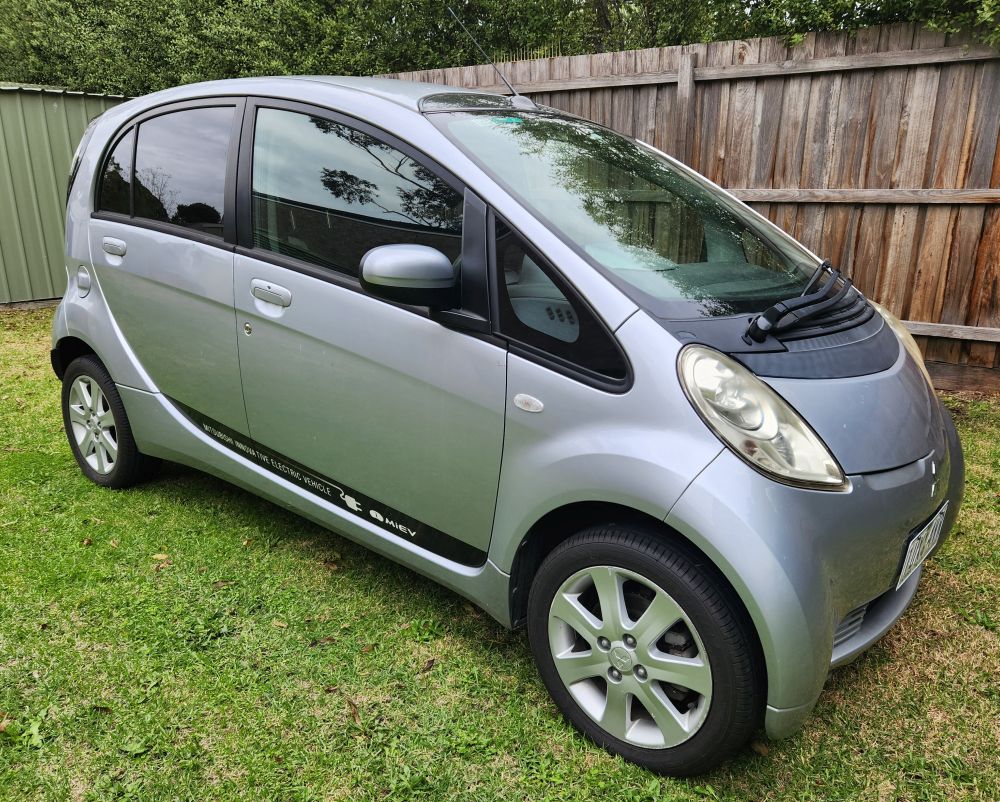
In 2010, a year marked by the debut of the first iPad and shifting political landscapes in Australia, a pioneering electric vehicle also arrived on the scene: the Mitsubishi iMiEV. Now, 16 years later, this early mass-produced Battery Electric Vehicle (BEV) is still operational, challenging long-held skepticism about EV battery lifespan.
A Look Back at the 2010 Mitsubishi iMiEV
The Mitsubishi iMiEV, launched in Australia in mid-2009, was a trailblazer in the modern EV era. It featured a 47 kW rear-wheel-drive motor, a 16 kWh battery, 40 kW DC fast-charging, and 3 kW AC charging. While its official range was optimistically quoted at 150 km, real-world performance typically fell between 100 to 110 km. Initially priced at a significant $63,000 on a lease-only basis, the cost later dropped to around $50,000 on-the-road. Despite these adjustments, sales were modest, with only about 250 units sold in Australia before Mitsubishi ceased sales in 2014. Production continued in Japan until 2021, with approximately 50,000 units sold globally.
EV Technology: A World Apart in 16 Years
Comparing the 2010 iMiEV to today’s electric vehicles highlights the rapid advancements in EV technology. While the iMiEV offered basic amenities like an AM/FM radio, CD player, sat nav, ABS, and a couple of airbags, current entry-level EVs such as the BYD Atto 1, priced around $26,500, offer significantly more. The Atto 1 boasts a 30 kWh battery delivering a 220 km WLTP range, Vehicle-to-Load (V2L) capability via an adapter, DAB radio, and an extensive list of Advanced Driver Assistance Systems (ADAS).
Charging and Connectivity: Evolving Standards
The iMiEV’s charging ports, a Type 1 AC and CHAdeMO DC combination, represent a superseded standard. While AC charging can be managed with an adapter, the scarcity of CHAdeMO DC fast-chargers presents a challenge for longer journeys. However, for its intended use as a city car, the owner reports never needing to use DC fast charging. This contrasts with the V2L and V2G functionalities that were available on Japanese market iMiEVs but not enabled for Australian models.
Battery Longevity: Exceeding Expectations
The 2010 Mitsubishi iMiEV came with a 5-year battery warranty, a shorter period compared to the current industry standard of 8 years. Mitsubishi had projected that the iMiEV’s battery would retain at least 80% capacity after 10 years. Astonishingly, the owner’s 16-year-old iMiEV, still on its original battery, retains approximately 68% of its capacity. This equates to about 70 km of reliable range, closely aligning with the projected 32% capacity loss over 16 years (an average of 2% per year). This performance suggests that modern EV batteries, with a projected annual capacity loss of 0.5% to 1%, could retain 84% to 92% capacity after 16 years.

Maintenance and Running Costs: The EV Advantage
Over the past five years of ownership, the iMiEV has required minimal maintenance, including wiper blade replacements, rear tail-light lens repairs, and a new set of tyres due to age-related cracking rather than wear. A brake component was replaced under a safety recall. The owner also replaced the front discs and pads upon purchase due to rust from disuse, not wear. Upcoming service needs are limited to a coolant change for the controller and a brake fluid flush. This is in stark contrast to internal combustion engine (ICE) vehicles, which would likely require more extensive and costly maintenance such as timing belt replacements, oil changes, filter replacements, spark plug changes, and potential exhaust system repairs over a similar period.
Conclusion: A Testament to EV Durability
The Mitsubishi iMiEV has proven to be a remarkably reliable and inexpensive vehicle for local driving. Its continued operation on its original battery serves as a powerful testament to the durability of EV batteries, often outliving warranty periods and initial expectations. For those considering a pre-owned electric vehicle, particularly if seeking an affordable option (iMiEVs can be found for around $6,000) and unconcerned with an older car’s aesthetics, the iMiEV remains a viable and recommendable choice.