
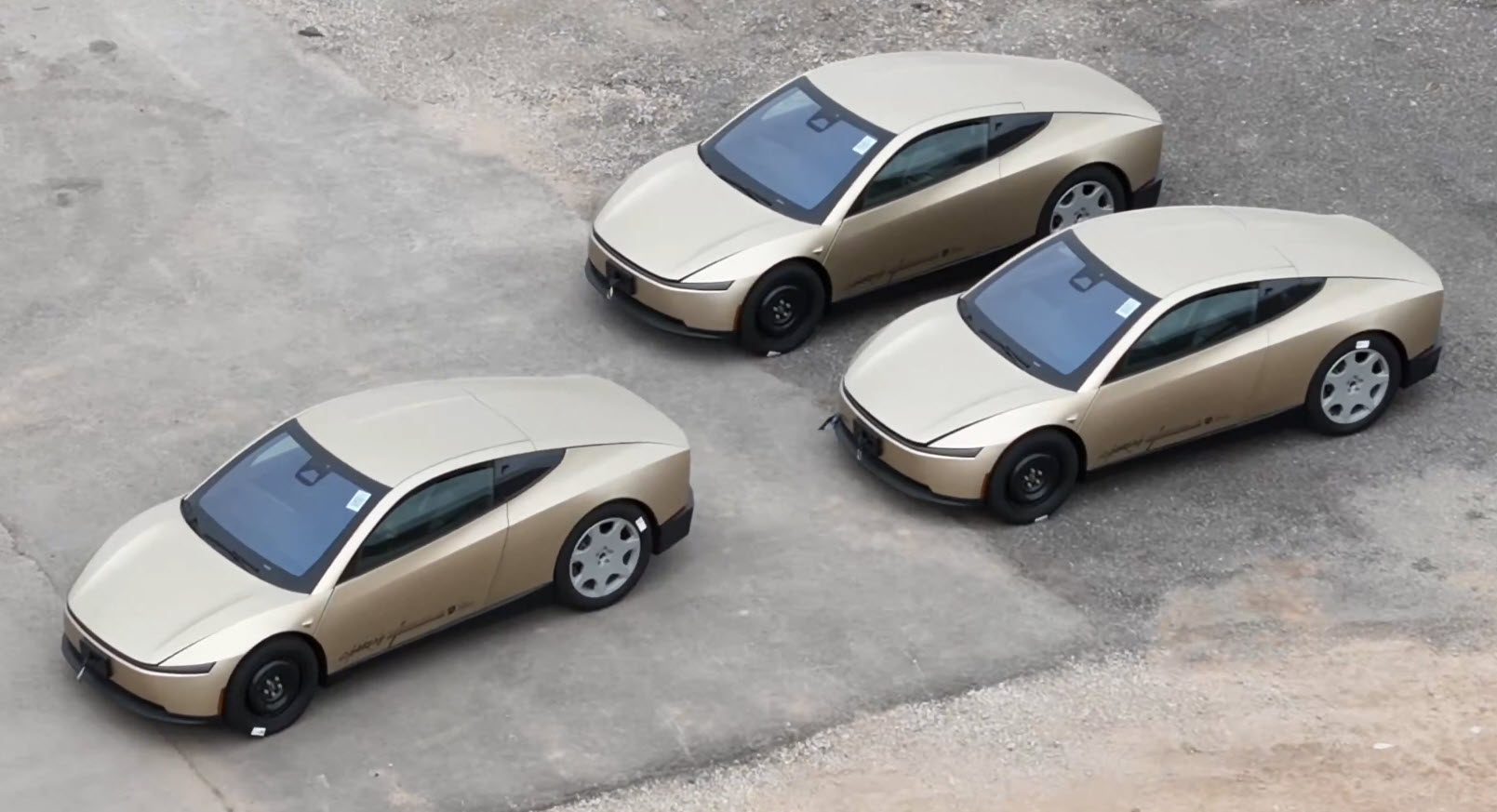
Multiple units of Tesla’s upcoming Cybercab, a fully autonomous robotaxi, have been observed at the company’s Giga Texas facility. These sightings follow closely behind reports of the first steering wheel- and pedal-free Cybercab being produced at the same location, signaling significant progress in Tesla’s pursuit of autonomous vehicle technology.
Cybercabs Appear Identical at Giga Texas
New drone footage captured by Joe Tegtmeyer, a drone operator and enthusiast of the Giga Texas factory, reveals several golden Cybercabs parked in the outbound lot. The vehicles appear identical, a consistent observation that underscores the standardized production of these futuristic robotaxis.

Crucially, the spotted Cybercabs lack a steering wheel, a key feature indicating their readiness for full autonomous operation. The presence of a tow hook on the front bumper is also noted, a practical addition for potential recovery or transport purposes.
The vehicles in the footage are equipped with staggered wheels, featuring hubcaps on the front and larger, white-painted alloy wheels at the rear. This distinct wheel configuration adds to the unique aesthetic of the Cybercab.
Potential Safety Evaluation Program
The observation of these Cybercabs, particularly their lack of manual controls, suggests they could be part of a safety evaluation program. This type of program is often conducted in collaboration with regulatory bodies, akin to the ANCAP in Australia or the National Highway Traffic Safety Administration (NHTSA) in the United States, to assess the safety and performance of autonomous systems.

Cybercab production versions (note stickers on tires, apparently no steering wheel & seat belts across both front seats at the Giga Texas crash testing facility today.
Note the image of the Cybercab team and my circled area on the top left … the wheels seen here appear to be… pic.twitter.com/nEDxv1CvYH
— Joe Tegtmeyer 🚀 🤠🛸😎 (@JoeTegtmeyer) February 20, 2026
The drone footage also highlights what appear to be safety belt systems spanning both front seats, suggesting a focus on passenger safety within the autonomous cabin.
Mass Production on the Horizon
Official mass production of the Cybercab is anticipated to commence in less than two months at the Giga Texas facility. Elon Musk, Tesla’s CEO, has projected that the Cybercab will become the company’s highest-volume vehicle in the coming years, underscoring its strategic importance.
Tesla initially unveiled the Cybercab at its “We, Robot” event in late 2024. The event showcased the vehicle, offering hundreds of fully autonomous test rides on closed roads at Warner Bros. studios in California. Alongside the Cybercabs, Tesla also provided rides in its popular Model Y in its Robotaxi configuration, drawing significant global attention.
Extensive On-Road Testing
Since its unveiling, numerous sightings of the golden Cybercab have been documented, primarily near Tesla’s test track in Fremont, California, and at the Giga Texas facility. The vehicles have been observed undergoing on-road testing in diverse weather conditions, including snow and rain.
Many of these test vehicles have been equipped with a physical steering wheel as a temporary measure. This allows evaluating engineers to intervene if necessary, providing valuable data for refining the autonomous driving systems.
Cost and Design Innovations
The Cybercab is expected to be priced around A$45,000, positioning it as an affordable option for a self-driving robotaxi. The design emphasizes practicality, featuring ample boot space and a simplified interior with fewer components compared to Tesla’s current passenger vehicles.
According to Tesla engineers, the Cybercab is designed to have approximately 50% fewer parts than a Model 3. This reduction in complexity is intended to lower manufacturing costs and facilitate scalability as mass production ramps up.
Ambitious Leap in Autonomous Transport
Should Tesla successfully adhere to its projected timeline, the Cybercab could represent a landmark achievement in the commercialization of fully autonomous transportation at scale. The vehicle’s development and impending production signify a significant step towards a future where self-driving vehicles are a common mode of transport.
About the author: Riz Akhtar is the founder of carloop, based in Melbourne, and specializes in Australian EV data, insight reports, and trends. A mechanical engineer with seven years of experience in transport infrastructure development, Akhtar is passionate about electric vehicles and reducing transport emissions in Australia. He currently drives a red Tesla Model 3.