
{
“title”: “Lucid Gravity Set for Uber Robotaxi Service Next Year with Nuro’s Autonomous Tech”,
“content”: “
Lucid Gravity Robotaxi Nears Production, Set for Uber Deployment Next Year
nn

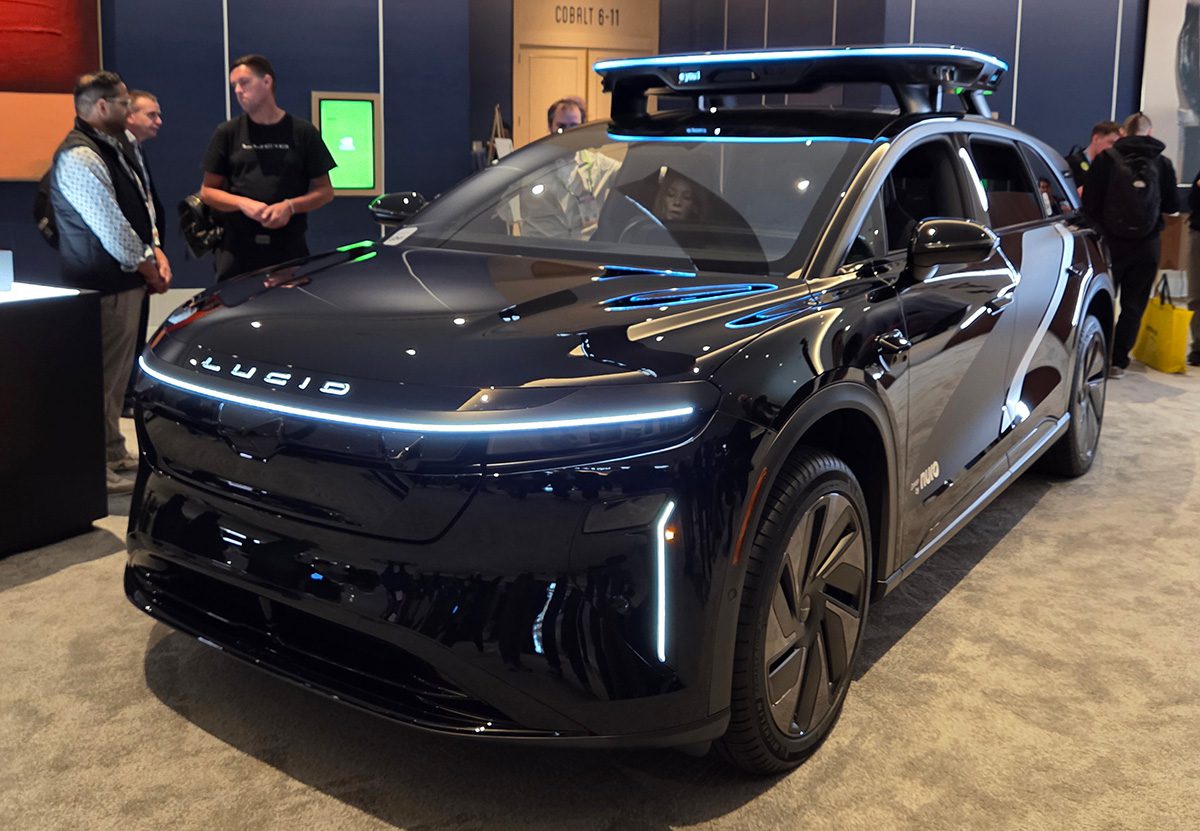
The highly anticipated robotaxi version of the Lucid Gravity electric SUV is on the cusp of entering commercial service, with final sensor cleaning systems being integrated before its planned deployment with Uber. Initially slated for San Francisco, the autonomous luxury vehicles are expected to begin operations by December.
nn
Earlier this year, EV manufacturer Lucid and autonomous driving software specialist Nuro unveiled a production-intent robotaxi, a significant collaboration aimed at transforming urban mobility. Uber has committed to deploying these vehicles, marking a substantial step towards a future of self-driving ride-hailing services.

nn
The partnership, announced last July, involves Uber purchasing 20,000 Lucid vehicles over six years. Lucid will manufacture the robotaxis, integrating Nuro’s advanced sensor suite and autonomous driving software stack in place of its own driver-assist systems. Uber, in turn, is making significant multi-hundred-million dollar investments in both Lucid and Nuro.
nn
Production-Ready Design, Awaiting Final Touches
nn
The vehicle showcased at CES represents the production model destined for Uber’s fleet. However, a crucial detail remains: the integration of microsprayers to maintain sensor functionality in adverse weather conditions. These systems are essential for ensuring the robotaxis operate reliably in rain, snow, ice, and dusty environments.
nn
Beyond the sensor cleaning system, the Gravity robotaxi incorporates several physical modifications from its standard production EV counterpart, which features Lucid’s ‘Dream Drive’ ADAS. These changes enable full self-driving capabilities.
nn
Visible Enhancements: The ‘Tiara’ and Sensor Integration
nn
The most striking visual alteration is the addition of a sensor array, dubbed the ‘tiara’ or ‘halo,’ mounted on the roof. This unit houses a variety of sensors and also features a small LED display. This display will show passenger initials for easy vehicle identification and provide public updates on the robotaxi’s autonomous service status.
nn
While the standard Lucid Gravity boasts an exceptionally low drag coefficient (Cd) of 0.24, the ‘tiara’ is expected to increase aerodynamic drag. While specific figures were not disclosed, it was indicated that the increase would be noticeable, impacting overall efficiency.
nn
The exact number of sensors—including solid-state lidar, high-resolution cameras, and radar for 360-degree data collection—remains proprietary. However, the standard Lucid Gravity already employs an extensive sensor package, comprising 14 cameras, 5 radars, lidar, and 12 ultrasonic sensors for its Dream Drive system. Nuro suggests the robotaxi’s sensor count will be consistent with industry advancements.
nn
Further sensor integration is evident in the modified front apron, below the distinctive Lucid ‘nose blade.’ This area is equipped with additional sensors, including Nuro’s solid-state lidar, replacing Lucid’s original hardware, alongside forward-facing cameras.
nn
At the rear, the Gravity’s prominent roof spoiler has been enlarged to accommodate sensors discreetly. This modification, while enhancing sensor placement, was acknowledged to slightly impede rearward vision through the rearview mirror, though the rear-view camera’s field of view remains unaffected.
nn
Notably, Lucid and Nuro strategically chose to integrate these modifications into areas of the vehicle that are factory-painted black, minimizing their visual impact to external observers.
nn
Software Transformation: Nuro’s Autonomy Stack Takes the Helm
nn
A fundamental transformation for the Gravity robotaxis involves the replacement of Lucid’s proprietary ADAS software with Nuro’s comprehensive autonomy stack. Nuro asserts that its software integrates “state-of-the-art AI [blended] with clear, verifiable safety logic.”
nn
The development process included rigorous testing, starting with early prototypes on closed courses and extensive simulations. On-road testing with safety drivers commenced in December, with the goal of launching revenue-generating robotaxi services less than two years after the initial partnership announcement.
nn
While the robotaxis will retain the capability for human driving, similar to any other Lucid Gravity, it is anticipated that the driver’s seat will not be used for passengers during autonomous rides. The companies remain discreet about specific safety protocols designed to prevent unauthorized manual operation by passengers.
nn
The Genesis of a Three-Way Partnership
nn
The collaboration originated between Nuro, the autonomous vehicle startup, and Uber, the ride-sharing giant that had previously scaled back its in-house robotaxi development following a fatal accident in 2018. Nuro, founded in 2016 by former Waymo engineers, initially focused on developing autonomous delivery vehicles.
nn
David Salguero, Nuro’s head of communications, highlighted Uber’s early recognition of Nuro’s “safety focus and development rigor.” These factors were crucial as Uber shifted its strategy to partner with established autonomy companies.
nn
The geographical proximity of Uber’s San Francisco headquarters and Nuro’s facility in Mountain View, less than 40 miles apart, facilitated close collaboration.
nn
Vehicle Selection Criteria for Robotaxi Service
nn
Once the partnership was established, Nuro and Uber evaluated the electric vehicle market to identify a suitable platform for integrating Nuro’s sensor technology and software. Key requirements included a spacious interior, substantial driving range, and rapid charging capabilities to maximize operational uptime and minimize vehicle downtime for recharging.
nn
Strategic Location and Future Expansion
nn
Lucid’s headquarters in Newark, California, also within the Bay Area, further streamlined communication and collaboration among the three partners. This proximity allowed for frequent face-to-face meetings essential for complex project development.
nn
Uber plans to launch its robotaxi service in San Francisco and will determine future market expansions. Nuro is also actively mapping areas in Tokyo and other parts of Japan, supported by an investment from Toyota’s Woven Capital made nearly five years ago. Test vehicles in Japan currently utilize right-hand-drive Toyota Priuses.
nn
The Lucid Gravity, in its current configuration, has not been engineered for right-hand-drive markets, which are prevalent in Japan, the United Kingdom, and Ireland. However, Lucid and Nuro have indicated the possibility of future robotaxi models designed for these markets as part of their “global robotaxi service” ambitions.
nn
Discussions regarding the extension of the robotaxi program to Lucid’s future midsize vehicle lineup are ongoing. It is anticipated that the performance and reliability of the Gravity fleet during pilot operations in 2027 and 2028 will inform such decisions.
nn
Lucid’s Production Outlook and the Robotaxi Deal’s Scale
nn
Marc Winterhoff, Lucid’s acting CEO, emphasized that the projected deployment of 20,000 Lucid vehicles over six years represents a small fraction of the company’s anticipated overall output within the next few years. Lucid is developing a new, more affordable midsize platform, expected to feature three distinct vehicle variants, with the first deliveries targeted for late 2027.
nn
The current year is pivotal for Lucid, following a challenging production ramp-up for the Gravity in the previous year, partly attributed to software issues and initial concerns regarding key fob functionality. In 2025, Lucid significantly increased its vehicle production to 18,378 units, more than double the prior year’s output, with 15,841 vehicles delivered to customers.”
}