
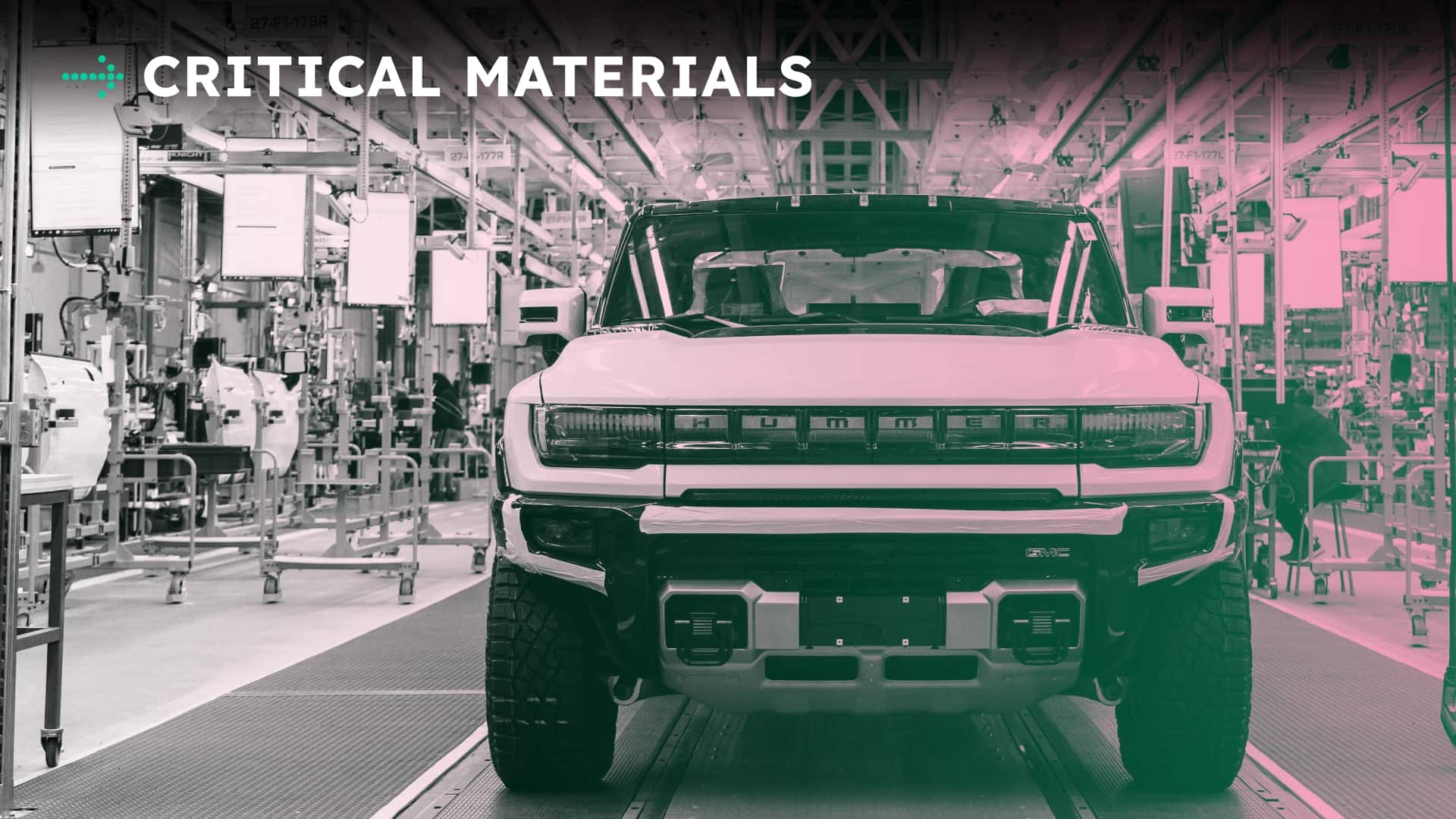
Welcome to Critical Materials, your essential daily briefing on the electric vehicle and technology landscape. Today, we unpack General Motors’ significant financial adjustments to its EV strategy, a move driven by policy shifts. We also look at China’s plans to exert greater control over its burgeoning battery manufacturing sector and preview the electric vehicles set to debut at the upcoming Brussels Motor Show.
GM’s EV Pivot Costs Billions
The rapid acceleration of electric vehicle development throughout the 2020s saw automakers invest heavily in retooling factories, designing new models, and securing crucial battery supply chains. However, a recent shift in U.S. policy, including the rollback of certain pro-EV incentives and a relaxation of emissions regulations, has prompted a costly reevaluation for many manufacturers.
General Motors is feeling the financial sting of this pivot. The automotive giant disclosed in a recent SEC filing that it incurred approximately $7.1 billion in charges during the fourth quarter of the previous year. A significant portion of this figure is directly linked to scaling back its ambitious electric vehicle plans.
The charges include $1.1 billion related to the restructuring of its joint venture in China with SAIC-GM. More substantially, roughly $6 billion stems from GM’s decision to decelerate its EV rollout in North America. This comes on top of a prior $1.6 billion charge taken earlier in the year, attributed to slower-than-anticipated EV sales.

GM explained its strategic adjustment, stating, “With the termination of certain consumer tax incentives and the reduction in the stringency of emissions regulations, industry-wide consumer demand for EVs in North America began to slow in 2025.” Consequently, the company has proactively adjusted its EV capacity. This includes repurposing its Orion, Michigan assembly plant from EV production to manufacturing internal combustion engine-powered SUVs and pickup trucks, areas where demand is reportedly strong. Additionally, GM has reduced its battery cell production capacity by selling its stake in the Ultium Cells LLC facility in Lansing, Michigan, to LG Energy Solution.
The $6 billion charge comprises $1.8 billion in non-cash write-downs and $4.2 billion with a direct cash impact, such as contract termination fees. This mirrors a similar, albeit larger, recalibration by rival Ford, which anticipates a profit hit exceeding $19 billion due to its own strategic shifts, including the pausing of the F-150 Lightning production.
Despite these adjustments, GM, which was the second-highest selling EV manufacturer in the U.S. last year behind Tesla, emphasized that its current EV portfolio remains robust. “Our strategic realignment of EV capacity does not impact today’s retail portfolio of Chevrolet, GMC and Cadillac EVs in production,” the company stated. “We plan to continue to make these models available to consumers.”
China’s Battery Sector Faces New Oversight
Meanwhile, in China, the government is moving to address concerns over overcapacity and price wars within its dominant battery manufacturing industry. Regulators recently convened a meeting with the country’s leading EV and energy storage battery producers, including major players like CATL, BYD, and Gotion.
According to reports, Chinese authorities intend to implement stricter oversight, enforce more rigorous pricing rules, enhance product quality standards, and crack down on intellectual property infringements. This move comes as industry analysis suggests a significant surplus in battery production capacity within China, exceeding current global demand even before accounting for planned future expansions.
Brussels Motor Show Spotlights European EV Push
The upcoming Brussels Motor Show is set to be the year’s first major automotive event, with electric vehicles taking center stage. The show will prominently feature a range of new EVs, with a particular focus on models tailored for the European market, where EV adoption is progressing ahead of the U.S. but still trails China.
Among the anticipated highlights are the new Kia EV2, Citroën’s Elo Concept electric van, a battery-powered version of the Hyundai Staria van, Mazda’s second European-exclusive EV, and Renault’s revived electric Twingo. Chinese manufacturer BYD is expected to showcase up to nine models, while Tesla will also be present, featuring lower-priced variants of the Model 3 and Model Y.
The influx of new, potentially more affordable EV models raises a key question for the industry: Will these new offerings stimulate consumer demand, or will incentives remain crucial for widespread EV adoption?
Contact the author: Suvrat.Kothari@InsideEVs.com