
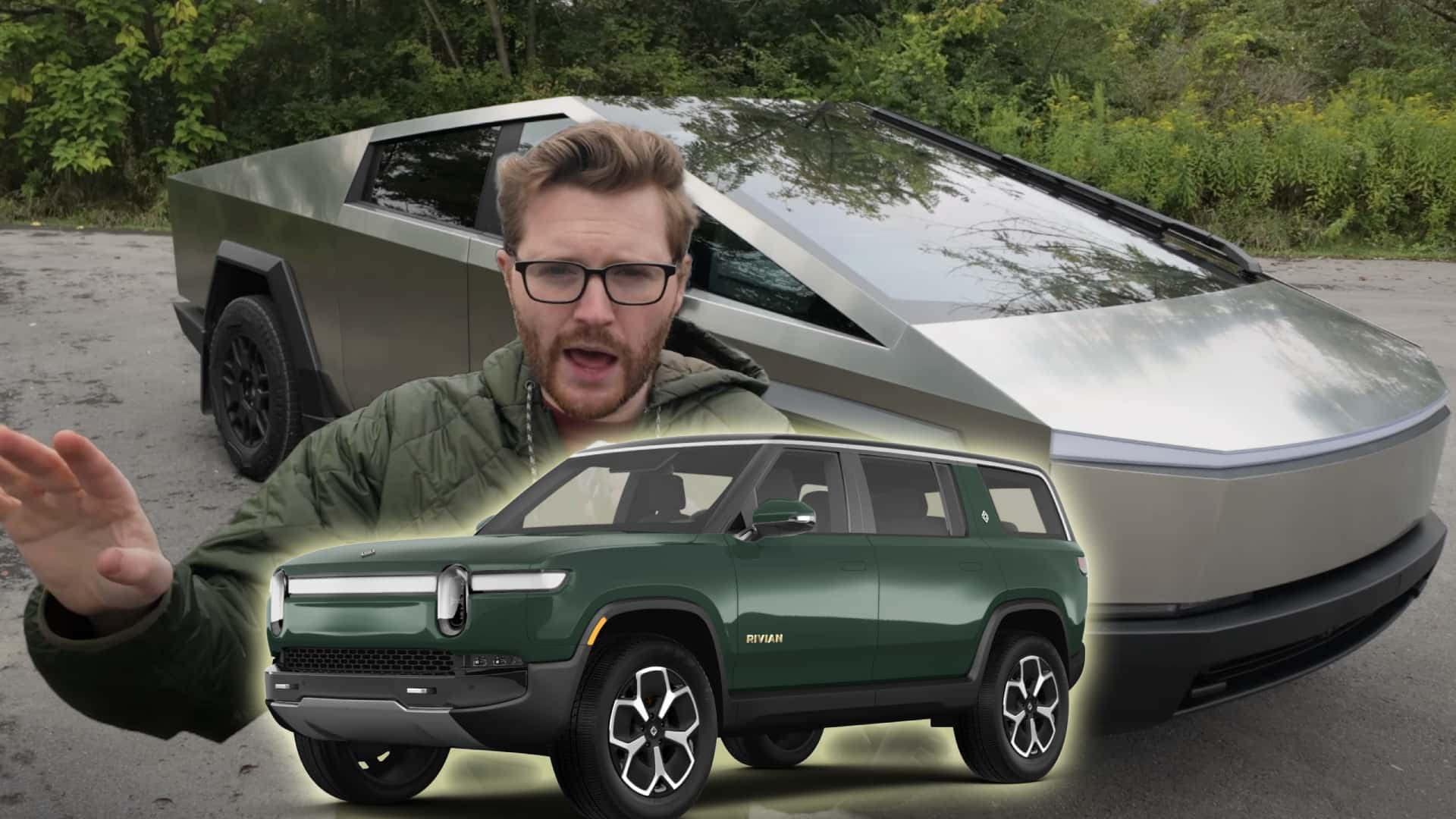
The electric vehicle landscape is rapidly evolving, prompting many long-time EV owners to re-evaluate their choices. For those who have exclusively driven Tesla vehicles, the question of what comes next is increasingly pertinent as competitors emerge and innovate. One such owner, YouTuber Robert Rosenfeld, who has documented his experiences with various Tesla models since 2019, recently spent a week with a Rivian R1S to see how it compared.
A Deep Dive into the Rivian R1S Experience
Rosenfeld, known for his Tesla-centric content and Tesla referral code promotions, took the opportunity to test a loaner 2025 Rivian R1S. While he ultimately decided to keep his Tesla, his week-long evaluation provided valuable insights into the differences between the two premium electric vehicle brands.
The specific Rivian R1S tested, a Tri-Motor Max Pack configuration, carries a price tag of approximately $111,000. This positions it comparably to a well-equipped Tesla Cybertruck or Model X Plaid. Notably, this Rivian model boasts an estimated range of 371 miles, surpassing the Model X’s 314 miles and the Cybertruck’s 325 or 301 miles, depending on configuration.
Customization and Design: Rivian’s Strengths
One area where Rosenfeld found Rivian to excel is in customization. He appreciated the extensive options available for both the R1S and R1T, including choices for trim levels, exterior colors, and wheel designs, which he found to be far more varied than Tesla’s more limited configurability. He also lauded the Rivian’s distinctive boxy design and its versatility as an SUV, noting, “I’ve got a whole lot of room for hauling, which is nice.”
Driving Dynamics and User Interface
Accustomed to Tesla’s minimalist approach with fewer physical buttons, Rosenfeld found the Rivian’s interior to be premium and capable of meeting many expectations. He particularly praised the 360-degree top-down camera system, expressing a wish for Tesla to adopt a similar feature. The driving experience also received high marks, with Rosenfeld acknowledging that even Tesla enthusiasts would appreciate the R1S’s customizable driving dynamics, such as adjustable regenerative braking, configurable displays, and various driving modes. “I’d have no qualms about taking this on a road trip,” he stated.
Software and Autonomy: Where Tesla Maintains an Edge
Despite the R1S’s strengths, software was the primary factor that kept Rosenfeld loyal to Tesla. He expressed dissatisfaction with the Rivian’s menu structures, finding them less intuitive than what he’s accustomed to, and described the maps and HVAC controls as clunky. A significant draw for Rosenfeld is Tesla’s Full Self-Driving (FSD) capability, a feature for which Rivian currently has no direct equivalent. While Rivian is beginning to introduce hands-free highway driving assistance and has future autonomy plans, FSD remains a key differentiator for Tesla.
The Apple vs. Android Analogy
Rosenfeld likened the choice between Tesla and Rivian to the Apple versus Android ecosystems: Tesla offers a more curated, standardized experience, while Rivian provides greater flexibility and customization. He noted that switching ecosystems can be challenging, though arguably less so for vehicles than for personal tech devices.
Other Perspectives and Future Considerations
The article also references YouTuber Darren Byrd, who similarly transitioned from a Tesla Model X to a Rivian R1S. Byrd described the R1S as a “more normal car that happens to be electric” compared to his previous SUV.
For drivers considering a move away from Tesla, the article suggests evaluating what aspects of their current EV they value most. For charging convenience, the NACS-equipped Hyundai Ioniq 5 is recommended. For software and technological parity, Rivian is identified as a strong contender poised to close any remaining gaps. For pure performance, options like the Polestar 3 or Porsche Taycan are mentioned. The EV market continues to expand with increasingly competitive offerings.