
Key Takeaways / Summary Box:
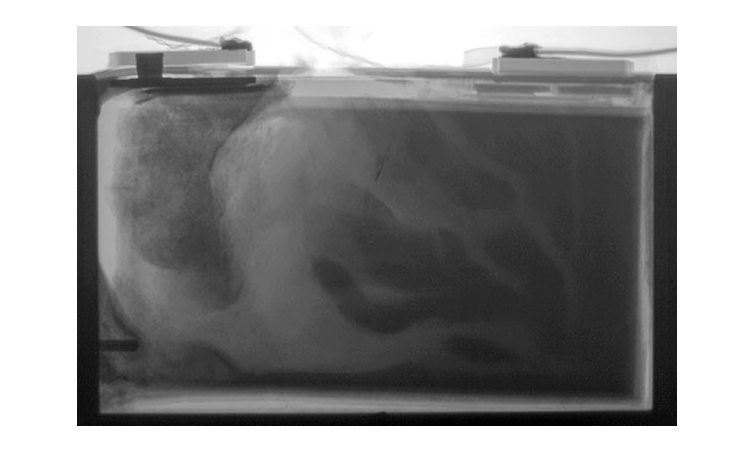
- Fraunhofer EMI has developed a pioneering high-speed X-ray system capable of imaging the internal dynamics of large-format prismatic battery cells in real-time.
- The system captures up to 1,000 images per second, revealing critical events like gas formation, material displacement, and crack propagation during battery operation and failure.
- A crucial engineering feat is a protective chamber designed to shield X-ray components from the extreme conditions of lithium-ion cell thermal runaway.
- This technology addresses a long-standing challenge, moving beyond reliance on simulations and destructive testing for internal battery analysis.
- In collaboration with PowerCo, the Volkswagen Group’s battery cell manufacturer, the system is slated for industrial integration at PowerCo’s Salzgitter site by 2028, significantly advancing EV battery safety and design optimization.
New Delhi: In a significant leap forward for electric vehicle (EV) technology, the Fraunhofer Institute for High-Speed Dynamics, Ernst-Mach-Institut (EMI) has unveiled a groundbreaking high-speed X-ray system. This innovative technology is set to redefine how the automotive industry understands and enhances EV battery safety and performance.

The newly developed system provides an unprecedented, real-time view into the complex internal processes of large-format prismatic battery cells, even when under extreme load. This capability is crucial for identifying potential failure mechanisms before they become critical, thereby improving the overall safety and reliability of EV batteries.
Unveiling Internal Dynamics: The High-Speed X-Ray Advantage
At the core of Fraunhofer EMI’s innovation is an advanced X-ray imaging setup, meticulously paired with a purpose-built battery test chamber. This integrated system is further augmented by sophisticated sensor systems designed to simultaneously capture vital parameters such as temperature, pressure, voltage, and gas flow within the battery cell.
The system’s remarkable ability to record up to 1,000 images per second offers engineers and researchers a detailed, high-resolution visual narrative of events occurring inside the cell. This includes the subtle yet critical processes of gas formation, material displacement, and the propagation of cracks, all of which are vital indicators of cell health and potential failure.
Overcoming Engineering Challenges: The Protective Chamber
A key engineering milestone in the development of this sophisticated system is the creation of a specialized protective chamber. This robust enclosure is engineered to safeguard the delicate X-ray components from the incredibly harsh and volatile conditions generated during a lithium-ion cell’s thermal runaway event.
Thermal runaway, a rapid and uncontrollable increase in temperature, poses significant risks and challenges in battery testing. The protective chamber ensures that continuous, high-fidelity imaging can proceed even under these extreme circumstances, providing invaluable data that was previously unattainable.
Transforming Battery Development and Analysis
Historically, cell manufacturers and vehicle integrators have largely relied on indirect methods to infer internal battery behavior. These methods typically included complex simulations, labor-intensive destructive testing, and various indirect measurements.
These traditional approaches, while useful, often fell short in providing the dynamic, real-time insights necessary to fully comprehend the intricate processes unfolding within a failing battery cell. The new X-ray system fundamentally alters this paradigm.
Sebastian Schopferer, Fraunhofer EMI’s Head of Battery Safety, underscored the transformative potential of this technology. “Our in-situ method allows us to see what happens inside a cell in fractions of a second—in real time and at the highest resolution,” Schopferer stated. “This fundamentally changes how we understand battery design and safety.”
Real-World Applications and Early Successes
The pioneering system has already demonstrated its significant utility through collaborations with several prominent German carmakers, including Volkswagen and Audi. These engagements have focused on characterizing critical phenomena such as material ejection during thermal runaway and understanding propagation behavior in complex multi-cell configurations.
The detailed data gleaned from these observations empowers engineers to make more informed assessments of battery cell designs. Crucially, it also enables them to refine existing simulation models with real-world empirical evidence, leading to more accurate predictions and robust designs.
A Strategic Partnership for Industrial Integration
The Fraunhofer Institute for High-Speed Dynamics, Ernst-Mach-Institut, is now working in close partnership with PowerCo, the dedicated battery cell manufacturer of the Volkswagen Group. The objective of this strategic collaboration is to facilitate the seamless transfer of this cutting-edge technology into industrial use.
This partnership leverages Fraunhofer EMI’s extensive expertise in materials research, rigorous battery abuse testing, and high-speed imaging. PowerCo, in turn, contributes invaluable insights into production requirements and provides access to a diverse range of real-world cell types, ensuring the system’s applicability to mass production.
Initial results emerging from this collaborative effort are already actively being integrated into the development of next-generation production cells at PowerCo. This direct feedback loop is instrumental in accelerating the innovation cycle for EV batteries.
Future Outlook: Scaling and Deployment
Looking ahead, the high-speed X-ray system is scheduled for full installation at PowerCo’s state-of-the-art Salzgitter site in 2028. This upcoming deployment signifies a major step towards widespread industrial adoption of this advanced testing methodology.
The partners envision the system as a modular platform, inherently designed for scalability. This flexibility will allow it to adapt efficiently to various cell formats and accommodate the continuous evolution of new cell chemistries, ensuring its relevance in a rapidly advancing technological landscape.
HW Vassen, PowerCo’s CTO, highlighted the profound impact of this collaboration. “For the first time, we can make the dynamic processes inside cells visible in real time and in slow motion,” Vassen explained. “This unprecedented depth of insight allows us to optimize EV battery safety and design in a highly targeted way and bring innovations into industrial use much faster.” This development marks a pivotal moment for enhancing EV battery safety and accelerating the future of electric mobility.
Frequently Asked Questions (FAQ)
What is the primary function of Fraunhofer EMI’s new X-ray system?
The system’s primary function is to enable real-time, high-speed X-ray imaging of the internal dynamics within large-format prismatic battery cells under various operational loads. It aims to reveal critical processes previously unobservable directly.
How fast can the X-ray system record internal battery activity?
The Fraunhofer EMI system is capable of recording internal battery activity at an impressive rate of up to 1,000 images per second. This high frame rate provides exceptionally detailed insights into rapid events.
What specific internal battery phenomena can this system observe?
The system allows for the direct observation of crucial internal phenomena, including the formation of gases, displacement of internal materials, and the propagation of cracks within the battery cell. These insights are vital for battery research.
Why is the protective chamber a significant engineering milestone?
The protective chamber is a key milestone because it effectively shields the sensitive X-ray components from the extreme and hazardous conditions generated during a lithium-ion cell’s thermal runaway, enabling safe and continuous data acquisition.
What role does PowerCo play in the development and deployment of this technology?
PowerCo, Volkswagen Group’s battery cell manufacturer, is partnering with Fraunhofer EMI to bring this system into industrial application. PowerCo contributes production requirements and access to diverse cell types, with planned installation at their Salzgitter site by 2028.
How does this technology improve EV battery safety and design?
By providing direct, real-time visualization of internal processes, the system helps engineers understand failure mechanisms, assess cell designs more accurately, and refine simulation models. This leads to more optimized, safer, and more reliable EV battery designs.
Is the system adaptable to different battery types and chemistries?
Yes, the partners describe the system as a modular platform designed to be scalable. This modularity ensures its adaptability to various cell formats and compatibility with new and evolving battery cell chemistries in the future.