
Key Takeaways
- Toyota’s ‘Electrification 101’ program provides essential training to employees, many of whom previously lacked in-depth knowledge of electric vehicle technology.
- The initiative underscores Toyota’s ‘multi-pathway’ approach to sustainable mobility, encompassing hybrids, plug-in hybrids, battery electric vehicles, and hydrogen fuel cell vehicles.
- Beyond technical education, the program aims to foster internal advocacy for electrification, influencing long-term decision-making and customer engagement.
- Despite a current focus on hybrids, the training emphasizes the benefits of pure electric propulsion and actively dispels common EV myths.
- This internal educational drive is crucial for aligning a global automotive giant like Toyota with the rapidly evolving landscape of electric mobility.
In the rapidly evolving landscape of the global automotive industry, the transition to electrification stands as a paramount challenge and opportunity. For those immersed daily in the intricacies of electric vehicle (EV) debates, it is easy to assume a universal understanding of these complex shifts, even within major automotive corporations. However, a recent experience attending Toyota Motor North America’s ‘Electrification 101’ program offered a compelling reality check: a significant portion of employees within legacy automakers may not possess comprehensive knowledge about electrification or its inherent advantages.
This revelation, far from being discouraging, highlights a crucial strategic imperative for global giants like Toyota. The internal education initiative points towards a proactive effort to bridge knowledge gaps and foster a deeper understanding of the company’s long-term **Toyota electrification strategy** among its diverse workforce. Such programs are vital for driving the necessary internal cultural and technological shifts required to navigate the future of mobility effectively.

Understanding Toyota’s ‘Electrification 101’ Program
Toyota, renowned as the world’s largest automaker, recognizes that its vast workforce in offices like Plano, Texas, comprises individuals from varied professional backgrounds. Not every employee, from corporate accountants to app developers, is inherently a ‘car nerd’ or deeply conversant with the nuances of automotive technology, let alone the specialized domain of electrification.
Many join the company for its robust benefits, organizational stability, respectful culture, and the prestige associated with working for a global leader. Consequently, the intricacies of advanced battery chemistries like Nickel Manganese Cobalt (NCM) versus Lithium Iron Phosphate (LFP) might be entirely new territory, even for seasoned automotive enthusiasts who have traditionally focused on internal combustion engines.
A Multi-Pathway Approach to Sustainable Mobility
To address this internal knowledge disparity, Toyota meticulously designed the ‘Electrification 101’ program. This initiative marks the second such educational offering, following an earlier ‘Automotive 101’ class, reinforcing the company’s commitment to foundational employee education. The program’s title, ‘Electrification 101,’ is intentionally chosen over ‘EV 101,’ signaling Toyota’s well-documented ‘multi-pathway’ approach to sustainable transportation.

This strategy involves a clear and immediate focus on hybrid electric vehicles (HEVs), while maintaining a forward-looking perspective on battery electric vehicles (BEVs) and, notably, hydrogen fuel cell vehicles (FCEVs). This comprehensive vision is reflected in recent sales figures; in the last reported quarter, an impressive 56.8% of Toyota’s sales were electrified vehicles, encompassing HEVs, BEVs, plug-in hybrid electric vehicles (PHEVs), and FCEVs. However, pure BEVs constituted a smaller, albeit growing, segment at 1.7% of these electrified sales.
Demystifying Electrified Technologies
The four-hour classroom-based course meticulously covered the fundamentals of all these powertrain types, drawing clear distinctions between concepts like conventional hybrids and plug-in hybrids. Despite Toyota’s significant current investment in hybrid technology, a substantial portion of the program was dedicated to dispelling prevailing myths and misconceptions surrounding pure electric vehicles.
The curriculum initiated with a historical analogy, harking back to the early 20th century when gasoline cars faced challenges akin to modern EVs, including nascent infrastructure, limited public education, and evolving regulations. The parallel suggested that just as automobiles eventually triumphed over horse-drawn carriages, electrification is poised for a similar trajectory.
The program thoroughly explored the manifold advantages of electrification, emphasizing enhanced efficiency and reduced environmental impact. It also advocated for the multi-pathway approach, presenting it not only as a means to offer diverse customer choices but also as a more judicious allocation of finite battery resources. While this perspective remains a subject of debate within the industry, with most independent research indicating BEVs are generally the cleanest option on a life cycle basis, the program articulated Toyota’s rationale for its diversified **Toyota electrification strategy**.
Exploring Limitations and Future Potential
While the program’s overview of powertrain advantages was comprehensive, some observers noted a disproportionate emphasis on the limitations of BEVs compared to other electrified options. For instance, the discussion did not extensively cover the additional maintenance or noise, vibration, and harshness (NVH) characteristics often associated with gasoline vehicles. Conversely, the segment on hydrogen technology was notably bullish, highlighting the Toyota Mirai’s impressive 402-mile range and asserting that hydrogen “can reduce ‘range anxiety’ as number of stations grow.”
Such range figures, while significant in the early stages of EV development, are now matched or surpassed by several BEV models in the U.S. market, with many more high-range EVs under development. Nevertheless, the majority of the in-classroom content remained objective, providing essential knowledge on battery chemistries, various charging standards, fundamental electrical concepts like kilowatts (kW) and kilowatt-hours (kWh), and the ongoing efforts in battery recycling.
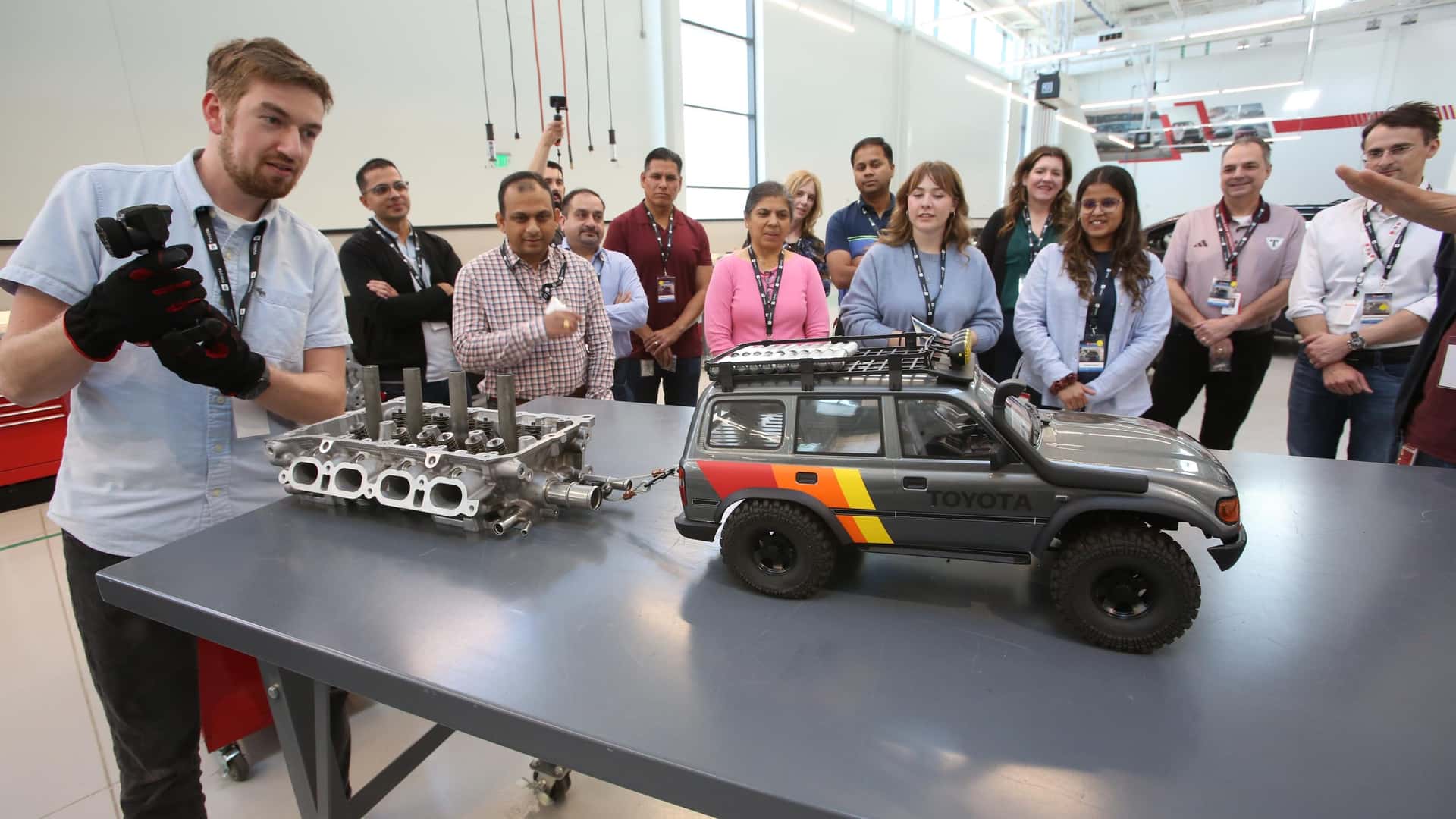
The educational experience culminated in an engaging interactive session. Employees participated in hands-on activities, such as constructing a basic electric motor using a screw, a magnet, a AA battery, and a wire. They also assembled a rudimentary potato-based battery and observed different charging outputs in real-time. A particularly vivid demonstration involved a tiny remote-controlled Land Cruiser, powered by an EV motor, effortlessly pulling a 30-pound cylinder head, showcasing the instant torque capabilities of electric propulsion.
The Enduring Lesson: Simplicity and Efficiency of Electric Motors
The core takeaway from the program was unequivocally clear: electric motors represent an extraordinary technological advancement. Presenters contrasted a complex, stripped-out Toyota V-6 engine, replete with its numerous accessories and intricate components, with an equivalent electric motor. The latter demonstrated superior power output within a significantly smaller footprint and showcased a remarkably simpler design.
Even when integrated into a gasoline powertrain through the company’s hybrid system, electric propulsion enhances efficiency and reduces mechanical complexity by often eliminating the need for a traditional, finicky transmission. The underlying message was that incorporating electric power into any powertrain inherently boosts efficiency with minimal trade-offs. Progressing further down the electrification path, towards a pure battery electric vehicle, leads to even greater simplicity, reducing the number of potential points of failure.
Despite these undeniable benefits, Toyota representatives maintained that the company advocates for continuous improvements in battery chemistry and charging infrastructure before BEVs can truly become a universal, one-size-fits-all solution for every consumer. However, the overarching sentiment conveyed during the program was a deliberate effort to cultivate excitement and enthusiasm among employees for an all-electric future. This internal push is complemented by Toyota’s rapid introduction of new EV models, including the C-HR, bZ Woodland, updated bZ, Highlander, Lexus ES, and TZ, all launched within the last 18 months.
Empowering the Workforce: An Opportunity for Transformation
The significance of this internal educational drive cannot be overstated. In a large corporate structure, individuals in departments like corporate procurement, who might initially perceive new component designs and supplier onboarding as mere added costs or logistical challenges, are critical. Without a foundational understanding of the long-term benefits of electrification, resistance to change is a natural human tendency.
However, by inspiring and educating its workforce, Toyota is cultivating an environment where employees are willing to embrace short-term complexities for the realization of ambitious long-term sustainability goals. This shift in internal perspective is epitomized by individuals like Brigette Armato, a Toyota employee who attended the ‘Electrification 101’ class. Initially admitting she knew “nothing” about EVs and hybrids, she emerged as an informed advocate.
Armato, who works with the lease experience team, engaging directly with customers and vehicles, stated, “This was extremely helpful because now I can have an educated conversation with them and maybe convince them to go for an electric vehicle, whereas before I don’t think I had that skill.” Her transformation extends to her personal choices, as she is now seriously considering an EV for herself, expressing a desire for an electric alternative to her current Toyota 4Runner.
Her sentiment, “I wish we would gravitate more towards electric vehicles across the lineup,” reflects a growing internal consensus. With hundreds of employees participating in these classes and a substantial waitlist for future sessions, the number of ‘EV believers’ within Toyota’s North American headquarters is steadily increasing. This proactive educational approach by Toyota is not merely about technical training; it is about cultivating a knowledgeable and enthusiastic workforce that can champion the company’s comprehensive **Toyota electrification strategy**, driving both internal innovation and external customer adoption. It underscores the understanding that, like many consumers, a significant portion of the workforce simply needed better information to fully grasp the potential of electric mobility.
FAQ: Toyota’s Electrification Training
What is Toyota’s ‘Electrification 101’ program?
Toyota’s ‘Electrification 101’ is an internal training program designed to educate employees on the fundamentals of various electrified vehicle technologies, including hybrids, plug-in hybrids, battery electric vehicles, and hydrogen fuel cell vehicles. It aims to bridge knowledge gaps and foster a deeper understanding of the company’s long-term electrification strategy.
Why did Toyota implement this training for its employees?
Toyota implemented this training recognizing that many employees, regardless of their role or initial automotive interest, lacked comprehensive knowledge about electrification. The program’s goal is to ensure that its diverse workforce understands the benefits of electric propulsion and supports the company’s strategic transition towards sustainable mobility solutions.
What is Toyota’s ‘multi-pathway’ electrification strategy?
Toyota’s ‘multi-pathway’ strategy focuses on a diversified approach to electrification. It prioritizes the immediate development and sales of hybrid vehicles while simultaneously investing in and developing battery electric vehicles and hydrogen fuel cell vehicles for future market penetration. This strategy aims to offer diverse customer choices and optimize battery resource utilization.
Did the training focus solely on battery electric vehicles (BEVs)?
No, the training did not focus solely on BEVs. While it dedicated significant energy to dispelling myths about BEVs and showcasing their advantages, it covered all types of electrified powertrains, including hybrids, plug-in hybrids, and hydrogen fuel cell vehicles, reflecting Toyota’s broader multi-pathway electrification strategy.
How does employee education impact Toyota’s overall electrification goals?
Employee education is crucial for Toyota’s electrification goals as it fosters internal advocacy and informed decision-making. Knowledgeable employees are more likely to support strategic shifts, embrace new technologies, and effectively communicate the benefits of electrified vehicles to customers, thereby accelerating the company’s transition to a more sustainable future.
What were some key learnings about electric motors from the program?
The program highlighted that electric motors are incredibly efficient and technologically superior. They offer more power in a smaller footprint, feature simpler designs compared to complex internal combustion engines, and reduce overall mechanical complexity when integrated into powertrains, leading to enhanced efficiency and reliability across all electrified vehicle types.
Are there concerns about hydrogen fuel cell vehicle (FCEV) infrastructure?
Yes, the program acknowledged that while FCEVs like the Toyota Mirai offer impressive range, their widespread adoption is currently limited by a nascent hydrogen fueling infrastructure. The availability of hydrogen stations is restricted to specific regions, such as parts of California in the U.S., posing a challenge for broader market acceptance compared to more established EV charging networks.