
Key Takeaways
- The 2026 Jeep Recon Moab’s 222-mile range and $66,995 starting price have drawn criticism, but these figures are a direct consequence of its advanced off-road capabilities.
- Achieving superior off-road performance in an electric vehicle inherently compromises on range and efficiency due to factors like high ground clearance, heavy-duty components, large all-terrain tires, and aggressive gearing.
- Unlike on-road EVs such as the Wagoneer S (294 miles), the Recon is engineered for rugged terrains, featuring 9.1 inches of ground clearance, skid plates, 33-inch tires, and 15:1 rear motor gearing for maximum torque.
- Comparative analysis with other off-road EVs like the Rivian R1S (370 miles with AT tires) and Mercedes G580 (239 miles) reveals a consistent pattern: enhanced off-road prowess often correlates with reduced electric range and higher costs.
- The current state of EV technology means consumers seeking dedicated electric off-road vehicles must often reconcile with lower range figures and premium pricing, a situation expected to evolve with advancements in battery technology and charging infrastructure.
The announcement of the all-electric Jeep Recon Moab’s official range — under 230 miles — has ignited considerable debate among automotive enthusiasts and industry observers. Specifically, the reported 222-mile range, coupled with a starting price of $66,995, prompted a wave of critiques, with many suggesting that Jeep should have prioritized greater range at a more accessible price point.
However, this perspective overlooks the complex engineering trade-offs inherent in developing a truly capable off-road electric vehicle. The perception that a significant increase in range could be achieved without sacrificing the vehicle’s core capabilities or inflating its cost is largely a misconception within the automotive industry, particularly for specialized segments like extreme off-roading.
Automotive design, whether for conventional or electric powertrains, is fundamentally an exercise in compromise. Balancing desired attributes such as off-road prowess, purchase price, and electric range involves navigating conflicting engineering goals. The Jeep Recon, particularly its Moab variant, appears to have made specific design decisions that, while seemingly detrimental to range and cost, are foundational to its intended purpose as a robust off-road EV.
The vehicle’s design prioritizes a demanding set of off-road capabilities, which inevitably impacts its on-road efficiency and manufacturing cost. Understanding these compromises is crucial to appreciating the engineering behind the Recon’s specifications.
The Inherent Efficiency Challenges of Off-Road Design
The fundamental principles governing efficiency are consistent across both gasoline-powered and electric vehicles. For traditional internal combustion engine (ICE) off-roaders, the relationship between capability and fuel economy is well-established. A body-on-frame 4×4 truck with lifted suspension and aggressive gearing typically delivers less than 20 miles per gallon, often closer to 10 or 15 mpg.

This diminished fuel efficiency is not an oversight but a direct consequence of design choices optimized for tackling rugged terrain. Tall suspensions, for instance, are critical for increasing ground clearance, allowing vehicles to navigate obstacles without scraping their undercarriage. However, this elevated stance significantly increases aerodynamic drag, requiring more energy to maintain speed, especially on highways.
Similarly, the knobby, large all-terrain (AT) tires characteristic of off-road vehicles provide essential traction in mud, sand, and rock. Yet, these aggressive tread patterns generate considerably more rolling resistance and road noise compared to smooth, road-optimized tires. This increased resistance translates directly into higher energy consumption.
A 4×4 system, while indispensable for navigating slippery or uneven conditions, inherently adds mechanical friction and weight. When engaged, the additional drivetrain components working in unison further reduce fuel efficiency. Aggressive gearing, designed to multiply torque at the wheels for superior climbing and obstacle traversal, means the engine (or electric motor) operates at higher RPMs (or speeds) for a given road speed, leading to increased fuel or energy consumption during cruising.
Consider the contrast between a Toyota Prius, engineered for maximum fuel efficiency, and a Jeep Wrangler, built for unparalleled off-road capability. Their vastly different designs underscore the opposing priorities. Modifying a Prius for off-road use—by lifting it, adding larger tires, and altering its aerodynamic profile—would inevitably negate its 50 mpg efficiency, illustrating how capability enhancements come at an efficiency cost.
These principles apply equally to electric vehicles. High ground clearance, multiple electric motors for all-wheel drive, large all-terrain tires, and a characteristically boxy, robust shape all contribute to increased energy consumption. For an authentic off-road vehicle, many of these features are not merely optional luxuries but absolute necessities to deliver genuine capability on challenging trails.
Jeep’s Strategic Compromise: Balancing Range and Off-Road Prowess
Jeep itself offers a compelling illustration of these trade-offs with its all-electric Wagoneer S. This vehicle, sharing the same 100.5 kWh battery pack as the Recon, prioritizes on-road refinement and efficiency over extreme off-road capability. Consequently, with a lower 6-inch ground clearance and street-optimized tires, the Wagoneer S achieves a significantly higher estimated range of 294 miles.
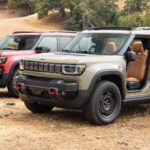
The Recon, however, is engineered from the ground up to deliver substantial off-road performance. It boasts a substantial 9.1 inches of ground clearance, a suite of heavy-duty skid plates for underbody protection, and aggressive 33-inch all-terrain tires. Furthermore, its upright, boxy design is not merely aesthetic; it is meticulously crafted to optimize approach and departure angles, critical metrics for navigating steep inclines and declines without damage. All these components and design elements contribute to increased weight and aerodynamic drag, directly impacting the Jeep Recon’s range.
A crucial, yet often overlooked, factor in an EV’s efficiency is its gear ratio. While electric vehicles do not have multi-speed transmissions in the conventional sense, they employ fixed gear ratios to transmit torque from the electric motor(s) to the wheels. Taller ratios, characterized by a lower first number (e.g., 9:1), are generally more efficient for sustained cruising speeds.
In contrast, shorter gearing significantly increases torque at the wheels from a standstill, providing the immense low-end grunt essential for challenging off-road maneuvers like rock crawling and steep ascents. For the Recon, Jeep has opted for a 15:1 gearing ratio on its rear motor, a decision squarely aimed at maximizing wheel torque and climbing ability. This engineering choice is perfectly logical for a dedicated off-roader, also contributing to its brisk 0-60 mph acceleration in 3.6 seconds.
This aggressive gearing, however, inherently reduces efficiency, particularly at higher speeds. Observations of the Recon’s performance, such as achieving just 2.5 miles per kWh, directly reflect these engineering compromises. The vehicle prioritizes power delivery and capability over optimal energy consumption, especially in conditions that demand high torque.
Comparative Off-Road EV Perspectives
Examining competitors further illuminates this dynamic. The heavier Rivian R1S, for example, typically offers better efficiency than the Recon. However, Rivian’s strategy also demonstrates range-capability trade-offs. Customers opting for all-terrain tires on the R1S must upgrade to the larger 140 kWh battery pack, as these tires are not offered with the base 108-kWh pack. Even with the larger pack, the range drops from an impressive 410 miles to 370 miles when equipped with AT tires.
Despite its higher price point (around $96,000 for the larger battery with ATs), the R1S, with its taller gearing and lack of a locking rear differential, still misses some of the specialized off-road advantages embedded in the Recon’s design. This highlights that even premium electric off-roaders face similar engineering dilemmas.
Further up the luxury and capability spectrum, the Mercedes G580 w/EQ Technology provides even greater off-road prowess than both the Recon and R1S. It features separate low-range gears for each of its four motors, allowing for superior climbing capability and the flexibility to switch to higher gears for more efficient on-road cruising. However, despite its advanced hardware, a staggering $163,000 price tag, and a 116 kWh usable battery capacity, its EPA estimated range is only 239 miles.
Crucially, for all these off-road EVs, it is important for consumers to anticipate that highway range will likely be significantly lower than the combined range estimates. The factors that reduce efficiency – such as aerodynamic drag, rolling resistance from large tires, and aggressive gearing – compound at higher speeds, leading to a more rapid depletion of battery charge.
Implications for the Electric Vehicle Market
The market reception of the Jeep Recon’s range underscores a critical lesson for the evolving electric vehicle industry: consumer expectations must adapt to the physical and engineering realities of vehicle design. The electrification of the most inefficient vehicle segments—such as large, heavy, and boxy off-roaders—presents formidable challenges.
Fitting an exceptionally large battery pack to achieve extensive range in such vehicles involves significant cost and weight penalties. Even a 91- or 100-kWh battery, which is far from small, will not translate into a vast range when powering a vehicle with inherent aerodynamic inefficiencies, substantial weight, and specialized components like all-terrain tires, high ground clearance, and aggressive gearing.
As battery technology continues to advance, charging times decrease, and the charging infrastructure expands, many of these present limitations will undoubtedly mitigate. However, for the foreseeable future, consumers desiring genuine electric off-roading capabilities should be prepared to accept a compromise on both the vehicle’s total electric range and its acquisition cost. These are the unavoidable trade-offs of pushing the boundaries of electric mobility into the rugged domain of off-road adventure.
More EV Off-Roading Stories
I Drove The $138,000 Range Rover Electric Off-Road. It Was Exceptional
EV Off-Roading Is Just Plain Better
The Electric Mercedes G-Class Shows Why EVs Are Better Than Gas Cars
The All-Electric Jeep Recon Beats The Wrangler In One Key Way. But It’s Still Flawed.
Frequently Asked Questions About Jeep Recon’s Range
What is the estimated range of the 2026 Jeep Recon Moab?
The 2026 Jeep Recon Moab is estimated to offer under 230 miles of range, with a specific figure of 222 miles. This range is a subject of discussion due to the vehicle’s focus on extreme off-road capabilities, which inherently impacts its overall energy efficiency and battery performance on the road.
Why is the Jeep Recon’s 222-mile range considered low by some critics?
Critics often compare the Recon’s range to on-road focused EVs that achieve much higher figures. They desire more range for less money without sacrificing capabilities. However, off-road features like high ground clearance, heavy construction, and specialized tires reduce efficiency, making a direct comparison misleading and overlooking engineering realities.
How do off-road features impact an EV’s range?
Off-road features such as lifted suspension, large all-terrain tires, a boxy design, heavy skid plates, and aggressive gear ratios significantly increase aerodynamic drag, rolling resistance, and mechanical friction. These factors require more energy to propel the vehicle, directly reducing the available electric range compared to more aerodynamically efficient vehicles.
What compromises did Jeep make in designing the Recon?
Jeep prioritized off-road capability, incorporating features like 9.1 inches of ground clearance, 33-inch all-terrain tires, and a 15:1 gearing ratio on its rear motor for superior torque. These choices, while excellent for traversing difficult terrain, inherently lead to reduced on-road efficiency and thus lower range compared to an EV designed for city driving.
How does the Recon’s range compare to other electric off-road vehicles?
Compared to other electric off-roaders, the Recon’s range reflects a common trade-off. For instance, a Rivian R1S with AT tires offers 370 miles but costs more, while the Mercedes G580, with even greater off-road tech, gets 239 miles for significantly higher cost. This demonstrates that enhanced off-road capability often correlates with reduced range and a premium price across the segment.
Will EV off-roading range improve in the future?
Yes, as battery technology advances, charging infrastructure improves, and vehicle-to-vehicle charging solutions become more prevalent, the limitations on EV off-roading range are expected to diminish. Future innovations aim to offer higher energy density batteries and faster charging, making longer off-road excursions more feasible for electric vehicles.