
Key Takeaways:
- The Jeep Recon Moab’s 222-mile electric range and $66,995 starting price have drawn criticism, but this perspective often overlooks fundamental engineering trade-offs in off-road vehicle design.
- Achieving genuine off-road capability in any vehicle, whether gasoline-powered or electric, inherently compromises on-road efficiency. Features like high ground clearance, aggressive tires, and specialized gearing reduce range.
- Jeep prioritised extreme off-road performance for the Recon, incorporating robust features such as 9.1 inches of ground clearance, heavy skid plates, 33-inch all-terrain tires, and low 15:1 gearing for superior torque.
- Comparing the Recon to the road-focused Wagoneer S (294 miles with the same battery) and other premium electric off-roaders like the Rivian R1S and Mercedes G580 further illustrates the consistent trade-off between range, price, and off-road capability in the evolving EV market.
- Consumers should anticipate these compromises in the current generation of electric off-road vehicles, as electrifying inherently inefficient designs requires significant battery capacity and comes at a higher cost.
The announcement of the all-electric Jeep Recon Moab’s estimated range — under 230 miles, specifically 222 miles — has sparked considerable debate among automotive journalists and potential buyers. Critics often express dissatisfaction with this figure, especially when paired with a starting price of $66,995, advocating for greater range at a lower cost.

However, this viewpoint frequently overlooks the complex engineering compromises inherent in developing a vehicle that marries formidable off-road capabilities with an electric powertrain. The automotive industry operates on a principle of trade-offs, where optimizing for one performance metric often necessitates adjustments in others.
Far from being an oversight, the Jeep Recon’s electric range is a direct consequence of design decisions made to ensure its prowess in challenging off-road environments. Understanding these technical choices reveals why expecting extensive range, a low price, and uncompromised off-road capability simultaneously presents a significant challenge.
The Inherent Trade-Offs in Off-Road Vehicle Design
The foundational principle governing off-road vehicle design is that enhanced capability away from paved roads almost always comes at the expense of on-road efficiency. This reality is well-understood by enthusiasts of traditional, internal combustion engine (ICE) off-roaders.

For instance, a conventional gasoline-powered, body-on-frame, 4×4 truck equipped with lifted suspension and aggressive gearing typically delivers less than 20 miles per gallon (mpg), often closer to 10 or 15 mpg. This reduced fuel economy is not a defect but a direct outcome of its design.
Tall suspension systems, crucial for increased ground clearance during rock crawling, significantly elevate aerodynamic drag. Large, knobby all-terrain tires, while excellent for traction in mud or loose terrain, are notably inefficient and noisy at highway speeds compared to their street-oriented counterparts.
Furthermore, a robust 4×4 system, while indispensable for slippery conditions, inherently consumes more fuel when engaged. Aggressive gearing, designed to maximize torque at the wheels for superior climbing and obstacle negotiation, tends to make the engine rev higher and consume more fuel during highway cruising.
These principles are vividly demonstrated by comparisons. A Toyota Prius, optimized for fuel efficiency, looks dramatically different from a Jeep Wrangler, which is built for off-roading. Any attempt to enhance a Prius’s off-road capabilities – such as lifting it, adding larger tires, and modifying its aerodynamic bumper – would inevitably lead to a substantial drop from its typical 50 mpg.
Electric Vehicles Face Similar Constraints
The fundamental laws of physics and engineering apply equally to electric vehicles (EVs). High ground clearance, the use of dual-motor designs, large and heavy tires, boxy aerodynamic profiles, and aggressive gearing all contribute to increased energy consumption in an EV. These characteristics directly impact the total electric range.
However, many of these elements are not merely desirable but absolutely essential for a vehicle genuinely designed for off-road use. An off-road vehicle cannot credibly claim its capabilities if it offers only 6 inches of ground clearance or is fitted with thin, pavement-focused tires. The performance demands of conquering rugged terrain dictate specific design choices that inherently trade off against energy efficiency.
Jeep’s Strategic Compromise with the Recon Electric Range
Jeep has strategically designed the Recon to prioritize substantial off-road capability. This approach is evident when comparing the Recon to the Jeep Wagoneer S, another electric SUV from the brand that shares a similar 100.5 kWh battery pack.
The Wagoneer S, built with a focus on on-road comfort and efficiency, offers approximately 6 inches of ground clearance and is fitted with street tires. Consequently, it achieves a significantly higher estimated range of up to 294 miles. This comparison clearly highlights how design choices directly influence electric range.
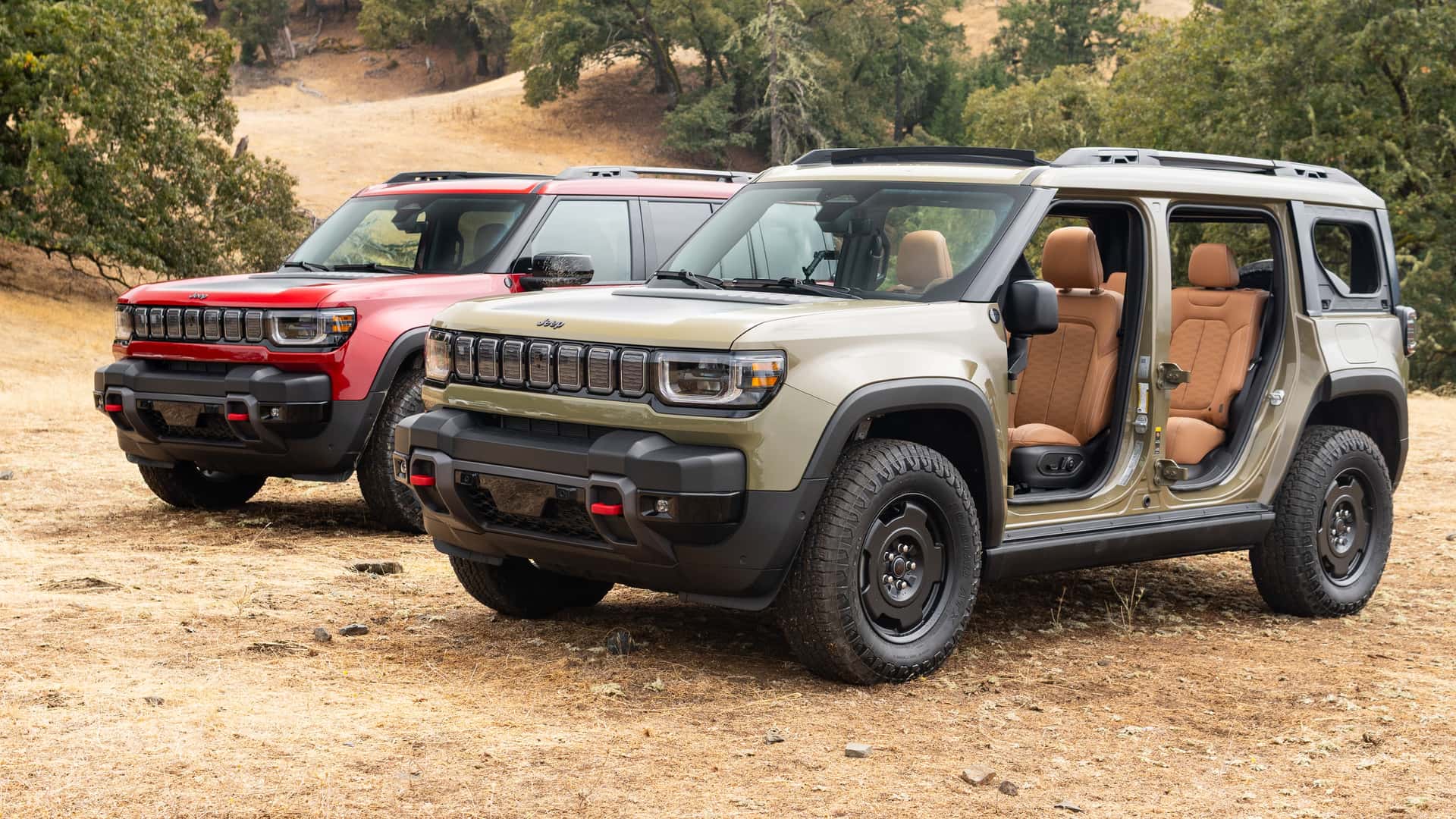
In contrast, the Jeep Recon is engineered for genuine off-road performance. It boasts a robust 9.1 inches of ground clearance, features a comprehensive array of heavy skid plates for underbody protection, and comes equipped with aggressive 33-inch all-terrain tires. Its upright design is specifically crafted to optimize approach and departure angles, critical metrics for navigating difficult obstacles.
Beyond these visible attributes, a less obvious yet crucial factor in the Recon’s design is its gearing. While EVs do not have traditional multi-speed transmissions like ICE vehicles, they still utilize gear ratios to manage how the electric motors deliver torque to the wheels. Taller gear ratios (e.g., a lower first number like 9:1 for an EV) are generally more efficient for cruising and higher speeds.
However, for off-roading, low-end torque is paramount. To maximize this, the Recon’s rear motor is equipped with significantly shorter 15:1 gearing. This setup dramatically increases torque at the wheels from a standstill, enabling the vehicle to climb over and power through tougher obstacles more effectively. An added benefit of this aggressive gearing is quicker acceleration, allowing the Recon to reach 60 mph in a swift 3.6 seconds.
This engineering decision, while crucial for off-road dominance, comes with an inherent compromise: reduced efficiency. During tests, the Recon exhibited an efficiency of just 2.5 miles per kWh, directly attributable to these design choices that prioritize torque and capability over maximum electric range.
Comparative Analysis: Other Electric Off-Roaders and Their Ranges
To further contextualize the Jeep Recon’s electric range, it is insightful to examine how other high-performance electric off-road vehicles navigate the same engineering challenges of balancing capability, range, and cost.
Rivian R1S
The Rivian R1S, a formidable electric SUV, generally demonstrates better efficiency than the Recon, even when equipped with all-terrain tires. However, Rivian itself acknowledges the range implications of off-road equipment. For instance, the company does not offer all-terrain tires on models featuring its base 108-kWh battery pack.
Customers seeking AT tires must upgrade to the larger 140 kWh version, which still sees its range drop from an impressive 410 miles to 370 miles. This configuration typically pushes the price point to around $96,000. Moreover, the R1S, with its taller gearing and absence of a locking rear differential, sacrifices some of the low-speed crawling advantages found in the Jeep Recon.
Mercedes-Benz G580 with EQ Technology
At the pinnacle of electric off-road luxury and performance sits the Mercedes-Benz G580 with EQ Technology. This vehicle offers even more sophisticated off-road capabilities than both the Recon and the R1S, thanks to separate low-range gears for each of its four motors. This advanced system allows for superior climbing performance and the flexibility to switch to higher gears for more efficient on-road cruising.
However, even with such cutting-edge hardware, a substantial 116 kWh of usable battery capacity, and a premium price tag of $163,000, the G580 still achieves an EPA estimated range of only 239 miles. It is also crucial to note that for all these high-performance electric off-roaders, actual highway range is often significantly lower than combined range estimates, as the various efficiency-compromising factors are compounded at higher speeds.
What This Means for the EV Industry
The trajectory of electrification in the automotive sector is proving to be multifaceted, revealing that the most inherently inefficient vehicle types — such as heavy-duty off-roaders — present the greatest challenges for conversion to electric power. Therefore, the relatively modest electric ranges offered by vehicles like the Volkswagen ID. Buzz or the Jeep Recon should not come as a surprise.
Equipping such vehicles with batteries of sufficient capacity, such as a 91- or 100-kWh pack, is already a costly endeavor. Yet, the sheer size, boxy aerodynamics, and significant weight of these vehicles mean that the stored energy does not translate into the same mileage as it would in a sleeker, lighter EV.
This efficiency reduction is further exacerbated by the inclusion of all-terrain tires, additional ground clearance, and specialized aggressive gearing. While advancements in battery technology, improvements in charging infrastructure, and faster charging times are continually evolving, these fundamental challenges persist in the near term.
For the foreseeable future, consumers interested in acquiring highly capable electric off-road vehicles should anticipate making compromises on both maximum electric range and initial purchase price. The current market reflects a critical balance between engineering for extreme environments and the practicalities of electric vehicle deployment.
Frequently Asked Questions (FAQ) about the Jeep Recon’s Electric Range
Q1: Why is the Jeep Recon’s electric range lower than some other EVs?
A1: The Jeep Recon is designed for extreme off-road capability. Features like high ground clearance, heavy skid plates, aggressive 33-inch all-terrain tires, and low 15:1 gearing for maximum torque significantly increase energy consumption, thus reducing its overall electric range compared to road-focused EVs.
Q2: Does off-road capability always reduce an EV’s range?
A2: Yes, almost always. The very design elements that make a vehicle excellent off-road – such as aerodynamic inefficiencies from a boxy shape and tall stance, increased rolling resistance from large, knobby tires, and higher energy draw from specialized gearing and powerful motors – inherently reduce an EV’s energy efficiency and range.
Q3: How does the Jeep Recon’s range compare to other electric off-roaders?
A3: The Recon’s 222-mile range is comparable to or slightly below premium electric off-roaders like the Mercedes G580 w/EQ Technology (239 miles). The Rivian R1S can achieve higher ranges, but often at a higher price point and with different off-road gearing compromises, especially when equipped with all-terrain tires.
Q4: Why is the Jeep Recon priced at $66,995 despite its 222-mile range?
A4: The price reflects the substantial engineering and hardware required for its robust off-road capabilities, including a large 100.5 kWh battery, advanced 4×4 systems, durable body protection, and specialized components. Integrating these features into an electric platform adds significant cost, which is passed on to the consumer.
Q5: Will electric off-roaders eventually offer longer ranges at lower prices?
A5: As battery technology advances, becomes more energy-dense, and manufacturing costs decrease, it is anticipated that electric off-roaders will offer improved ranges and potentially become more affordable. However, the fundamental trade-off between extreme capability and ultimate efficiency will likely remain a design consideration.