
New York City presents a formidable landscape for drivers, characterized by a constant battle against potholes, a relentless search for parking, and navigating some of the nation’s most congested traffic. Yet, despite these challenges, the city maintains a stubbornly car-centric culture, now increasingly embracing electric vehicles (EVs) and plug-in hybrids. As of September, combined registrations for these greener vehicles surpassed 81,000, signaling a significant shift in urban transportation.
This surge in EV adoption, however, creates a substantial infrastructure challenge. For those in suburban homes with garages, EV charging is often a straightforward process with a personal home charger. In New York’s dense urban environment, where many residents live in apartments and rely on street parking, accessible charging solutions become a far more complex issue.
Key Takeaways: Lamppost EV Chargers in NYC
- Addressing Urban Charging Gaps: New York City faces a significant challenge in providing adequate EV charging infrastructure for its growing electric vehicle population, particularly for apartment dwellers without private parking.
- Innovative Solution: Voltpost has introduced the city’s first lamppost EV charger, Voltpost Air, in South Brooklyn, transforming existing street infrastructure into accessible charging points.
- Enhanced Convenience: The lamppost chargers offer Level 2 charging, ideal for topping up vehicles over several hours while parked, rather than requiring high-speed, dedicated charging sessions.
- Cost-Effective and Rapid Deployment: By utilizing existing poles and electrical connections, Voltpost significantly reduces installation costs by up to 70% and deployment time to mere hours, avoiding extensive construction.
- User-Friendly Design: The chargers feature an elevated, retractable cable system that protects equipment from vandalism and flooding while keeping sidewalks clear for pedestrians.
- Broader Innovation: Other startups like It’s Electric and Gravity Charging Center are also contributing to New York’s evolving curbside EV charging solutions, focusing on leveraging existing building infrastructure.
- Scaling Up: With plans for 26 additional lamppost EV chargers in New York State and a total of 500 across nine U.S. states, this technology is poised for wider adoption, though NYC still lags behind global leaders like London.
While new fast chargers continue to emerge across the five boroughs, the city’s inherent limitations—dense streets, high real-estate costs, and protracted permitting processes—constrain the pace of their development. Moreover, not every charging session necessitates a high-powered station. Many urban drivers seek chargers they can plug into for a few hours while engaged in other activities.
The Imperative for Accessible Level 2 Curbside Charging
This is precisely where an expanded network of Level 2 charging curbside and within parking lots proves invaluable. These lamppost EV chargers are notably more economical to use compared to their fast-charging counterparts, capable of replenishing an EV’s battery in approximately 6 to 8 hours, depending on battery capacity.
Unless one is a rideshare driver with a constant need for rapid charging, vehicles typically spend the majority of their time stationary. Consequently, increasing the availability of Level 2 plugs where cars are parked for extended durations not only offers a more cost-efficient solution for owners but also contributes to less stress on the battery during the charging cycle.
In response to this critical demand, several New York-based startups are actively developing such solutions. Among them is Voltpost, a company whose premise is remarkably straightforward: instead of constructing entirely new charging stations, it repurposes existing street infrastructure, such as lampposts or utility poles, into functional EV charging points.
Voltpost recently marked a significant milestone with the installation of New York City’s inaugural lamppost charger, the Voltpost Air, situated at Bush Terminal Park in South Brooklyn. A personal assessment of this innovative charger revealed its potential as a true game-changer, capable of significantly accelerating the city’s electric vehicle ambitions if deployed at scale.
A Hands-On Experience: Navigating the Voltpost Air Charger
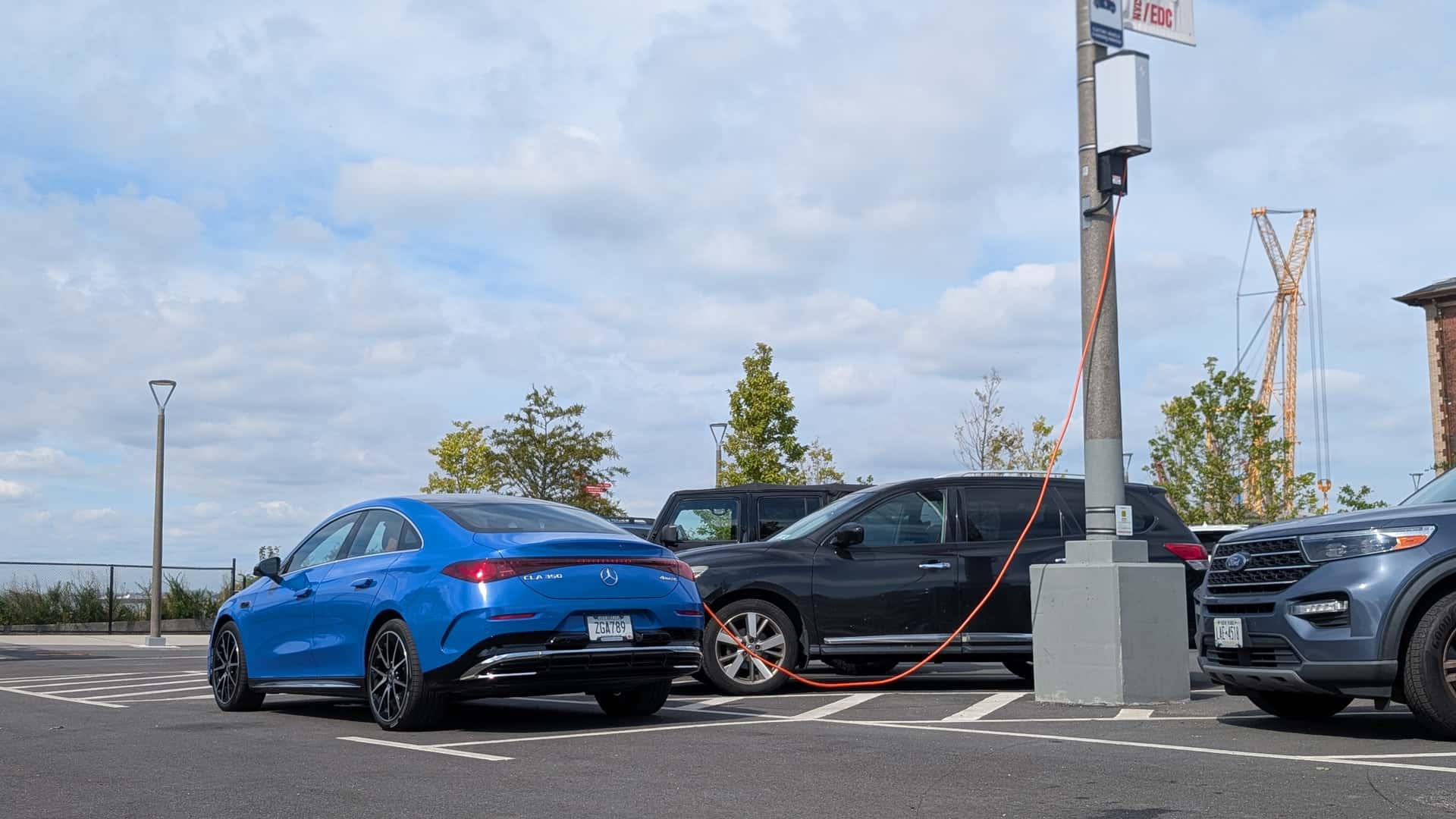
The Voltpost Air charger is strategically positioned approximately 10 feet up a streetlight pole, placing it roughly at the height of a basketball hoop. This elevated placement, according to Voltpost, serves a dual purpose: it protects the unit from potential vandalism and safeguards it against flooding, a pertinent concern in coastal urban areas.
Upon arrival, it was not surprising to find conventional gasoline-powered cars occupying the parking spaces on either side of the charger. However, the dispenser’s generous 25-foot cable proved sufficiently long to effortlessly reach the charge port of the Mercedes-Benz CLA 350 Electric being tested, without obstructing the surrounding vehicles or pedestrian pathways.
Streamlined Charging Process and Cost Efficiency
Initiating a charging session with the Voltpost Air was designed for simplicity. The process involved scanning a QR code located on the charger, followed by just two taps on the associated application. Immediately, the charging cable automatically lowered itself from its elevated position on the pole. Once the cable was within comfortable reach, a press of a button on its handle extended it directly to the vehicle’s charging port.
While a card reader remains the gold standard for a truly frictionless charging experience, offering instantaneous authorization, the Voltpost app demonstrated impressive functionality. Its interface was slick, and the connection established instantaneously—a notable achievement, particularly when some larger fast-charging networks still struggle with similar app-based processes.
Upon completion of the charging session, disconnecting the cable triggered its automatic retraction back into the dispenser. A minor observation during the test was the need to release the handle gently; a sudden disengagement could cause the cable to swing and momentarily strike against the pole as it returned to its housing. Beyond this minor detail, the overall experience proved remarkably uneventful and efficient.
Performance and Practicality for Urban Drivers
During the hour spent utilizing the lamppost EV charger, the Mercedes-Benz CLA 350 Electric accumulated approximately 30 miles of indicated range. This increment was more than sufficient to cover the round trip from the apartment and provided an additional 20 miles of range, effectively addressing the day’s driving requirements.
This demonstrates precisely where such Level 2 charging solutions offer the most significant value. Drivers are not required to remain at the charging station. Instead, they can park, plug in, and proceed with other activities, integrating charging seamlessly into their daily routines.
Locations such as parks, shopping centers, apartment complexes, and office buildings emerge as prime candidates for the deployment of these chargers. They enable vehicles to quietly gain miles while owners are walking their dogs, purchasing groceries, or socializing with friends, thereby enhancing the convenience of electric vehicle ownership in urban settings. The cost for the session was $0.39 per kilowatt-hour, a rate considerably lower than the fast chargers in the vicinity, which can exceed $0.60 per kWh, and generally competitive with other public Level 2 chargers across the city.
The Strategic Advantages of Lamppost EV Chargers
Voltpost asserts that its lamppost installations effectively resolve several key inconveniences associated with conventional curbside EV chargers. These include issues such as charging cables lying haphazardly on the ground and bulky charging stations occupying valuable pedestrian space on already crowded urban sidewalks.
Crucially, the charger itself is positioned safely above street level, offering inherent protection against potential flooding, a pertinent environmental consideration in many urban areas. Furthermore, the automatic retraction mechanism for the charging cable prevents drivers from leaving it on the ground, thereby mitigating wear and tear on the equipment and eliminating trip hazards for pedestrians.
Streamlined Deployment and Cost Efficiency
However, the most significant advantage lies in the speed and reduced cost of deployment, as highlighted by Luke Mairo, the Chief Operating Officer and co-founder of Voltpost. Traditional charging station installations often necessitate extensive civil engineering work, including digging up sidewalks, laying new conduits, and establishing dedicated electrical connections. Voltpost’s approach circumvents these costly and time-consuming steps.
“The main benefit of using pole mounted infrastructure is that we don’t do construction and trenching work,” Mairo stated in an interview. He further explained that this methodology translates to “less permitting, significant reductions in the cost to install, and less disruption to the communities,” accelerating the rollout of crucial EV charging infrastructure.
The Brooklyn charger, notably, does not share its power supply with the lamppost it is affixed to. Instead, it draws electricity from a nearby building. Mairo clarified, “We don’t split the power to the light. With the conversion of street lights to LED, there’s spare capacity on the grid. We can use the existing capacity at the distribution to bring new service through the grid to our lamppost locations.”
This innovative approach can slash project costs by an impressive 70% and enables a charger to be installed within a matter of hours, with minimal to no construction or trenching required. The Voltpost Air supports both J1772 and Tesla-style J3400 connectors, capable of delivering up to 9.6 kilowatts at 240 volts and 40 amps.
Scaling Up: Expansions and Durability Considerations
Voltpost initiated its lamppost EV chargers program with its first installation in Chicago last year. This was subsequently followed by multiple deployments in Detroit and New York City. The expansion continues, with an additional 26 lamppost chargers slated for installation across New York State as part of a program funded by the New York State Energy Research and Development Authority (NYSERDA). In total, approximately 500 new lamppost EV chargers have been awarded across nine U.S. states.
Naturally, the integration of a cable retraction system onto a streetlight introduces an additional potential point of failure. When queried about the durability of this mechanism against real-world conditions, including freezing winters, scorching summers, and thousands of charging cycles, Mairo emphasized the charger’s UL certification. He noted that the mechanism has undergone thousands of tests across various climates and temperatures, achieving a rating for operation between -22 degrees Fahrenheit and 122 degrees Fahrenheit.
Nevertheless, the true test of robustness will emerge with widespread, large-scale usage by drivers. Anecdotal experience suggests that urban drivers in New York City are not always gentle with charging equipment, frequently leading to instances of broken plugs and cracked screens. Voltpost addresses this by monitoring its chargers in real-time, enabling remote resolution of some issues via software. For problems necessitating physical repair, the company dispatches local maintenance providers to ensure prompt service.
Broader Innovations in New York City’s Curbside Charging Ecosystem
Voltpost is not an isolated pioneer in leveraging existing electrical infrastructure to circumvent the prohibitive costs and time delays associated with extensive utility upgrades. Other innovative companies are also contributing to the evolution of New York City’s EV charging landscape.
Another prominent New York-based startup, It’s Electric, is poised for expansion with its distinctively sleek curbside chargers. These units are designed to draw spare electrical capacity from adjacent residential and commercial buildings. A key differentiator in their model is that drivers supply their own charging cables—which the company also makes available—thus eliminating hanging cables across sidewalks. After charging, users simply detach and take their cable with them, much like an iPhone charger.
On a grander scale, the Gravity Charging Center in Times Square exemplifies a similar strategic approach. This substantial 500 kW charging station reportedly utilizes surplus electricity from the entire block it occupies, demonstrating how large-scale charging can be integrated without significant new grid investments. The common thread among these innovative startups is their proactive stance: rather than passively awaiting the city to undertake massive street rebuilds to facilitate EV charging, they are actively working within and adapting to the city’s existing infrastructure. This collective effort aims to accelerate EV adoption in a more efficient and less disruptive manner.
NYC’s Path Towards Comprehensive Curbside Charging
Despite these promising innovations, there remains a considerable journey before chargers from companies like Voltpost and It’s Electric become a ubiquitous sight across the U.S. New York City, in particular, still significantly lags behind many other major global metropolises in terms of readily available curbside charging infrastructure.
London, for instance, boasts an impressive network of more than 27,000 curbside chargers, a substantial proportion of which are also lamppost retrofits. This highlights that while the lamppost concept is innovative for NYC, it is not an entirely novel idea on the global stage.
In contrast, New York City’s current curbside charging network is considerably smaller, featuring only 88 chargers installed by Flo. These units, with their prominent towers and extended cables, can often be visually intrusive within the city’s already congested and visually chaotic streetscapes.
However, the burgeoning demand for EV charging is undeniable. The long queues observed at public fast-chargers across the city underscore a significant imbalance between supply and demand. With electric vehicles now accounting for 8.3% of new vehicle registrations in the city, plans are already in motion to install approximately 600 additional curbside chargers in the forthcoming years.
The pivotal question for New York City’s electric vehicle future is how swiftly these crucial charging solutions can be deployed and effectively integrated to genuinely simplify the lives of EV drivers.
Frequently Asked Questions About Lamppost EV Chargers in NYC
What is a lamppost EV charger?
A lamppost EV charger is an innovative electric vehicle charging unit integrated into existing street infrastructure, such as lampposts or utility poles. Instead of requiring new dedicated charging stations, it repurposes these structures, offering a more streamlined and cost-effective solution for urban charging, especially where space is limited.
How does Voltpost’s lamppost charger work in NYC?
Voltpost’s Voltpost Air charger in NYC is installed on existing streetlight poles, approximately 10 feet high. Users scan a QR code via an app to initiate charging, which lowers a 25-foot cable automatically. The charger draws power from nearby electrical infrastructure, not the lamppost light itself, and retracts the cable once charging is complete.
What are the benefits of lamppost EV chargers?
Lamppost EV chargers offer numerous benefits, including significantly reduced deployment costs (up to 70% less than traditional stations) and faster installation times (hours instead of weeks/months). They utilize existing infrastructure, minimize street disruption, and their elevated design protects equipment from vandalism and keeps sidewalks clear of cables.
How much does it cost to charge an EV using a Voltpost lamppost charger?
During the recent test in NYC, the cost for charging with a Voltpost lamppost EV charger was $0.39 per kilowatt-hour (kWh). This rate is considerably more affordable than many public fast-charging stations in the city, which can exceed $0.60/kWh, and is competitive with other Level 2 public charging options.
What are the technical specifications of the Voltpost Air charger?
The Voltpost Air charger supports both J1772 and Tesla-style J3400 connectors. It is capable of delivering up to 9.6 kilowatts (kW) at 240 volts and 40 amps, providing Level 2 charging suitable for overnight or multi-hour daytime charging sessions. The unit is designed for durability across a wide range of temperatures.
How does NYC compare to other major cities in terms of curbside EV charging?
New York City currently lags behind global leaders in curbside EV charging infrastructure. For example, London boasts over 27,000 curbside chargers, many of which are lamppost retrofits. NYC’s network, while growing, is significantly smaller, with just 88 Flo curbside chargers currently, although plans are underway for 600 more.
What other companies are innovating in NYC’s EV charging space?
Beyond Voltpost, other startups like It’s Electric are contributing to NYC’s EV charging ecosystem. It’s Electric offers sleek curbside chargers that draw power from residential and commercial buildings, requiring drivers to use their own cables. Additionally, large-scale projects like the Gravity Charging Center in Times Square utilize spare block electricity for high-capacity charging.
What is the future outlook for EV charging in New York City?
The future outlook for EV charging in New York City is one of rapid growth and innovation. With EV registrations increasing and plans for hundreds of new curbside chargers, including lamppost EV chargers, the city is committed to expanding its infrastructure. The key challenge remains the swift and efficient deployment of these solutions to meet burgeoning demand and integrate seamlessly into urban life.