
Key Takeaways
- New York City’s rapidly growing EV adoption faces significant curbside charging challenges due to dense urban infrastructure.
- Voltpost has launched NYC’s first lamppost EV charger, the Voltpost Air, at Bush Terminal Park, South Brooklyn, aiming to provide a scalable and cost-effective solution.
- The Voltpost Air, positioned 10 feet high, uses a retractable cable system, offering Level 2 charging at $0.39 per kilowatt-hour, significantly cheaper than many fast chargers.
- The innovation leverages existing street infrastructure, dramatically reducing installation costs by 70% and deployment time compared to traditional EV charging stations.
- This technology represents a potential “game changer” for urban electric vehicle charging, addressing issues of vandalism, flooding, and sidewalk obstruction while boosting accessibility.
New York City, a vibrant metropolis grappling with the complexities of urban mobility, is witnessing a significant surge in electric vehicle (EV) adoption. While the city’s car-centric culture persists, the transition to sustainable transportation is undeniable, with combined registrations for electric vehicles and plug-in hybrids exceeding 81,000 as of September.
This rapid embrace of EVs, however, presents a formidable challenge: establishing a robust and accessible charging infrastructure, particularly for the vast number of residents who rely on street parking and live in apartments without private garages.
The conventional approach to EV charging often involves dedicated fast chargers, which, while efficient, are constrained by the city’s dense streets, high real-estate costs, and protracted permitting processes. Moreover, not every charging session necessitates a high-powered station; for many urban drivers, a convenient, slower charging option accessible during daily routines is often preferable.
Addressing New York’s Urban Charging Conundrum
The urban landscape of New York City poses unique hurdles for electric vehicle owners. Unlike suburban counterparts who can easily install home chargers, city dwellers often lack dedicated parking spaces, relying instead on street parking with its myriad rules and constant search for available spots. This scenario transforms EV charging into a complex logistical exercise.
While the expansion of fast-charging networks across the five boroughs is crucial, its pace is inherently limited by the realities of urban development. The demand for charging solutions that integrate seamlessly into existing city life is immense, pointing towards a need for more Level 2 charging options.
Level 2 chargers offer a practical and cost-effective alternative, typically recharging an EV in six to eight hours, depending on battery capacity. These chargers are considerably cheaper to operate than high-powered fast chargers and are ideal for situations where vehicles are parked for extended periods, such as overnight or during work hours.
This approach not only reduces costs for electric vehicle owners but also lessens the strain on the vehicle’s battery during the charging cycle. It aligns with the reality that most cars remain stationary for the majority of the day, making such ‘opportunity charging’ a highly efficient solution.
Voltpost’s Innovative Lamppost EV Charger Emerges as a Solution
In response to these specific urban challenges, several New York-based startups are pioneering innovative charging solutions. Among them is Voltpost, a company whose strategy is remarkably straightforward: transform existing street infrastructure, such as lampposts or utility poles, into functional EV charging stations.
Voltpost recently marked a significant milestone by installing New York City’s inaugural lamppost charger, the Voltpost Air, at Bush Terminal Park in South Brooklyn. This development has garnered considerable attention, with early assessments indicating its potential to fundamentally alter the city’s electric vehicle charging landscape if deployed at scale.
A First-Hand Look at the Voltpost Air Charger
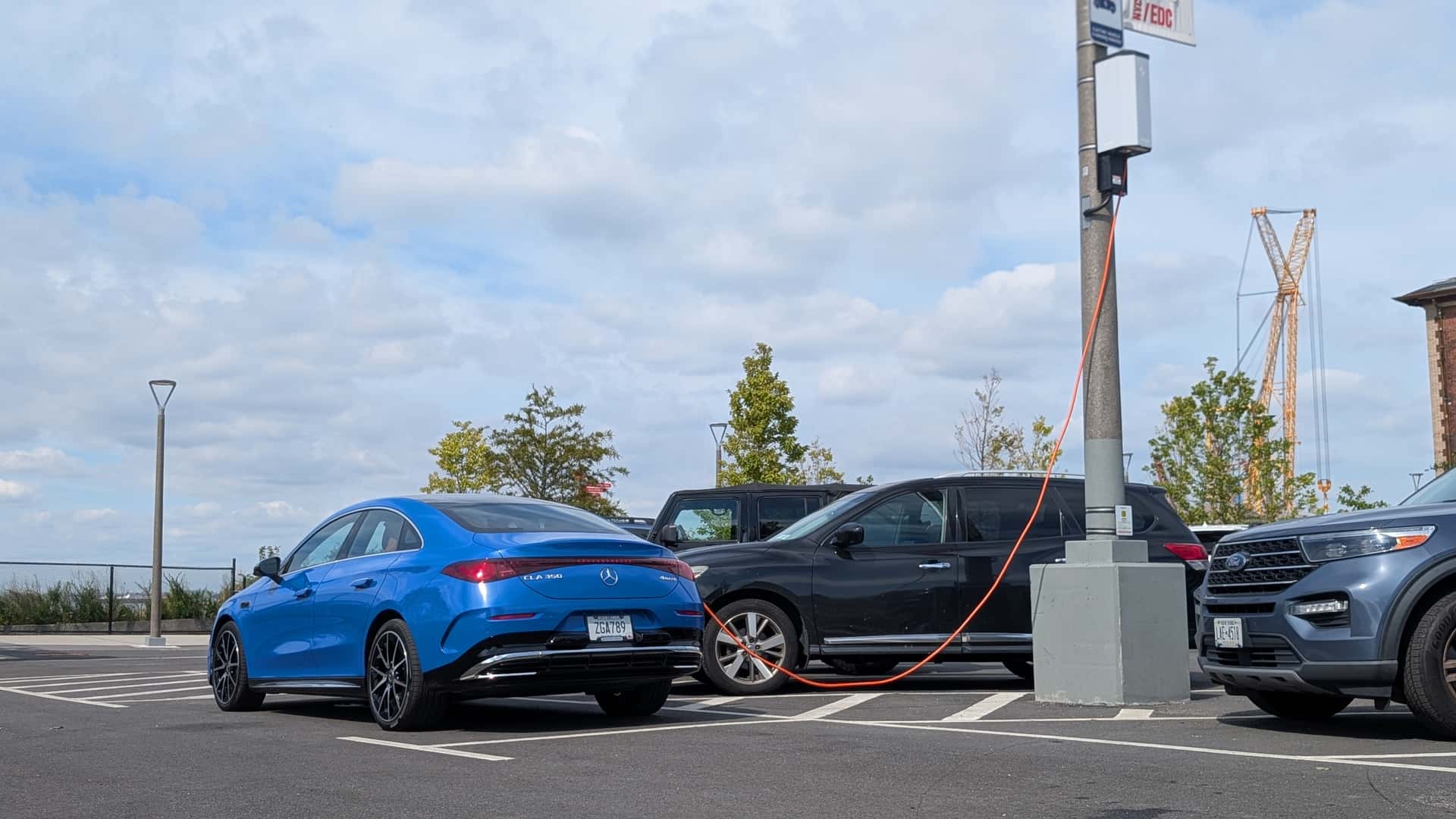
During a recent evaluation, the Voltpost Air demonstrated its practicality and user-friendly design. The charger is strategically positioned approximately 10 feet up a streetlight pole, a height intended to safeguard it from vandalism and potential flooding. Despite gas-powered vehicles often occupying parking spots on either side, the dispenser’s 25-foot cable proved sufficiently long to connect to the Mercedes-Benz CLA 350 Electric being tested, without obstructing surrounding vehicles.
Initiating a charging session was notably simple. Users scan a QR code on the charger, and within two clicks, the cable automatically lowers to an accessible height. A subsequent press of a button on the handle extends the cable further to the car’s charge port. While the preference for a card reader for ultimate frictionless charging remains, Voltpost’s application demonstrated impressive speed and connectivity, a noteworthy achievement compared to some established fast-charging networks.
Upon completion of charging, the process was equally seamless: unplugging the vehicle triggers the cable to retract automatically. A minor operational nuance observed was the need for a gentle release of the handle to prevent the cable from banging against the pole during retraction. Overall, the experience was remarkably uneventful, highlighting the charger’s intuitive design.
The test session, lasting approximately one hour, added about 30 miles of indicated range to the Mercedes-Benz CLA 350 Electric. This increment was more than sufficient for a round trip from an apartment and provided an additional 20 miles of range, effectively covering the day’s driving requirements. This efficiency underscores the value of such chargers in scenarios where drivers can plug in and engage in other activities, such as walking a dog, grocery shopping, or meeting friends, allowing the vehicle to charge quietly in the background.
The cost of charging was recorded at $0.39 per kilowatt-hour, a rate considerably more economical than fast chargers in the vicinity, which can exceed $0.60 per kWh. This pricing aligns with that of other public Level 2 chargers across the city, reinforcing its appeal as a cost-effective solution for urban electric vehicle charging.
The Strategic Advantages of Lamppost Integration
Voltpost’s approach to integrating EV chargers into existing lampposts offers multifaceted benefits beyond mere convenience. A primary advantage is the elevated placement of the charger, which mitigates common issues such as cables lying on sidewalks, potential flooding risks, and stations encroaching on pedestrian space. The automatic retraction of the cable ensures it is not left on the ground, reducing wear and tear and eliminating tripping hazards for pedestrians.
Luke Mairo, COO and co-founder of Voltpost, emphasized the critical advantages of this deployment model. “The main benefit of using pole mounted infrastructure is that we don’t do construction and trenching work,” Mairo stated. He added that this translates to “less permitting, significant reductions in the cost to install, and less disruption to the communities.” This innovative use of existing poles and electrical infrastructure bypasses the arduous process of digging up sidewalks, laying new conduits, and establishing dedicated electrical connections.
The current Voltpost charger in Brooklyn draws its power from a nearby building rather than directly from the lamppost. Mairo clarified this aspect, explaining, “We don’t split the power to the light. With the conversion of street lights to LED, there’s spare capacity on the grid. We can use the existing capacity at the distribution to bring new service through the grid to our lamppost locations.” This strategic leveraging of existing grid capacity and infrastructure significantly reduces project costs, potentially by up to 70%, and allows for charger installation in a matter of hours, with minimal or no construction. The system supports both J1772 and Tesla-style J3400 connectors, providing up to 9.6 kilowatts at 240 volts and 40 amps.
Durability and Scalability in a Challenging Urban Environment
A key concern for any infrastructure deployed in a bustling urban environment like New York City is durability and resilience to extreme weather conditions and frequent public use. The cable retraction system, a novel feature of the Voltpost Air, raises questions about its long-term reliability.
Mairo addressed these concerns by highlighting the charger’s UL certification and extensive testing across various climates and temperatures. The mechanism is rated to operate reliably between -22 degrees Fahrenheit and 122F, suggesting a robust design. However, the true test will unfold as drivers interact with these chargers at scale, especially given the observed tendency of city drivers to be less than gentle with public charging equipment.
To mitigate potential issues, Voltpost employs real-time monitoring of its chargers, enabling remote problem diagnosis and, in some cases, resolution via software updates. For physical repairs, the company can dispatch local maintenance providers, ensuring operational continuity.
Voltpost’s expansion is already underway, with its first lamppost charger launched in Chicago last year, followed by installations in Detroit and New York. Further illustrating its scalability, 26 additional lamppost chargers are slated for deployment across New York State as part of a program funded by the New York State Energy Research and Development Authority (NYSERDA). Nationally, approximately 500 new chargers have been awarded across nine U.S. states, underscoring the widespread potential of this sustainable transportation solution.
Beyond Lampposts: Diverse Approaches to Curbside Charging
Voltpost is not alone in its quest to innovate urban EV charging by utilizing existing electrical infrastructure. Other startups are also devising creative solutions to circumvent the costly and time-consuming utility upgrades typically associated with establishing new charging points.
Another New York-based company, It’s Electric, plans to expand its network with sleek curbside chargers that draw spare capacity from residential and commercial buildings. A distinguishing feature of It’s Electric is its reliance on drivers bringing their own charging cables, which the company also provides. This eliminates cables dangling across sidewalks and allows drivers to take their charging cables with them, much like a mobile phone charger, after their charging session concludes.
On a larger scale, the Gravity Charging Center in Times Square exemplifies a similar principle. This ambitious project aims to power a substantial 500 kW charging station by harnessing spare electricity from the surrounding block. These diverse approaches share a common goal: to work synergistically with New York City’s existing infrastructure, rather than awaiting extensive street overhauls, thereby accelerating EV adoption more efficiently and contributing to smart city solutions.
The Evolving Landscape of Curbside Charging in NYC
Despite these promising innovations, New York City still has considerable ground to cover to match the advanced curbside charging infrastructure found in other major global cities. London, for instance, boasts over 27,000 curbside chargers, many of which are retrofitted lampposts, demonstrating the proven efficacy of this concept internationally.
In contrast, NYC’s current curbside charging network is significantly smaller, comprising only 88 chargers installed by Flo. These units, with their distinctive towers and long cables, can often appear visually intrusive and contribute to the already cluttered and chaotic nature of city streets.
Nevertheless, the demand for accessible EV charging solutions is unequivocally on the rise. With electric vehicles now constituting 8.3% of new vehicle registrations in the city, the current supply of charging points is clearly insufficient to meet demand, evidenced by frequent long queues at public fast chargers. Recognizing this growing need, the city has ambitious plans to install approximately 600 additional curbside chargers in the coming years, marking a concerted effort to enhance electric vehicle infrastructure.
The critical question now facing New York City is the speed and efficiency with which these planned charging solutions can be deployed and integrated into the urban fabric, ultimately making the lives of electric vehicle drivers significantly easier and fostering further EV adoption within this dynamic metropolis.
Frequently Asked Questions (FAQ)
What is a lamppost EV charger?
A lamppost EV charger is an electric vehicle charging unit integrated into existing street infrastructure like lampposts or utility poles. This innovative design leverages existing electrical connections, minimizing the need for extensive new construction and reducing deployment costs and time significantly. It offers a convenient, space-saving solution for urban charging.
How does the Voltpost Air charger work?
The Voltpost Air charger operates by scanning a QR code via a smartphone app. Once authorized, its cable automatically lowers from a height of 10 feet for easy access. After plugging into the electric vehicle, the charging session begins. Upon completion, the cable retracts back into the unit, ensuring it doesn’t obstruct pedestrian pathways.
What are the benefits of using lamppost EV chargers in cities like NYC?
Lamppost EV chargers offer numerous benefits for dense urban environments. They reduce installation costs by up to 70% by utilizing existing infrastructure, minimize disruption to communities, save valuable sidewalk space, and protect the charging unit from vandalism and flooding due to its elevated position. They provide accessible Level 2 charging where dedicated stations are impractical.
Is lamppost charging cheaper than traditional fast charging?
Yes, typically, lamppost EV chargers, which are primarily Level 2 chargers, are considerably cheaper to use than high-powered fast chargers. For instance, the Voltpost Air charges at $0.39 per kilowatt-hour, while many fast chargers in New York City can exceed $0.60 per kWh. This makes it a more economical option for regular charging needs.
How durable are lamppost EV chargers in varied weather conditions?
Lamppost EV chargers, like the Voltpost Air, are designed and certified to withstand a wide range of environmental conditions. They are rated to operate reliably in temperatures between -22 degrees Fahrenheit and 122F. Real-time monitoring and local maintenance providers ensure continued functionality despite challenging urban use and diverse weather.
How does NYC compare to other global cities in terms of curbside charging?
New York City currently lags behind some global counterparts in curbside charging infrastructure. London, for example, boasts over 27,000 curbside chargers, many of which are lamppost retrofits. NYC has fewer than 100 Flo curbside chargers, though plans are underway to install 600 more, indicating a growing commitment to expanding its electric vehicle infrastructure.