
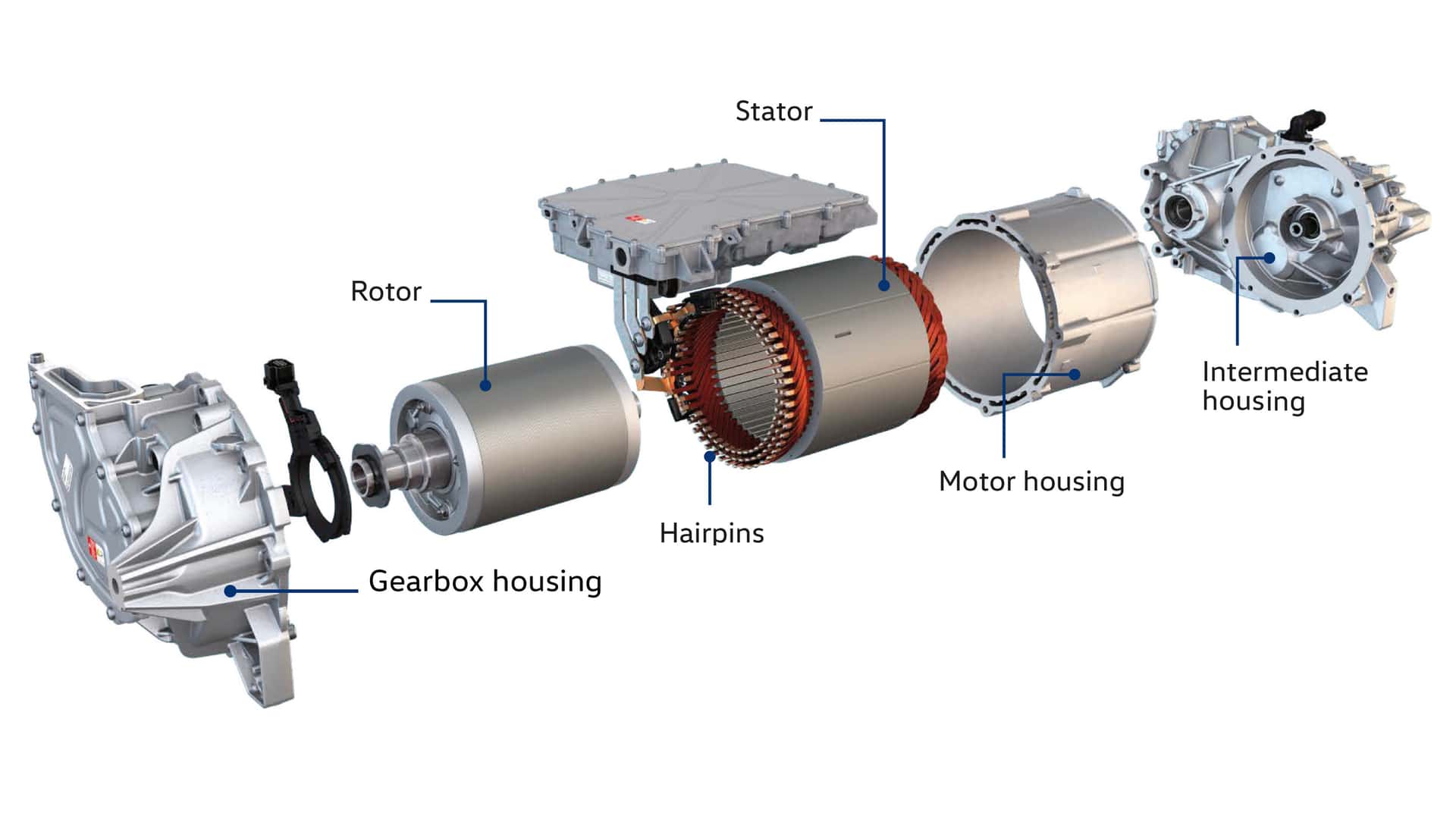
While much of the public discourse around electric vehicles (EVs) often centres on battery technology and range, the electric motors powering these vehicles are equally crucial and technologically diverse. Far from being a monolithic component, EV motors employ various designs, each balancing efficiency, performance, packaging, and cost. Understanding these distinct EV motor types is key to appreciating the engineering marvels that drive modern electric mobility.
The fundamental difference lies in how a motor generates its magnetic field – the force that induces rotation. Some motors rely on permanent magnets, while others create this magnetic field using an electrical current. Though all utilise magnetism, the methods of generation and application vary significantly, impacting their characteristics and suitability for different applications.
Key Takeaways
- EV motors are not uniform; they vary in design to optimise efficiency, performance, and cost.
- The primary distinction among EV motor types is how their rotors generate magnetism: via permanent magnets or electrically powered coils.
- **Permanent-Magnet Synchronous Motors (PMSM)** offer high efficiency and power density but depend on rare earth elements.
- **Induction Motors** are robust and avoid rare earths, but are generally less efficient due to ‘slip’ and heat generation.
- **Electrically Excited Synchronous Motors (EESM)** provide adjustable magnetism for optimised operation and reduce reliance on rare earths, at the cost of added complexity and some energy consumption for excitation.
- Many modern EVs, especially all-wheel-drive models, strategically combine different EV motor types to achieve an optimal balance of performance and energy efficiency.
The Fundamental Principle of Electric Motor Operation
At its core, an electric motor operates through the interaction of magnetic fields. Every EV motor consists of two main sections: the stationary outer casing, known as the stator, and the rotating inner component, called the rotor. This rotor is directly linked to a shaft, which transmits power to the vehicle’s wheels through reduction gearing.
The traction battery supplies direct current (DC) to the EV. However, an inverter converts this DC into precisely controlled alternating current (AC). This AC is then fed into the stator’s coils in a specific sequence, generating a rotating magnetic field. The rotor, whether magnetised permanently or electrically, continuously ‘chases’ this moving magnetic field, causing it to spin and generate torque.
Motors where the rotor spins at precisely the same speed as the magnetic field are termed ‘synchronous’. Both permanent-magnet and electrically excited motors fall into this category. In contrast, induction motors operate with a slight speed differential between the stator’s rotating field and the rotor, a characteristic known as ‘slip’.

Permanent-Magnet Synchronous Motors (PMSM): The Dominant Force
Unpacking Permanent Magnets in EV Motors
The Permanent-Magnet Synchronous Motor (PMSM) is arguably the most prevalent EV motor type in today’s electric vehicle market. In this design, the rotor is equipped with powerful permanent magnets, which can be either attached to its surface or embedded within its structure. These magnets inherently provide the necessary magnetic field, meaning the rotor itself does not require an external electrical supply to maintain its magnetism.
The stator’s rotating magnetic field then interacts with these fixed rotor magnets, pulling the rotor around in continuous motion. This mechanism is akin to a compass needle aligning with a moving external magnet. The consistent and inherent magnetism of the rotor is a significant advantage, as it eliminates the energy losses associated with powering rotor windings, contributing to superior efficiency.
Advantages and Drawbacks of PMSM Technology
PMSMs offer a compelling combination of attributes, including high efficiency across a broad operational range and substantial power output from a relatively compact and lightweight package. These characteristics make them a preferred choice for the primary drive motors in most electric vehicles, delivering robust performance and energy economy.
However, the widespread adoption of PMSMs is not without its challenges. The high-performance magnets typically utilised in these EV motors often incorporate rare earth elements. These materials, such as neodymium and dysprosium, can expose manufacturers to geopolitical sourcing complexities and significant price volatility in global markets. While ‘permanent magnet’ doesn’t exclusively imply ‘rare earth’, these specific materials are commonly chosen for their magnetic strength in automotive applications, posing a supply chain consideration for the industry.
Induction Motors: Always Chasing
How Induction Motors Generate Power
Also referred to as asynchronous motors, induction motors present a distinct EV motor type that eschews permanent magnets in favour of conductive bars within the rotor. This design often earns the moniker ‘squirrel cage’ due to the arrangement of these bars, joined by rings at both ends, resembling a rodent’s exercise wheel.
In an induction motor, the stator’s moving magnetic field induces an electrical current within these rotor bars. This induced current, in turn, generates the rotor’s own magnetic field. This ingenious mechanism allows the motor to produce torque without the need for permanent magnets or a direct electrical connection to the rotor.
A crucial operational characteristic of induction motors is ‘slip’. As the EV accelerates, the rotor always turns slightly slower than the stator’s magnetic field. This speed difference is essential for inducing current in the rotor. Should the rotor match the stator field’s speed completely, the induction effect, and thus the torque production, would cease.
Benefits and Trade-offs of Induction Motors
Induction motors are celebrated for their robust construction and, importantly, their ability to operate without relying on rare earth magnets. This makes them a more sustainable and potentially less costly option from a raw material perspective. However, the process of inducing current in the rotor inherently generates heat, which can reduce overall efficiency compared to PMSMs.
Despite this, induction motors possess a notable advantage: when unpowered, they can spin with minimal mechanical drag. This characteristic is particularly valuable in all-wheel-drive (AWD) EV configurations. For instance, Audi cites this benefit for the front induction motor in its Q6 E-tron Quattro. In such setups, a more powerful permanent-magnet motor often drives the primary axle, while a lighter, less potent induction motor is used for the secondary axle, engaging only when additional propulsion or traction is required. This hybrid motor strategy is common in many Tesla and GM EVs.
Electrically Excited Synchronous Motors (EESM): The Adjustable Powerhouse
Harnessing Electromagnets in EESM Technology
The Electrically Excited Synchronous Motor (EESM) represents a third, innovative EV motor type. Instead of permanent magnets, its rotor contains coils that are supplied with electricity, effectively transforming the rotor into an electromagnet. Unlike induction motors, the EESM does not depend on ‘slip’ to create its rotor field; its synchronicity is maintained by directly exciting the rotor coils.
This design can be conceptualised as a permanent-magnet motor where the strength of the magnets is not fixed but can be actively adjusted. The term ‘excited’ simply refers to the rotor being energised by electricity. This ability to precisely control the rotor’s magnetic field strength offers engineers an additional degree of freedom to optimise the motor’s operation across varying speeds and loads, enhancing efficiency and performance.
Balancing Performance and Resource Dependency
Automakers like BMW have integrated EESMs into their latest sixth-generation EV powertrains. BMW notes that these motors demonstrate high energy efficiency in everyday driving conditions and maintain strong power delivery even at very high rotational speeds. Renault also employs this approach in vehicles such as the Renault 5 E-Tech, specifically highlighting the reduced dependency on rare earth elements and magnet suppliers as a key driver for choosing wound rotors in their designs.
The primary trade-off with EESM technology is the electrical energy consumed to power the rotor’s field. Furthermore, the presence of rotor windings and the associated power supply adds complexity to the motor’s design and manufacturing process. Thus, while EESMs mitigate the reliance on permanent magnets and rare earths, they introduce their own set of engineering and energy management considerations.
The Strategic Integration: Why EVs Use Multiple Motor Types
Optimising Performance and Efficiency
The diversity in EV motor types is not merely a matter of technological alternatives but often a strategic choice for optimising vehicle performance and energy efficiency. The Audi Q6 E-tron Quattro serves as a prime example, combining a permanent-magnet motor at the rear for efficient primary propulsion with an induction motor at the front for on-demand performance and enhanced traction. This configuration allows the vehicle to leverage the strengths of each motor type while mitigating their respective drawbacks.
Similarly, BMW’s new all-wheel-drive system pairs an electrically excited rear motor with a front induction motor, showcasing another permutation of this blended approach. Other manufacturers, such as Mercedes-Benz, employ permanent-magnet front motors that can be mechanically disconnected from the wheels when not required. This disengagement significantly reduces drag and associated energy losses, thereby improving overall vehicle efficiency.
Future Trends in EV Motor Deployment
The choice of EV motor types is a multifaceted engineering decision, balancing factors such as manufacturing cost, material sourcing, power output, and thermal management. The goal is not just to generate power when needed, but also to conserve energy effectively when propulsion is not the priority. This intricate interplay of design philosophies ensures that a variety of motor architectures will continue to be integral to the evolution of electric vehicle technology.
As the EV market matures, advancements in material science, power electronics, and manufacturing techniques will likely continue to refine existing EV motor types and potentially introduce new ones. The ongoing quest for improved range, performance, and sustainability will ensure that the internal workings of these silent powerhouses remain a dynamic and crucial area of innovation within the automotive industry.
Frequently Asked Questions (FAQ)
What are the main EV motor types?
The primary EV motor types are Permanent-Magnet Synchronous Motors (PMSM), Induction Motors (also known as asynchronous motors), and Electrically Excited Synchronous Motors (EESM). Each uses different methods to create the magnetic fields necessary for rotation, impacting their characteristics.
Why do some EVs use permanent magnets?
Permanent-Magnet Synchronous Motors (PMSMs) use magnets on the rotor to create a fixed magnetic field. This design is highly efficient, delivers significant power from a compact size, and is a popular choice for main drive motors due to its performance benefits.
What is the benefit of an induction motor in an EV?
Induction motors are robust, avoid the use of rare earth elements, and exhibit very low drag when unpowered. This makes them ideal for secondary drive axles in all-wheel-drive EVs, where they can provide power on demand without significantly impacting efficiency when inactive.
How do Electrically Excited Synchronous Motors (EESM) work?
EESMs use coils on the rotor, supplied with electricity, to create an adjustable electromagnet. This allows engineers to vary the rotor’s magnetic field strength, optimising motor operation across different speeds and loads, and reducing reliance on rare earth materials.
Are rare earth elements a concern for EV motors?
Yes, many high-performance Permanent-Magnet Synchronous Motors (PMSMs) use rare earth elements. Their sourcing can be geographically concentrated and prices volatile, prompting some manufacturers to explore alternative EV motor types like induction or electrically excited motors to mitigate these dependencies.
Why do some EVs use two different motor types?
Automakers often combine different EV motor types, for example, a PMSM with an induction motor, in all-wheel-drive vehicles. This strategy leverages the strengths of each motor – like the efficiency of a PMSM and the low drag of an induction motor – to optimise overall performance, efficiency, and traction.
What does ‘synchronous’ mean in EV motors?
In electric motors, ‘synchronous’ refers to the rotor spinning at the exact same speed as the rotating magnetic field generated by the stator. Permanent-Magnet Synchronous Motors (PMSMs) and Electrically Excited Synchronous Motors (EESMs) are examples of synchronous EV motor types.
What is ‘slip’ in an induction motor?
‘Slip’ is the necessary speed difference between the stator’s rotating magnetic field and the rotor’s actual rotational speed in an induction motor. This difference is crucial for inducing the electrical current in the rotor that creates its magnetic field and generates torque.