
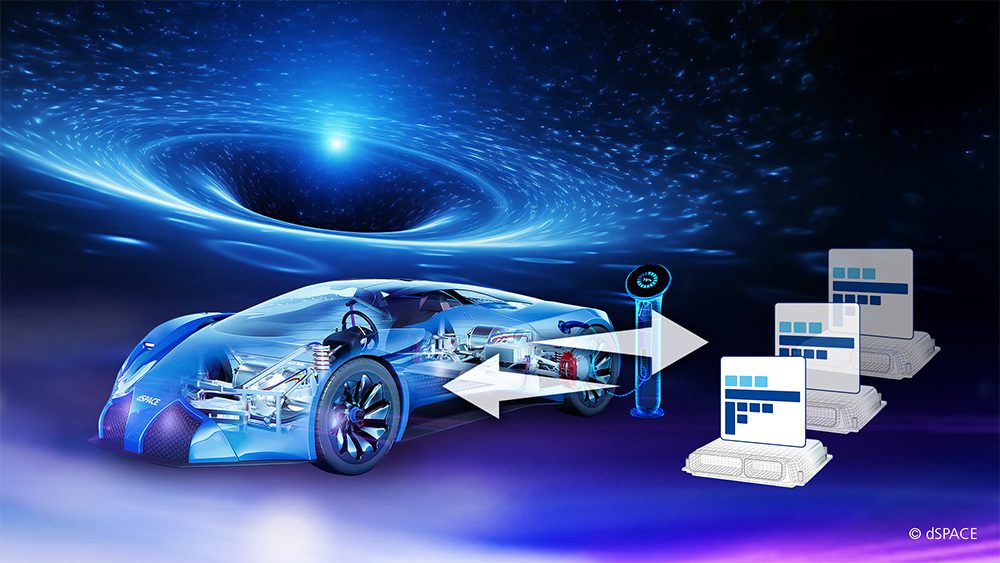
The electromobility sector is undergoing rapid transformation, driven by new vehicle concepts, intricate E/E architectures, and advanced battery systems. Amidst increasing pressure to shorten development cycles and curb costs, Software-in-the-Loop (SIL) testing is emerging as a critical methodology for virtual validation and accelerated innovation.
Understanding Software-in-the-Loop Testing
SIL testing involves the virtual verification of Electronic Control Unit (ECU) functions using sophisticated simulation models, entirely bypassing the need for physical hardware. In this approach, the ECU’s software operates within a virtual environment, interacting with a digital replica, or ‘digital twin,’ of the vehicle or a specific subsystem. This enables engineers to validate functions at an early stage, pinpoint potential errors, and significantly mitigate development risks.

The Role of SIL in Battery Electric Vehicles (BEVs)
Battery electric vehicles present a unique set of complexities, with battery management systems (BMS), charging functionalities, thermal regulation, and energy management systems requiring seamless integration. SIL testing addresses these challenges by facilitating:
- Early validation of critical control algorithms for energy, charging, and thermal management.
- Simulation of charging infrastructure and smart charging scenarios, including adherence to communication protocols like ISO 15118-20.
- Thorough testing of Battery Management Systems (BMS), simulating various cell behaviors and fault conditions to confirm the robustness of safety and efficiency algorithms.
- Seamless integration of novel E/E architectures, such as zonal controllers and centralized vehicle computers.
Advantages Over Traditional Testing
SIL testing proves especially potent during the initial phases of development, offering support for parallel testing, automated regression checks, and effortless integration into Continuous Integration/Continuous Testing (CI/CT) pipelines. Its inherent scalability allows teams to execute thousands of test cases concurrently across multiple virtual environments. Virtualization further enhances this by enabling the testing of entire software stacks, including middleware and operating systems, without requiring physical ECUs. The full potential of SIL is realized through its scalability in cloud applications, which drives parallel test execution, thereby increasing both test coverage and development speed.
Navigating New E/E Architectures with SIL
Contemporary vehicles are increasingly adopting zonal architectures, centralizing functions previously distributed across numerous ECUs. While this offers advantages in weight reduction, cost savings, and improved update capabilities, it introduces new validation complexities, particularly in modeling the hardware dependencies of ECUs. SIL testing provides solutions through:

- Modularity: Enabling the isolated testing of individual software components.
- Flexibility: Allowing for the rapid simulation and evaluation of architectural modifications.
- Reusability: Facilitating the reuse of models and test scenarios from SIL to Hardware-in-the-Loop (HIL) testing, potentially executing up to 80% of tests before the first physical ECU is available.
- Virtualization Support: Enabling the testing of containerized applications and service-oriented architectures.
Seamless Integration into Development Workflows
A key strength of SIL testing is its smooth integration into modern development pipelines. Leveraging a powerful API, the entire process, from creating a Virtual ECU (VECU) to executing automated tests, can be fully scripted and embedded within existing toolchains. This allows developers to initiate tests directly from their development environments or any CI/CT system. Artefacts generated from source code are automatically built, deployed, and tested, providing immediate feedback on implementation accuracy. This rapid feedback loop can be integrated into pull requests, ensuring every code change is validated before integration.
Furthermore, OEMs can extend this approach to their supplier networks. When a supplier provides an update, it can be uploaded as an artefact to the cloud and automatically tested within a complete virtual vehicle context. This cloud-based validation workflow supports scalable, distributed testing across organizational boundaries, eliminating the need for physical infrastructure or manual coordination. The capacity for full-vehicle simulations in the cloud also unlocks on-demand compute scaling, enhanced remote collaboration, and continuous integration across global teams – essential capabilities for modern development organizations aiming to accelerate innovation while upholding quality and compliance.
Lifecycle Coverage with SIL Testing
While often associated with early-stage development, the benefits of SIL testing extend throughout the vehicle software lifecycle. With dSPACE’s SIL solutions, teams can:
- Continuously validate software updates, even post-SOP (Start of Production), by integrating SIL into Over-the-Air (OTA) update pipelines.
- Support variant management through parallel testing of multiple configurations and feature sets.
- Conduct integration testing by combining multiple VECUs and Functional Mock-up Units (FMUs) into comprehensive system simulations.
- Perform long-term regression testing to ensure new features do not compromise existing functionality.
This comprehensive lifecycle coverage is particularly valuable in agile development environments characterized by incremental software delivery and the need for continuous validation. Platforms like VEOS, with their cloud-native capabilities, enable these tests to be executed at scale, on demand, across teams, and without hardware constraints.
System-Level Integration with VEOS
The dSPACE VEOS platform elevates SIL testing beyond basic function validation to encompass system-level integration by supporting diverse abstraction levels. The abstraction level of a V-ECU provides insights into its development status, dictating the level of detail required for simulation:
- Levels 0 and 1: During early development, the focus is on validating individual application components, with the precise nature of signal transmission between V-ECUs being a secondary consideration and often not yet fully defined.
- Level 2 and beyond: As development progresses, bus communication and the integration of V-ECUs into a broader simulation become critical. Basic software for bus communication must be integrated into the V-ECU. Simplified basic software, including only the communication (COM) module, is typically used in earlier phases for easier integration and faster V-ECU creation.
- Level 3: V-ECUs at this level closely resemble their real counterparts, differing primarily in hardware-dependent driver modules. All basic software above these modules is part of the test object and fully integrated into the V-ECU.
This layered approach empowers developers and integrators to select the appropriate fidelity for their specific use case and gradually refine their virtual test environment as the software matures. VEOS supports all these levels and allows for their combination in mixed configurations, ensuring flexibility and scalability throughout the development lifecycle.
VEOS is designed for openness and interoperability, facilitating integration with third-party simulation and testing platforms to build hybrid environments. It supports proprietary models, open standards, and commercial software, enabling the consolidation of diverse solutions into a cohesive simulation framework. VEOS also embraces cloud-native deployment models, allowing simulations and tests to run on scalable cloud infrastructures, transitioning organizations from local, hardware-dependent setups to flexible, cloud-based validation platforms that offer remote access, elastic computing, and global collaboration.
This openness is a significant advantage, enabling OEMs and suppliers to collaborate across tool boundaries, validate across domains, and scale testing across platforms without being restricted to a single ecosystem.
Open Standards and Toolchain Compatibility
dSPACE SIL solutions are engineered for seamless integration into heterogeneous toolchains. VEOS supports key industry standards, including:
- FMI (Functional Mock-up Interface): For efficient model exchange and co-simulation.
- ASAM XIL: For standardized test automation.
- AUTOSAR Classic and Adaptive: For robust ECU software integration.
This standards-based approach guarantees compatibility with third-party tools, allowing customers to leverage their existing investments in modeling, testing, and automation infrastructure.
Scalable Deployment: Desktop to Cloud
A distinguishing feature of the dSPACE SIL ecosystem is its scalable deployment model. VEOS adapts to project and organizational needs, whether executed locally on a developer’s workstation or within a high-performance cloud environment:
- Local Execution: Optimal for debugging and interactive development.
- Cloud-based Execution: Enables large-scale regression testing, parallel scenario validation, and global collaboration.
This flexibility allows teams to commence with smaller-scale operations and expand as required, without altering their tools or workflows. Coupled with containerization and orchestration support, VEOS integrates into enterprise-grade infrastructures, facilitating DevOps practices and continuous validation pipelines. By bridging the gap between desktop simulation and cloud-native testing, dSPACE equips organizations with resilient, scalable, and future-proof validation environments prepared for the demands of next-generation vehicle development.
Conclusion: Virtual Validation as a Catalyst for Scalable, Collaborative Development
Software-in-the-Loop testing transcends being a mere tool; it is a strategic enabler for the future of electromobility, driving faster innovation, enhancing quality, and reducing costs. For battery electric vehicles and evolving E/E architectures, SIL testing is now an indispensable component of modern development workflows.
Through VEOS, dSPACE offers a powerful, open, and scalable platform that supports comprehensive system integration, cross-tool collaboration, and cloud-based validation pipelines, empowering developers and organizations to collectively shape the future of mobility. dSPACE empowers developers worldwide by providing advanced tools, deep expertise, and a steadfast focus on the future of mobility.