
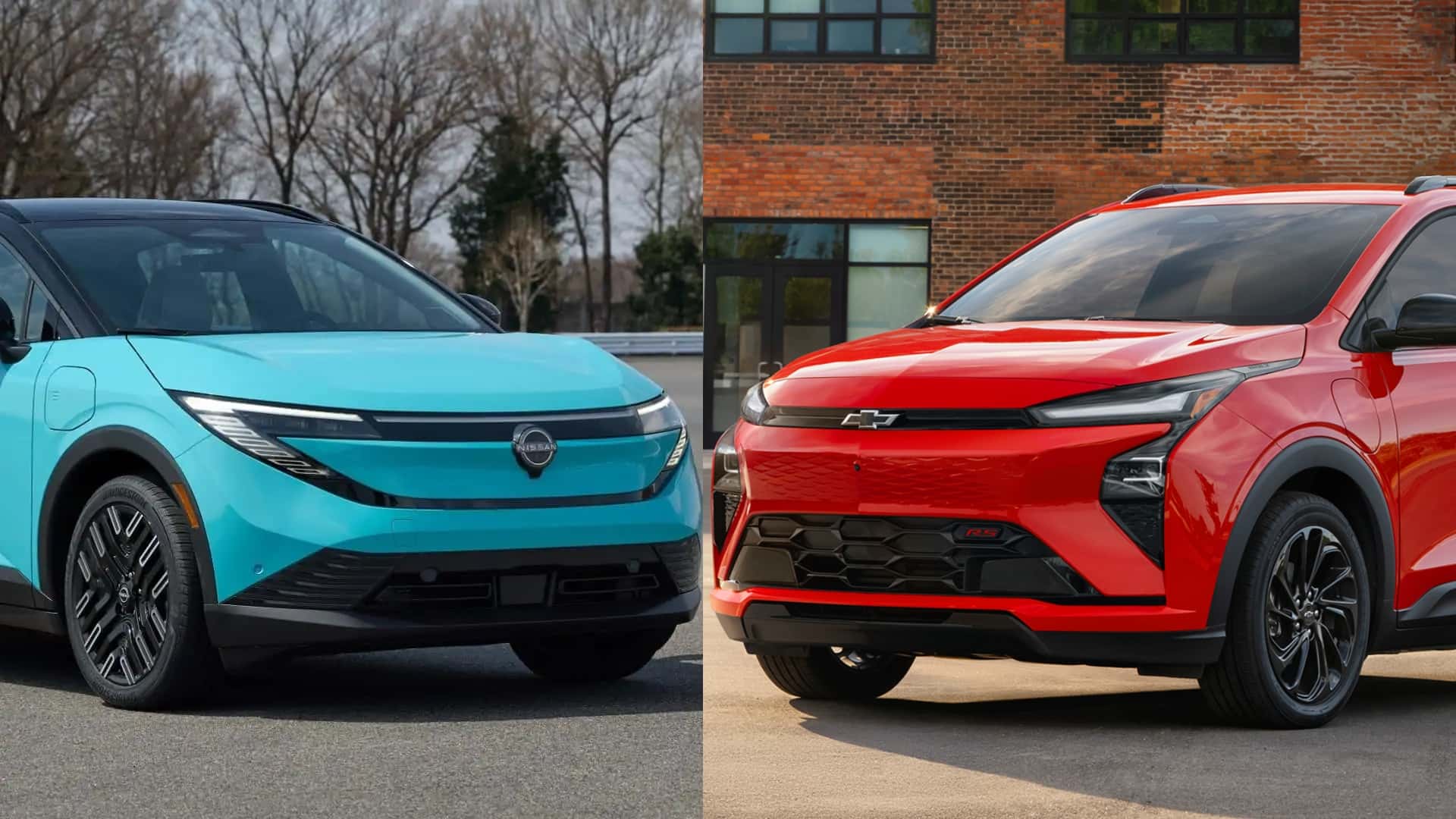
Chevy Bolt VS. Nissan Leaf: How America’s Cheapest EVs Stack Up
Here’s how America’s most affordable new EVs compare on paper. Spoiler alert: it’s closer than we thought.
The electric vehicle landscape is rapidly evolving, and for many consumers, the dream of affordable EV ownership is finally becoming a reality. Leading the charge in this segment are the highly anticipated 2027 Chevrolet Bolt and the all-new third-generation 2026 Nissan Leaf. Both models are poised to shake up the market with starting prices hovering around the $30,000 mark, significantly undercutting other EVs and making them the most accessible options for American buyers. This detailed comparison will help potential buyers navigate the key differences and similarities between these two compelling electric contenders.
Pricing and Availability: The Road to Affordability
Chevrolet is making a strong statement with the return of the Bolt, aiming to reclaim its title as America’s cheapest new EV. The 2027 Bolt is set to launch in early 2026 with a price tag of $29,990, including freight charges. A more accessible base LT model will follow shortly after, priced at an attractive $28,995.

Nissan isn’t far behind with its revitalized 2026 Leaf. The current base trim, the Leaf S+, is available now for $31,485. However, Nissan plans to introduce an even more budget-friendly ‘S’ variant featuring a smaller battery and reduced range. When it arrives, this S model is expected to dip below the Bolt’s starting price, making the competition even tighter.
Design Evolution: Fresh Looks and Under-the-Hood Upgrades
While both vehicles aim for affordability, their design philosophies diverge. The 2026 Nissan Leaf boasts a complete redesign, built on an entirely new platform. This comprehensive overhaul not only enhances its visual appeal but also contributes to improved driving range, increased power, and faster charging capabilities.
The 2027 Chevrolet Bolt, on the other hand, presents a more subtle evolution. Visually, it bears a strong resemblance to the discontinued Bolt EUV. However, Chevrolet has focused its efforts on significant internal upgrades. Key improvements include a new, more efficient battery, a more potent electric motor, and a refreshed interior, ensuring a more modern driving experience despite the familiar exterior.

Charging and Energy Features: Powering Up
A significant development for both models is the inclusion of the North American Charging Standard (NACS) port, aligning them with Tesla’s charging infrastructure and making them compatible with Superchargers without an adapter. However, owners will still need adapters for non-NACS charging stations.
The Nissan Leaf presents an interesting charging setup, featuring both a NACS port and a traditional J1772 port for Level 1 and Level 2 charging. The Chevrolet Bolt offers vehicle-to-home (V2H) capability, allowing it to power a house with the appropriate hardware. The Leaf counters with vehicle-to-load (V2L) functionality, enabling it to power external devices and appliances.
Both EVs offer a competitive peak DC fast-charging rate of 150 kilowatts, a substantial improvement over previous generations, though still not matching the fastest charging EVs on the market. For AC charging, the Bolt has a slight edge, accepting up to 11.5 kW compared to the Leaf’s 7.2 kW.
Range and Battery: Going the Distance
When it comes to driving range, the Nissan Leaf S+ takes the lead. Equipped with a 75-kWh lithium-ion battery, it offers an EPA-estimated range of 303 miles on a full charge. Nissan claims a 10% to 80% charge can be achieved in approximately 35 minutes.
The 2027 Chevrolet Bolt utilizes a smaller, 65 kWh lithium iron phosphate (LFP) battery, providing a GM-estimated range of 255 miles. Chevrolet estimates a faster 10% to 80% charge time of just 26 minutes. Notably, the Bolt includes a heat pump as standard, enhancing efficiency in colder climates, while the Leaf offers this feature only on its higher trim levels.
Performance: Adequate Power for Daily Commutes
Neither the Bolt nor the Leaf are designed for blistering speed, focusing instead on providing adequate power for everyday driving. Both are front-wheel-drive EVs. The Bolt’s motor delivers 210 horsepower, while the Leaf boasts a slightly higher 214 hp.
Torque figures show a more significant difference, with the Leaf offering a substantial 261 lb-ft compared to the Bolt’s 169 lb-ft. While official zero-to-60 mph times are not yet published, the Bolt’s lighter weight (3,776 pounds) compared to the Leaf (4,206 pounds in its base configuration) might help close the gap in acceleration.
Interior, Cargo, and Infotainment: Comfort and Connectivity
In terms of interior space and cargo capacity, both vehicles offer comparable dimensions. The Bolt provides slightly more passenger room, while the Leaf boasts a larger cargo area.
The new Chevrolet Bolt features an 11-inch digital instrument display and an 11.3-inch infotainment screen powered by Google Built-in, offering access to apps like Google Maps and Spotify. However, it notably lacks Apple CarPlay and Android Auto support.
The Nissan Leaf S+ comes with a dual-display setup, featuring a 12.3-inch instrument cluster and a 12.3-inch infotainment screen that supports wireless Apple CarPlay and Android Auto. Higher Leaf trims offer larger 14.3-inch screens and a Google-based system. For users heavily reliant on smartphone integration, the Leaf’s inclusion of Apple CarPlay and Android Auto could be a deciding factor.
Safety Technology: Advanced Driver Assistance
Both models come equipped with a comprehensive suite of standard safety features. The 2026 Nissan Leaf includes Nissan’s Safety Shield 360 suite, encompassing Automatic Emergency Braking with Pedestrian Detection, Rear Cross Traffic Alert, Lane Departure Prevention, Blind Spot Intervention, and Forward Collision Warning. It also features a 360-degree camera system and ProPILOT Assist for enhanced driver support.
The 2027 Chevrolet Bolt is outfitted with Adaptive Cruise Control, Front Pedestrian Braking, Lane Keep Assist with Lane Departure Warning, Side Bicyclist Alert, Intersection Automatic Emergency Braking, Blind Zone Steering Assist, and IntelliBeam auto high beams, providing a robust package of active safety technologies.
The Verdict: Two Strong Contenders in the Affordable EV Segment
The arrival of the 2027 Chevrolet Bolt and the 2026 Nissan Leaf marks a significant moment for the U.S. EV market, offering much-needed affordable options. While a full driving comparison is pending for the Bolt, early impressions suggest both vehicles are substantial improvements over their predecessors and represent excellent value.
The Nissan Leaf offers a compelling advantage in driving range and the convenience of Apple CarPlay. The Chevrolet Bolt, on the other hand, currently holds the edge in price and offers slightly more interior space for passengers. Ultimately, the choice between these two electric vehicles will likely come down to individual priorities and a test drive.
2027 Chevrolet Bolt vs. 2026 Nissan Leaf: Side-by-Side Comparison
| Feature | 2027 Chevrolet Bolt | 2026 Nissan Leaf |
|---|---|---|
| Starting Price (incl. freight) | $28,995 | $31,485 |
| Driving Range | 255 miles (GM-estimated) | 259 to 303 miles (EPA-estimated) |
| Battery Capacity | 65 kWh | 75 kWh |
| Max DC Fast Charging Power | 150 kW | 150 kW |
| Max AC Charging Power | 11.5 kW | 7.2 kW |
| 10-80% Fast Charging Time | 26 minutes | 35 minutes |
| Heat Pump | Standard | Standard (except entry-level) |
| Horsepower | 210 hp | 214 hp |
| Torque | 169 lb-ft | 261 lb-ft |
| Length | 169.6 in | 173.4 in |
| Width | 69.7 in | 71.3 in |
| Height | 63.9 in | 61.3 in |
| Wheelbase | 105.3 in | 105.9 in |
| Weight | 3,766 lbs | 4,206 to 4,393 lbs |
| Cargo Capacity (Seats Up) | 16.2 cu ft | 20 cu ft |
| Cargo Capacity (Seats Folded) | 56.3 cu ft | 55.5 cu ft |
| Front Headroom | 39.1 to 40 in | 39.9 in |
| Front Legroom | 44.3 in | 42.4 in |
| Rear Headroom | 37.8 in | 36.6 to 37.2 in |
| Rear Legroom | 39.1 in | 31.8 in |
Note: The cheapest versions of the Chevrolet Bolt and Nissan Leaf were not available at the time of this comparison and will be updated upon release.