
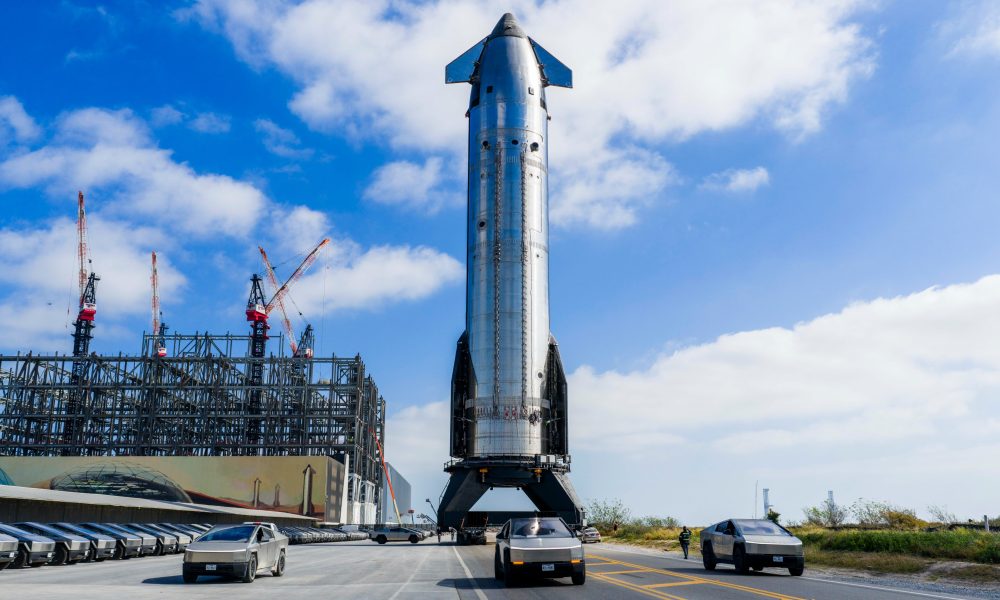
Elon Musk, the CEO of SpaceX, has provided a clear timeline for the company’s ambitious plan to catch a Starship upper stage using its launch tower. This strategic move is a significant step towards achieving full reusability for the company’s groundbreaking rocket system.
Ground Tests and Confidence in V3 Design
In a series of recent posts on the social media platform X, Musk confirmed that Starship V3 Ship 1 (SN1) is undergoing preparation for crucial ground tests. He expressed strong optimism regarding the updated design of the V3 vehicle.

“Starship V3 SN1 headed for ground tests. I am highly confident that the V3 design will achieve full reusability,” Musk stated, underscoring the advanced development of this latest iteration.
Phased Approach to Tower Catch
Musk further elaborated on the sequence of events leading up to the tower catch attempt. He clarified that SpaceX will not proceed with catching the Starship upper stage with the launch tower until specific safety milestones are met.
“Should note that SpaceX will only try to catch the ship with the tower after two perfect soft landings in the ocean. The risk of the ship breaking up over land needs to be very low,” Musk explained. This measured approach highlights SpaceX’s commitment to safety and risk mitigation.

A Major Step Towards Reusability
The ability to catch the Starship upper stage with its launch tower is considered a pivotal advancement in making the entire Starship system reusable. This capability is essential for SpaceX’s long-term vision of frequent launches for various missions, including supporting the Starlink satellite constellation, enabling lunar exploration, and ultimately, facilitating human missions to Mars.
Starship V3: Key Upgrades
SpaceX is currently targeting March 2026 for the first flight of the Starship V3. This new iteration represents a significant leap forward from previous versions, incorporating several critical upgrades designed to enhance performance and reliability.
A notable enhancement is the integration of SpaceX’s Raptor V3 engines. These engines are engineered to deliver substantially higher thrust compared to their predecessors, while simultaneously reducing manufacturing costs and overall vehicle weight. This optimization is crucial for increasing launch cadence and operational efficiency.
Furthermore, the V3 design places a strong emphasis on manufacturability. This focus is vital for SpaceX’s objective to scale up Starship production. Efficient and high-volume manufacturing is a prerequisite for meeting the demands of future space exploration and commercial ventures that rely on the Starship vehicle.
The development and testing of the Starship V3, coupled with the planned tower catch, signal SpaceX’s persistent drive to innovate and overcome the complex engineering challenges associated with fully reusable spaceflight.