
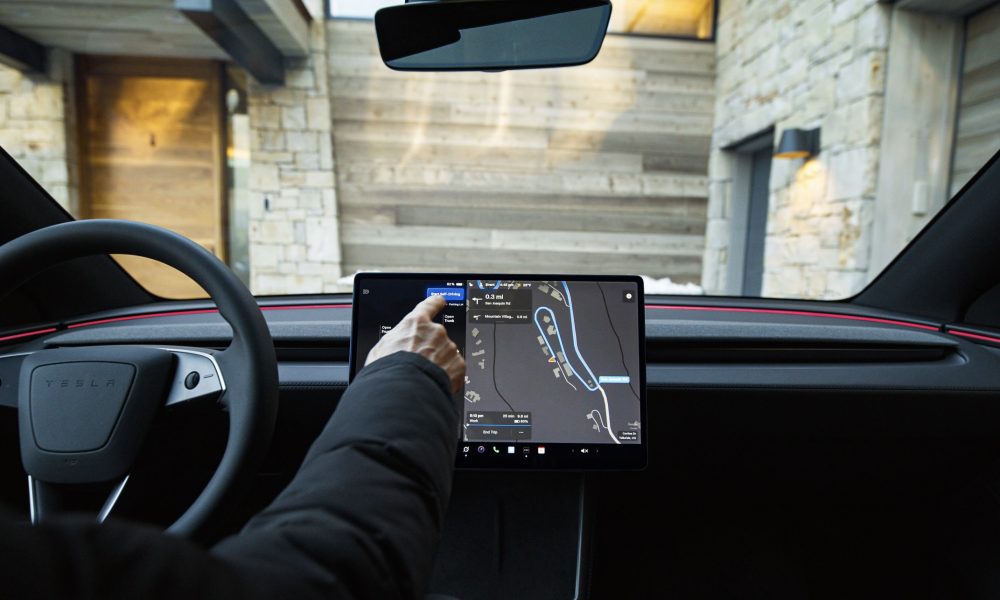
Tesla’s advanced driver-assistance system, Full Self-Driving (Supervised), has demonstrated a sophisticated ability to recognize and react to human hand signals, a feature recently brought to public attention by CEO Elon Musk.
Key Feature Highlighted by CEO
In a post on the social media platform X, Musk explicitly stated, “Tesla self-driving now recognizes hand signals.” This announcement underscores a subtle yet critical advancement in the system’s environmental perception and interaction capabilities.
The CEO’s remark followed a demonstration shared by Tesla Europe, which showcased a vehicle equipped with Full Self-Driving (Supervised) navigating a challenging, narrow lane in the Netherlands. During the maneuver, the vehicle appeared to acknowledge and respond appropriately to hand gestures from a person directing traffic.
Importance of Hand Signal Recognition in Driving
The ability to interpret hand signals is a significant development for any advanced driver-assistance system (ADAS) or autonomous driving technology. In diverse real-world driving scenarios, human intervention through gestures is commonplace.
Pedestrians, construction workers directing traffic, parking attendants, and even other drivers frequently use hand signals to communicate intentions such as yielding the right-of-way, indicating it’s safe to proceed, or managing flow in complex situations. For a self-driving system designed to operate safely in mixed environments alongside human road users, understanding these non-verbal cues is essential for seamless and secure operation.
Tesla’s FSD (Supervised) Milestones and Data
Elon Musk’s recent emphasis on this feature comes as Tesla owners collectively surpass a significant milestone: over 8 billion cumulative miles driven with FSD (Supervised) engaged.
The company itself shared this achievement on X, noting, “Tesla owners have now driven >8 billion miles on FSD Supervised.” This data reflects a dramatic increase in the utilization of the system over the past five years.
To illustrate the growth, annual FSD (Supervised) mileage has seen exponential increases: approximately 6 million miles were logged in 2021, followed by 80 million in 2022, a substantial leap to 670 million in 2023, and further acceleration to 2.25 billion miles in 2024. In 2025, Tesla owners accumulated 4.25 billion miles using the system.
The trend continues into the current year, with Tesla owners logging an additional 1 billion miles in just the first 50 days of 2026. Projections suggest that, at the current pace, the fleet is on track to accumulate approximately 10 billion FSD (Supervised) miles by the end of 2026.
Safety Data Comparison
In addition to usage statistics, Tesla also regularly publishes safety data. The company’s latest North America safety report, which covers a 12-month period across all road types, provides a comparative analysis of accident rates.
According to the data, vehicles operating with FSD (Supervised) engaged were involved in one major collision for every 5,300,676 miles driven. For context, the U.S. national average during the same period reported one major collision for every 660,164 miles.