
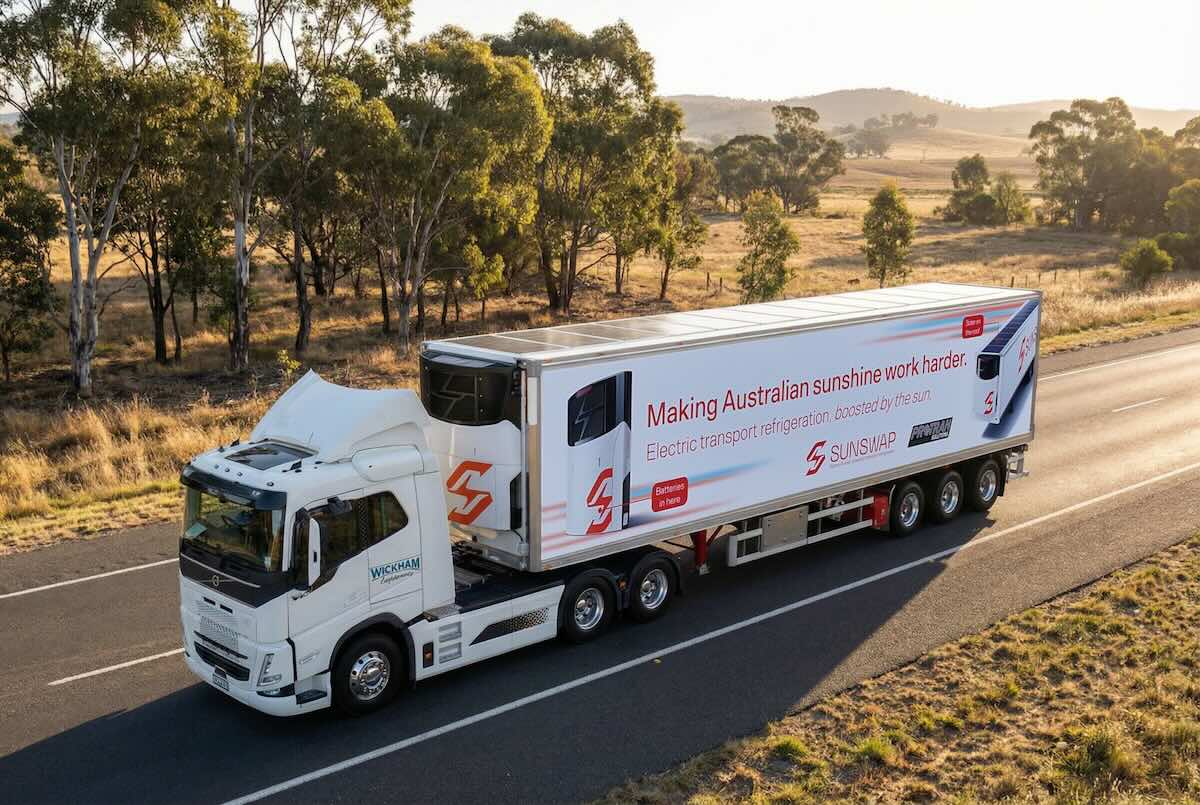
The electrification of long-distance trucking in Australia is gaining momentum, but significant challenges remain, including the development of extensive charging infrastructure and the gradual replacement of the existing prime mover fleet. The long lifespan and high cost of prime movers mean that older diesel models will continue to operate for many years, contributing to ongoing carbon emissions.
Addressing Emissions with Advanced Trailer Solutions
Fortunately, innovative trailer-based technologies are emerging to enhance the efficiency of freight transport. Refrigerated trailers, which typically rely on a secondary internal combustion engine to power their cooling units, are a particular focus for emission reduction. These systems can consume substantial amounts of diesel, especially in Australia’s warmer climate. Two distinct solutions are currently undergoing trials on Australian and New Zealand roads to tackle this issue.
Sunswap’s Endurance Trailer Utilizes Solar and Battery Power
One such innovation is the Endurance trailer, developed by UK-based Sunswap and being demonstrated by Protran in Australia. This system integrates a solar array on the trailer’s roof with an onboard battery to power the refrigeration unit. This approach significantly reduces or eliminates the need for a separate diesel engine.
In a recent extensive test covering an 11,671km round trip between Sydney and Brisbane, the Endurance trailer successfully maintained its target temperature for over 32 hours of continuous operation. The system drew 58.9 kWh from solar power and an additional 27 kWh from its battery. This trial resulted in a saving of 64 litres of diesel and a reduction of 172kg in CO₂ emissions. The design is intended as a straightforward, drop-in replacement for conventional refrigeration units, facilitating easy integration by trailer manufacturers like Protran.
VE Motion’s Dual-Axle Technology Offers Regenerative and Motive Power
Another significant player in addressing the costs and emissions associated with refrigerated transport is Australia’s own VE Motion. The company offers two key technologies adaptable for trailer applications.
The first is a regenerative energy axle, which functions similarly to a regenerative braking system in electric vehicles. This axle captures energy by converting the truck’s kinetic energy into electrical energy during deceleration. The second innovation is the motive power axle. This system can provide electric assist to the vehicle, delivering up to 295kW of power directly to the wheels in a manner that is imperceptible to the driver. These systems can be complemented by battery packs ranging from 200kWh to 600kWh capacity.
While the regenerative axle is currently available, the motive power axle requires modifications to comply with Australian Design Rules. VE Motion is actively conducting trials in Australia and New Zealand to validate its performance and to advocate for regulatory changes that would permit widespread adoption of this technology. The company projects that these technologies can achieve not only substantial diesel savings, potentially up to 50%, but also reduce wear and tear on traditional braking components, offering benefits similar to those experienced by battery-electric vehicle (BEV) drivers.
Trailer Technology as a Bridge to Full Electrification
While the ultimate goal remains the full electrification of the trucking fleet, these advanced trailer solutions represent a crucial transitional phase. This is particularly relevant for Australia, a nation characterized by its use of large configurations like Doubles and Road Trains. Traditional prime movers, often designed overseas for less demanding operational conditions, can be better supported by distributing power and integrating battery systems along the length of the trailer. This approach is vital for enabling the haulage of the substantial loads typical in the Australian trucking industry.
The integration of these trailer technologies not only addresses immediate efficiency gains and emission reductions but also prepares the ground for future, fully electric prime movers by familiarizing the industry with electric powertrains and energy management systems.