
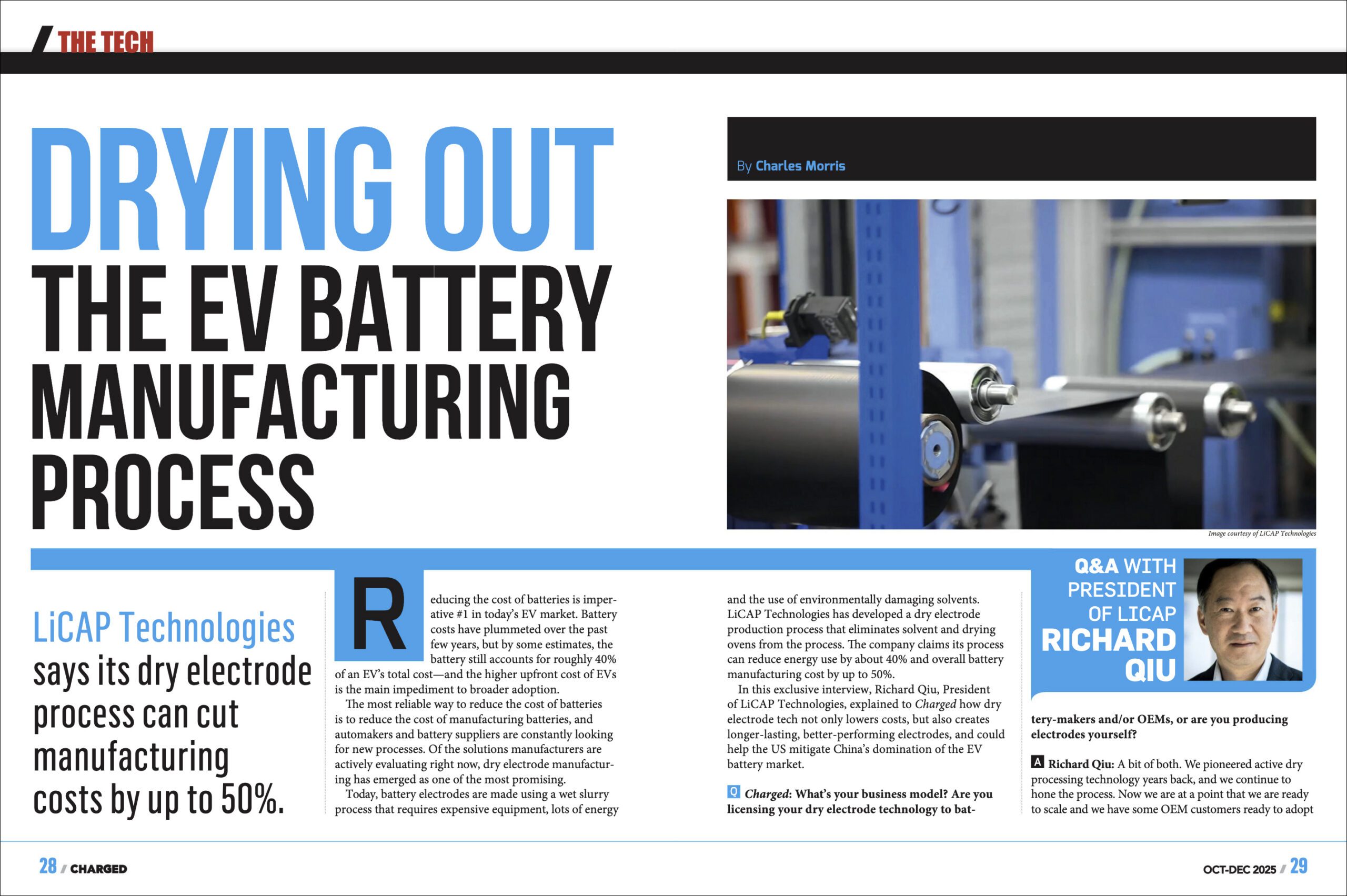
The electric vehicle (EV) market is poised for a significant transformation in its manufacturing processes, with a focus on drastically reducing battery costs. LiCAP Technologies has introduced a groundbreaking dry electrode manufacturing process that eliminates solvents and energy-intensive drying ovens, potentially slashing overall battery production costs by up to 50%.
Addressing the High Cost of EV Adoption
The upfront cost of electric vehicles remains a primary barrier to widespread consumer adoption. While battery prices have seen considerable declines in recent years, they still represent a substantial portion, estimated at around 40%, of an EV’s total price tag. Consequently, innovations aimed at lowering manufacturing expenses are critical for accelerating the EV revolution.

The Promise of Dry Electrode Manufacturing
Among the most promising solutions being actively explored by manufacturers is dry electrode manufacturing. This advanced technique offers a compelling alternative to the traditional wet slurry method, which is characterized by its reliance on expensive equipment, high energy consumption, and the use of environmentally detrimental solvents.
LiCAP Technologies’ proprietary dry electrode production process removes these traditional hurdles. The company asserts that its method can lead to approximately a 40% reduction in energy usage and a significant overall decrease in manufacturing costs. Richard Qiu, President of LiCAP Technologies, shared insights into how this innovation not only cuts costs but also enhances electrode performance and longevity, while potentially bolstering the US’s position in the global EV battery market currently dominated by China.
LiCAP Technologies’ Business Model: Licensing and Production
LiCAP Technologies is adopting a dual approach to market penetration. The company is primarily licensing its active dry processing technology and associated equipment to battery makers and original equipment manufacturers (OEMs). This licensing model is facilitated by partnerships, such as the one with Dürr, a major equipment manufacturer that will produce and install the necessary machinery for OEMs.

Recognizing the need for immediate product availability for piloting, testing, and ongoing innovation, LiCAP also maintains a small-scale manufacturing facility in Sacramento. This facility produces dry electrodes for OEMs prior to the full-scale installation of their large manufacturing lines.
Transforming the Traditional Wet Slurry Process
The conventional wet slurry process for battery electrode manufacturing typically involves five complex steps. LiCAP’s dry electrode process simplifies this significantly, reducing the number of steps to three. This streamlining not only cuts down process complexity but also substantially decreases the facility footprint required for installation.
The simplified three-step process begins with material mixing, focusing on formulation and incorporating the correct binders and active materials. The second step involves creating a freestanding film, followed by a final densification or calendering stage. This contrasts sharply with the wet process, where materials are mixed and processed sequentially.
A key advantage of producing a freestanding film is its ‘chemistry-agnostic’ nature. This flexibility allows for the production of various chemistries by focusing on formulation and ensuring consistent quality and thickness. Importantly, any waste generated from process irregularities or film edges can be 100% recycled, which is a significant benefit given the high cost and scarcity of battery raw materials, particularly in the US.
Customer Adoption and Production Timelines
LiCAP Technologies is actively engaged with OEMs on adopting its dry electrode technology. One notable partner is Cellforce, an affiliate of Porsche in Europe, which is integrating the technology into a new gigafactory for a high-performance car. This greenfield project is aimed at meeting stringent performance metrics while achieving cost savings.
Another significant collaboration is with Nissan in Japan, focused on developing next-generation all-solid-state EV batteries. This partnership, which has been ongoing for several years, recently expanded to jointly develop solid-state battery technology. Nissan has already established a portion of its plant and is working with LiCAP to refine the technology, with mass production targeted for 2028.
Qiu noted that the transition timeline differs between greenfield projects and retrofitting existing facilities. For new facilities, LiCAP’s technology reduces capital expenditure (CapEx) by approximately 50% compared to wet process installations. It also shrinks facility size by about 60% and incremental operational expenditure (OpEx) by 60-70%.
Eliminating the drying process, which accounts for about 60% of the electricity used in electrode manufacturing, significantly cuts energy consumption. While conversion projects for existing lines are in their early stages, new projects are further along, indicating a faster adoption rate for new builds.
Flexibility and Chemistry Agnosticism
The dry electrode process’s inherent flexibility makes it more adaptable than the wet process. Simplifying the manufacturing steps means fewer adjustments are required. LiCAP’s platform allows for easier adjustments in material mixing, binder incorporation, and film quality to accommodate different chemistries and achieve desired production speeds and thicknesses.
The company has successfully applied its technology to over half a dozen different chemistries for various OEM applications. This adaptability is crucial for clients like a major US energy storage enterprise that employs different chemistries, processes, and electrode thicknesses.
Advancing Solid-State Battery Technology
LiCAP’s work with Nissan on solid-state batteries is directly complementary to its production line innovations. Solid-state batteries, with their potential for faster charging and enhanced performance, require specialized manufacturing processes. LiCAP is positioned as a key player in overcoming the barriers to mass-producing these advanced batteries by 2028.
The development involves selecting the appropriate chemistry, integrating materials for optimal ionic connectivity, and establishing high-throughput manufacturing methods. This intensive, cross-functional effort underscores the complexity and potential of solid-state battery production.
Performance Enhancements and Sustainability Benefits
Beyond cost reduction and process simplification, LiCAP’s dry electrode process offers significant sustainability advantages by eliminating toxic solvents. The process allows materials to be stretched like fine fibers, leading to stronger binding and improved electrode density and ionic connectivity.
While the industry’s current focus is primarily on cost reduction, LiCAP acknowledges that its process also yields performance improvements, including higher energy density and power density. These benefits are achieved through a method that avoids the material degradation associated with solvent drying.
Superior Recycling Capabilities
The dry electrode process offers exceptional recycling capabilities. Unlike traditional methods where laminated materials complicate recycling, LiCAP’s freestanding film, prior to densification, acts much like raw material. This allows for near-total recycling of scrap material back into the feedstock, with efficiencies often cited at 98-99%.
Even trimmed film edges, a standard part of manufacturing to ensure precise width, can be immediately returned to the recycling stream. This contrasts with conventional processes, where recycling often requires additional complex equipment to strip away laminated layers.
Competitive Landscape and LiCAP’s Unique Position
The dry electrode manufacturing space includes competitors such as AM Batteries and Tesla, which has been investing in dry coating technology since acquiring Maxwell Technologies in 2019. LiCAP’s founding team was instrumental in Maxwell’s original dry electrode work for ultracapacitors.
Qiu believes LiCAP holds a competitive edge due to its integrated approach. While others might focus on the mechanical aspects of film production, LiCAP emphasizes the crucial integration of chemistry, materials, additives, and mixing processes. Their proprietary mixing technology is considered industry-leading.
LiCAP’s team comprises experts in material science, chemistry, and mechanical engineering, fostering a holistic, cross-functional development strategy. This integrated focus on all three critical areas—chemistry, materials, and equipment—sets LiCAP apart from competitors who may specialize in only one or two aspects.