
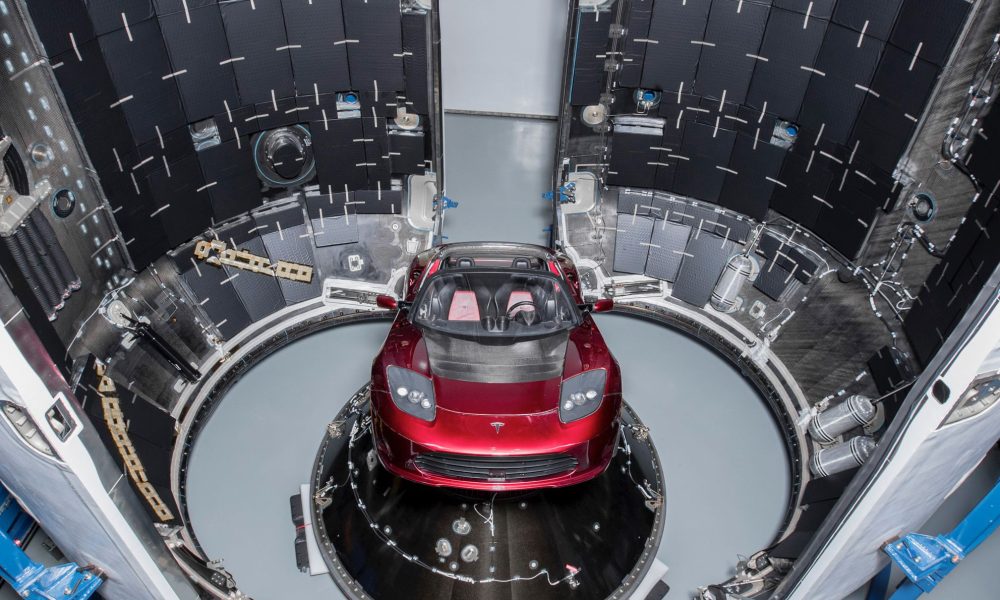
Seven years ago, SpaceX’s inaugural Falcon Heavy launch captivated the world not with a satellite, but with a cherry-red Tesla Roadster seemingly embarking on an interplanetary journey. More than just a spectacle, this mission, occurring in February 2018, served as a critical test for SpaceX’s most powerful rocket and occurred during a period of intense scrutiny for both the launch provider and its associated electric car company, Tesla.
A Bold Mission Amidst Corporate Challenges
In early 2018, Falcon Heavy’s feasibility was still a question mark for many, while Tesla was grappling with the significant production challenges of its Model 3, a period famously dubbed “production hell.” Tesla’s market valuation at the time was a modest $55-60 billion, a figure critics often deemed excessively high. SpaceX, conversely, was known for its audacious private ventures and willingness to undertake risks that more established aerospace firms shied away from.
The decision to launch the Falcon Heavy without a commercial or governmental payload, instead opting for Elon Musk’s personal Tesla Roadster accompanied by David Bowie’s “Space Oddity” playing on repeat, was a deliberate statement. While some perceived it as a mere stunt, for Musk and the SpaceX team, it represented a commitment to undertaking endeavors that could simply inspire wonder and ambition.
Transformative Growth for Tesla and SpaceX
The intervening seven years have seen dramatic transformations for both companies. Tesla has evolved into the world’s leading automaker by market capitalization, now valued at approximately $1.54 trillion. The Model Y has achieved remarkable sales success, becoming the best-selling car globally for three consecutive years. Furthermore, Tesla has advanced its autonomous driving technology, enabling its vehicles to navigate complex environments using only camera-based systems.
Beyond automotive applications, Tesla is increasingly involved in robotics and artificial intelligence. The Optimus humanoid robot program, which began as a concept, is now seen by Musk as a potential catalyst for building civilizations beyond Earth. This expansion signals Tesla’s evolution from a car manufacturer into a broader technology company at the nexus of AI, robotics, and advanced manufacturing.

SpaceX’s Dominance and Future Ambitions
SpaceX’s trajectory has been equally impressive. The Falcon 9 rocket has become the backbone of global launch operations, having successfully completed over 600 missions. Its boosters have achieved more than 560 successful landings, underscoring the reliability and reusability of the system. The Falcon 9’s operational tempo is unmatched, with launches occurring multiple times per week.
The company has demonstrably restored U.S. human spaceflight capabilities through its Crew Dragon spacecraft, which regularly transports astronauts to the International Space Station. It also played a crucial role in ensuring the safe return of NASA astronauts Butch Wilmore and Suni Williams when their mission required it.
Starlink, initially a debated concept, has rapidly become a dominant force in satellite communications, delivering broadband internet worldwide and revolutionizing space-based network deployment. SpaceX’s valuation has surged to approximately $1.25 trillion, with expectations high for what could be the largest initial public offering in history following its integration with xAI.
The Starship program, envisioned as a fully reusable launch system capable of interplanetary travel, has progressed from an aspirational idea in 2018 to an active development project with public flight tests. It is now integral to NASA’s future lunar exploration objectives.
A Symbolic Launch with Lasting Impact
Reflecting on the Falcon Heavy’s maiden flight carrying the Tesla Roadster, it becomes clear the mission was more than just placing a car in orbit. It served as a potent symbol of SpaceX’s and Tesla’s shared ethos: a willingness to embrace ambitious goals, accelerate innovation, and undertake risks that challenge conventional industry boundaries.
With the Roadster continuing its orbit around the Sun, the initial question of whether the mission would succeed has long been answered. The enduring question now is the extent of the future achievements these companies will reach, driven by a spirit of relentless innovation.