
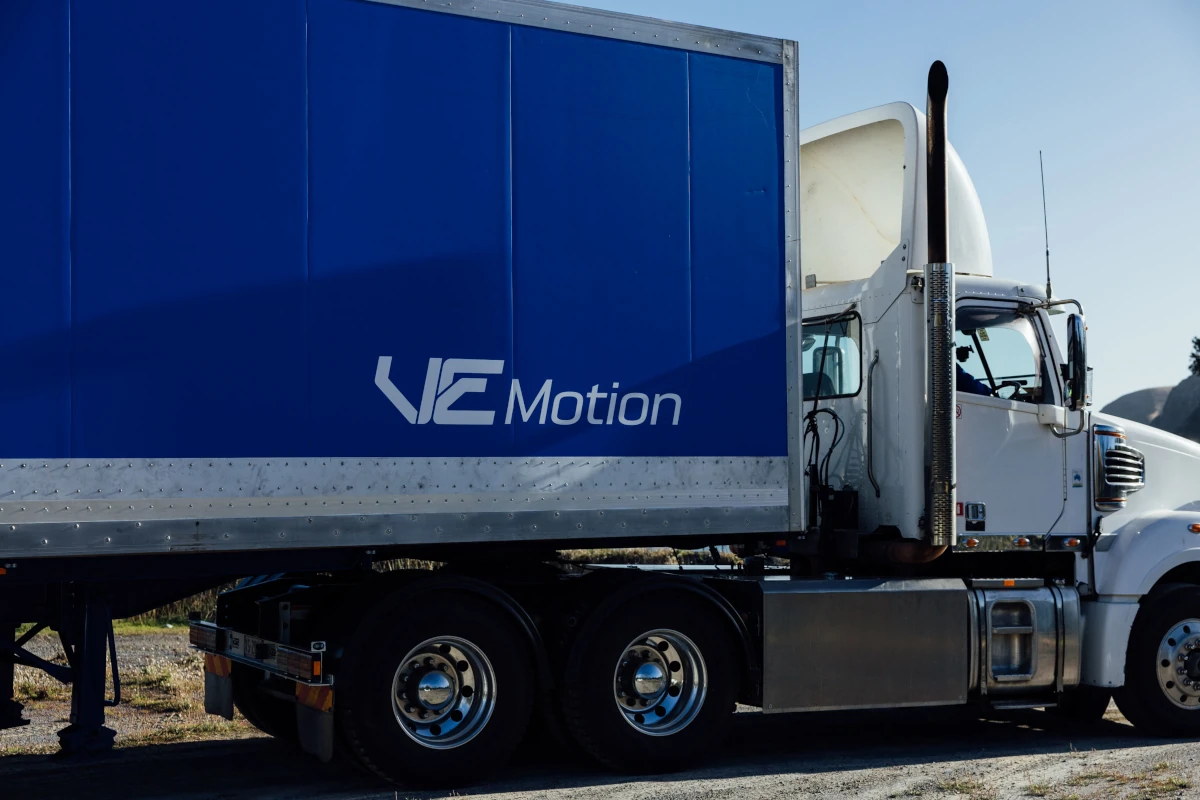
A South Australian company, VE Motion, has introduced Australia’s first commercially available powered trailer system for heavy transport, featuring a large battery pack integrated into the trailer itself. This innovative system aims to cut diesel consumption by up to 50 percent.
Revolutionizing Fuel Efficiency in Trucking
VE Motion’s Powered Trailer System is designed to significantly reduce fleet owners’ fuel costs through enhanced efficiency. It also promises to improve vehicle performance by providing propulsion assistance, enabling regenerative braking, and supplying onboard power for auxiliary systems such as pumps, blowers, and refrigeration units.
The trailer system, developed and engineered in South Australia, represents a significant investment of over $4 million in research and development since 2018. Production and assembly of the trailer systems are based in Murray Bridge, SA.
Addressing the Challenges of Full Electrification
VE Motion Co-founder and CEO Dean Panos highlighted the persistent reliance on diesel, Australia’s most expensive and highest-emission fuel, for nearly all heavy transport. “From our background in power generation, it was clear that electrification makes sense for heavy transport from an operating cost perspective,” Mr. Panos stated.
He further explained the limitations of full-electric trucks: “The problem is that full-electric trucks come with very high capital costs, added mass, range limitations and operational disruption. That is why uptake has been almost non-existent.” Mr. Panos identified powered trailers as a practical solution to these hurdles.

“They deliver real fuel savings, of up to 50% on diesel, more power and better efficiency, without forcing operators to replace fleets or change how they work. That is why we built VE Motion, to make that solution work for Australian conditions,” he added.
Cost-Effective and Scalable Solution
The initial offering, a base trailer kit equipped with a 200 kWh battery pack, starts at under $200,000. “This is roughly a quarter the price of a battery electric prime mover, while still providing half the benefits in terms of diesel savings and carbon emissions,” noted co-founder and CTO Stephen Bussenschutt.
Mr. Bussenschutt identified a substantial market opportunity in supplying trailer manufacturers, anticipating up to 10,000 trailers manufactured annually in Australia. He believes this segment presents a larger potential than that for electric prime movers.
Real-World Testing and Ideal Applications
The VE Motion Powered Trailer System has undergone successful demonstrations on South Australian roads. Current trials involving fleet owners across Australia and New Zealand are underway to refine the product based on extensive real-world testing.
The system is particularly suited for fleet operators with substantial depots featuring solar power installations or the capability for cost-effective grid charging. Long-haul freight operations between major hubs, where vehicles have sufficient downtime for recharging, are also ideal candidates.
System Mechanics and Components
Functionally, the system operates similarly to plug-in hybrid electric vehicles. Its electric motor assists propulsion and recovers energy through regenerative braking. In scenarios where the battery is depleted, trailers can revert to diesel-only operation.
VE Motion provides the system as a modular kit, adaptable for installation on both new and existing heavy-duty trailers by freight operators or trailer manufacturers. The integration process utilizes familiar components and procedures.
Key Components of the Powered Trailer System:
- e-Axle: Featuring a 295 kW Linamar electric drive unit, this component incorporates an electric motor, gearbox, and inverter, delivering approximately 400 horsepower for propulsion assist. It is rated for a Gross Axle Weight of up to 10 tonnes.
- Scalable Battery Packs: Mounted on custom brackets along the trailer chassis, these packs are available in 200 kWh, 400 kWh, and 600 kWh capacities, offering reduced diesel consumption ranges of approximately 200 km, 400 km, and 600 km, respectively. The batteries, utilizing lithium iron phosphate (LFP) chemistry, are sourced from CATL.
- Charging Infrastructure: The system supports DC charging via a standard CCS2 plug at speeds of 120-180 kW. An integrated 25 kW AC charger allows for charging at speeds up to 22 kW from a standard 3-phase outlet, offering a more economical charging option for trailers that idle for extended periods.
The onboard charger also supports Vehicle-to-Load (V2L) and Vehicle-to-Grid (V2G) capabilities, functionalities that Mr. Bussenschutt indicated will be implemented in later stages, potentially creating new revenue streams for fleet operators.
Integrated Control and Safety Features
Embedded control and safety systems include a battery management system, safety contactor box, power distribution unit, and vehicle control unit. A 7-inch touchscreen interface in the prime mover’s cabin allows drivers to adjust regeneration and propulsion assist settings.
Projected Savings and Environmental Impact
VE Motion projects that its system can reduce diesel consumption by up to 50%, resulting in an annual offset of 80 to 300 tonnes of carbon emissions per vehicle. This translates to potential annual savings of $50,000 to $200,000, or up to 125,000 litres of diesel.
The hybrid system also contributes to lower maintenance costs and a reduced total cost of ownership by decreasing wear on the truck’s engine, brakes, and retarder. Additional benefits include reduced noise pollution and fewer tailpipe emissions, improving conditions for drivers and communities along transport routes.
Performance Enhancements and Future Testing
The system is expected to enhance truck performance, offering improved acceleration, hill climbing, gradability, and startability. These improvements are particularly beneficial for heavy road trains that often face performance limitations.
VE Motion is scheduled to conduct further system tests with road trains next week as part of an industry showcase event in Rapid Bay, SA.