
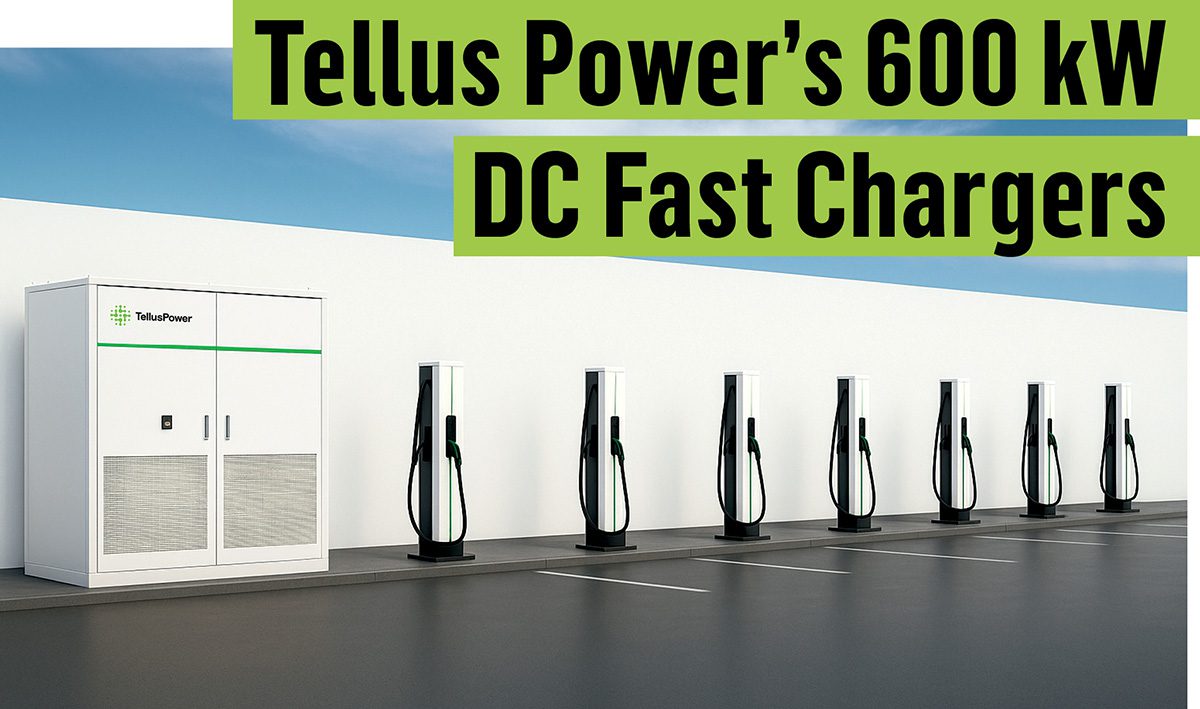
In the rapidly evolving electric vehicle (EV) charging landscape, Tellus Power is making a significant impact with its latest 600 kW DC fast charger systems. The company is focusing on delivering current customer needs while architecting for future scalability, addressing key industry challenges in deployment and user experience.
Navigating the EV Charging Evolution
The electric vehicle fast charging sector is experiencing unprecedented growth, marked by a proliferation of charging stations and an increasing number of charging points. Simultaneously, technical innovations are accelerating, leading to diverse approaches among operators and hardware manufacturers regarding cost-effective and user-friendly scaling solutions.
A central debate revolves around whether standalone chargers, integrating user interface and power supply into a single unit, or distributed systems, employing a central power source with satellite dispensers, represent the optimal path forward for large-scale deployments and broader coverage.
User interface improvements are also a critical focus, with a shared desire to move beyond fragmented and poorly designed proprietary apps. Questions remain about the efficacy of credit card readers, mandated in some regions, versus anachronistic devices prone to failure, and the pace of Plug & Charge implementation.
Tellus Power’s Dual-Approach Strategy
Tellus Power aims to address these industry challenges with its new line of 600 kW DC fast chargers, offered in two distinct configurations: a distributed system and an all-in-one unit. Both systems are engineered to support 800-volt architecture and offer broad compatibility, supporting NACS, CCS1, and CCS2 charging standards.

Mike Calise, CEO of Tellus Power since early 2025, discussed the company’s vision and product strategy with Charged.
Company Overview and Mission
Tellus Power specializes in the manufacturing of DC fast chargers and vehicle-to-grid (V2G) hardware. The company also provides essential software and energy storage products vital for grid-friendly infrastructure.
“We are in a record time for DC fast charging deployments. The opportunities are exceptional,” Calise stated.
With roots in Shanghai, Tellus Power benefits from world-class, low-cost global manufacturing capabilities. Its U.S. headquarters in Irvine, California, also serves as a manufacturing hub for DC fast chargers, adhering to the Build America, Buy America provisions with 55% U.S. content for products destined for the American market. The company also maintains offices in India, Europe, South America, and Southeast Asia.
Tellus Power observes significant opportunities driven by the electrification needs of ride-sharing services like Uber and Lyft, the growth of last-mile delivery fleets, and the emergence of medium- and heavy-duty electric trucks. The company’s ambition is clear: to establish itself among the top three players in all its target markets.
Distributed vs. Standalone Chargers: A Strategic Choice
The conversation around the future of EV charging often highlights distributed systems as the preferred model. However, Tellus Power acknowledges the practical advantages and continued demand for standalone, all-in-one units.
“I love the question, and they are correct to say that distributed charging is the future,” Calise remarked. “Well, it was the early present too. Think about Tesla. Tesla was such a streamlined experience. You show up, you plug in and you walk away.”
The challenge for the broader market, particularly in regions like North America with the CCS1 standard, is the necessity to accommodate a wider range of user preferences and regulatory requirements. This includes the integration of credit card readers and interactive displays.
“But we as a nation went with CCS1, so you have to meet the needs of every EV owner. You need to put a credit card reader on there. Obviously, you need a display to interact. We needed to put those units in to meet a large cross-section of the population’s different driving habits,” Calise explained.
Standalone units offer distinct practical benefits. “Sometimes bigger is better. If you can physically see a unit that’s lit up, you can clearly see where you can get your charge,” Calise noted. The integration of all necessary components—power supply, DC and AC connections, rectification, and cables—within a single, relatively compact cabinet simplifies installation and maintenance. “Everything is there—the power, the DC, the AC, the rectification, the cable,” he added.
Despite the advantages of integrated units, Calise confirmed that Tellus Power continues to see strong sales for them. However, he reiterated the belief that distributed charging represents the future.
“Is distributed charging the future? We believe it is. Why? Because ideally, everybody is feeling that Tesla experience. You show up, there’s a little pedestal, you plug it in, you walk away,” Calise elaborated. This seamless experience, facilitated by technologies like Plug & Charge, eliminates the need for complex user interactions with displays or credit card readers.
Comparing this to legacy computing, Calise suggested that the current all-in-one chargers are akin to mainframes, while the future lies in distributed processing, with intelligence increasingly residing in the cloud or the vehicle itself, as seen with Plug & Charge.
The appeal of smaller, distributed pedestals lies in reduced points of failure. “A lot of the downtime in these units is not charge-related, it’s display-related, it’s modem-related, it’s credit card-related,” Calise pointed out. “The charging isn’t the problem. Every now and then you’ve got to repair it, sure. But the things that fail are those human interface things—displays, buttons.”
Advantages of Distributed Architecture
The distributed system offers significant cost and efficiency advantages. By distributing power over a DC bus, it bypasses multiple AC-to-DC conversion steps common in other architectures.
“When we distribute to pedestals, all of that is DC, so the cost of installation goes down dramatically,” Calise explained. This approach centralizes the more complex power conversion equipment, such as AC-to-DC modules, in a less aesthetically sensitive, back-fence location, reducing costs.
Maintenance is also streamlined. If a pedestal unit fails, individual modules can be replaced within the central cabinet, which houses the bulk of the power conversion hardware. This modularity enhances reliability and simplifies repairs.
Addressing Payment Challenges and Plug & Charge
The discussion then turned to the controversial requirement for credit card readers at charging stations.
“We appreciate the well-intended nature of California’s requirement for credit card readers, but actually the credit card readers are a mess. They weren’t designed for abusive outdoor use,” Calise stated.
While mandated in some jurisdictions to ensure accessibility for all consumers, including those without smartphones or specific apps, Calise argued that cell phone penetration is nearly universal, making app-based or digital payment methods more equitable and reliable.
He highlighted the unreliability of credit card readers and associated components in harsh outdoor environments. “The credit card readers, the modems, the SIM cards and the connectivity and the displays, they take a beating in the wild. They weren’t designed for abusive outdoor use,” he said. Calise also noted that California appeared to be reconsidering its mandate.
Plug & Charge technology offers a more elegant solution, eliminating the need for physical payment interfaces altogether. “With Plug & Charge, you don’t even need a credit card, an app or a cell phone. You just plug in, and your car does it all,” Calise confirmed, clarifying that a pre-existing payment account, such as a credit card or bank account, is still required for authentication.
Regarding the widespread adoption of Plug & Charge, Calise expressed optimism. “The Plug & Charge concept and the 15118 standard have been around for several years. It’s not that far out. It’s being used daily today,” he indicated.
The Promise of Vehicle-to-Grid (V2G) Technology
Vehicle-to-Grid (V2G) technology is transitioning from a theoretical concept to practical application, with Tellus Power actively involved in pioneering projects.
“There are some real useful projects going on today, so it’s no longer pilots only,” Calise reported. He cited the example of the Oakland and Fremont Unified School Districts, which are utilizing V2G-capable electric school buses integrated with battery storage systems for both building power and stationary storage.
“V2G is a complete transformation for the school districts and a positive impact to their communities. It’s a killer application,” Calise enthused.
These school districts faced significant operational costs due to expensive petroleum fuel and high utility bills, often operating at a deficit. By implementing V2G projects, which include solar canopies for on-site energy generation, the districts have seen a dramatic reduction in overall utility and fuel expenses, enabling them to operate profitably.
The model involves charging the electric buses overnight during off-peak hours when energy is cheapest, and then discharging the bus batteries to power school buildings during peak demand periods, thereby lowering electricity costs and potentially earning revenue.
Calise emphasized that this V2G model represents a scalable solution applicable to numerous public school districts nationwide.
Scaling V2G Deployments
The successful implementation of V2G projects requires collaboration among multiple stakeholders, including utilities, technology providers like Tellus Power, and fleet operators.
“You need a lot of stakeholders. You need the utility—they’re critical because they’re going to transact the deal. You need a technology provider like Tellus Power. You need the bus company to say, we’re okay to run these batteries back and forth all day long, not just one way,” Calise explained. When these elements align, V2G becomes feasible.
While school buses represent an ideal application due to predictable routes and schedules, Calise noted that transit buses and last-mile delivery vehicles with fixed routes also present significant V2G opportunities. The ability to manage charging and discharging based on known solar generation patterns and utility time-of-use rates allows for mitigation of demand charges and exploitation of dynamic pricing.
Calise believes that V2G technology is poised for significant growth, requiring what he termed “escape velocity” within the next three years. He acknowledged that government grants often facilitate these initial investments due to the high cost of electric buses, but stressed that the technology is well beyond the lab testing phase.
Industry Consolidation and Differentiation
The EV charging sector has seen considerable churn, with many companies failing since the early days of the industry.
“Well, there’s already been a shakeout. There’s been failed companies since 2010,” Calise observed. “Littered on the highway, there’s probably 100 companies with chargers out there. I can name at least 20 that were around in the early days that looked incredibly promising but failed dramatically.”
Calise highlighted the importance of choosing suppliers with a proven track record. “So, who are you going to deal with? The company that still survived after all these years, or the company that’s gone?” he asked rhetorically.
Tellus Power differentiates itself through its deep industry experience and adaptability. “As any experienced CEO will tell you, we get tailwinds and headwinds. Just like in sailboat racing. That’s what makes Tellus Power different—we know how to sail in both headwinds and tailwinds,” Calise stated. This involves strategic adjustments, such as optimizing sail configurations or reducing load, to navigate market dynamics effectively.
He emphasized that future success in the charging market will depend not only on technological innovation but also on flexible business models. This includes exploring revenue sharing, leasing options, and novel payment structures related to energy tokenization and transferability.
“The companies that will succeed are the ones that continue to innovate through an evolving new market, but sometimes innovation isn’t necessarily technology—it’s also the business model,” Calise explained. He also pointed to the potential for revenue generation in services, logistics, software, and energy management, beyond just hardware sales.
Future Innovations in Charging Technology
Looking ahead, Calise anticipates significant advancements in charging infrastructure efficiency and grid integration.
“What we’re going to see are efficiency plays within a microgrid,” he said. The growing demand from data centers and AI is shifting the energy landscape, necessitating new approaches to energy production and consumption.
Innovations in transformer technology, particularly those utilizing intelligent high-switch capability and silicon carbide, are expected to enhance grid efficiency. “We’re seeing new innovations in transformer technology using intelligent high-switch capability. It’s going to be very important for overall grid efficiency,” Calise noted.
He also foresees a reduction in the number of power conversion systems. As battery and renewable energy sources are inherently DC, and the grid is AC, multiple conversions occur. Future systems aim to streamline these processes, potentially eliminating internal transformers and creating highly efficient microgrids with improved energy transfer rates, possibly reaching 94-97% efficiency compared to current 91-92%.
Regarding battery technology, Calise suggested that radical breakthroughs for ultra-fast charging might not be necessary. Instead, incremental improvements in battery chemistry and manufacturing costs are driving down prices, with the expectation that battery pack costs will continue to fall to around $80/kWh.
At this price point, the cost of producing an EV could fall below $20,000, making affordable commuter vehicles widely accessible. Combined with innovative business models like vehicle leasing, the EV market is poised for significant transformation in the coming years. Calise believes that advancements at the silicon level will be key drivers in delivering these cost-effective EV solutions.
This article first appeared in Issue 74 – Subscribe now.