
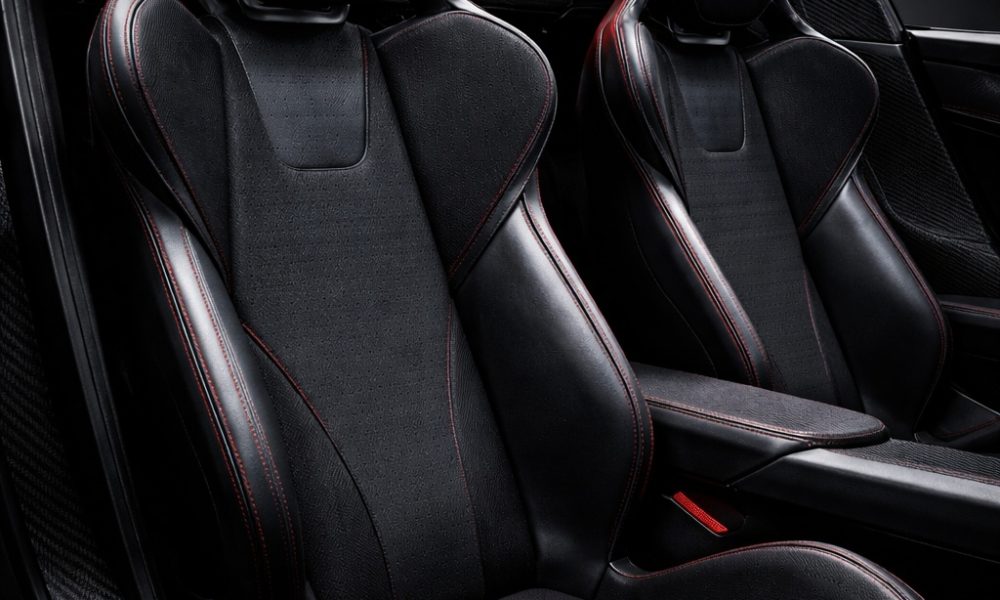
Revolutionary Seat Design Patented for Next-Generation Tesla Roadster
A recently published patent filing from Tesla is providing significant insight into the highly anticipated next-generation Roadster, with a novel vehicle seat system potentially hinting at the production model’s imminent arrival.
Monolithic Seat Structure: A Manufacturing Leap
Patent No. US 20260061898 A1, officially published on March 5, 2026, details a groundbreaking ‘vehicle seat system.’ This design moves away from the traditional automotive seat construction, which typically involves numerous metal brackets, complex recliner mechanisms, and many individual fasteners.

Instead, Tesla’s proposed design centers on a single, continuous composite frame. This ‘monolithic structure,’ as described, integrates the seat portion, backrest, headrest, and side bolsters into one unified, thermoformed piece. This approach aligns with Tesla’s established manufacturing ethos of simplifying production through component consolidation.
The company has previously demonstrated this philosophy with its use of massive aluminum castings in vehicle bodies, which significantly reduces the number of separate parts required. Applying this logic to interior components like seats promises fewer potential failure points, reduced weight, and a more streamlined assembly process.
Strategic Timing and Production Indicators
The timing of this patent publication is particularly noteworthy. Elon Musk has publicly slated April 1, 2026, for an “unforgettable” reveal of the Roadster’s design. This is further corroborated by the filing of two new Roadster trademarks in the preceding month. The patent for a unique seat architecture suitable for a hypercar, one that Tesla aims to make capable of accelerating from 0 to 60 mph in under two seconds, strongly suggests development is progressing towards production.
The Tesla Roadster, initially showcased in 2017, has faced significant delays. Positioned as a flagship vehicle with an estimated price point around $200,000, it is intended to be the ultimate demonstration of Tesla’s technological capabilities.
The patent was initially brought to attention by the user @seti_park on the social media platform X.
Key Innovations in the Tesla Roadster Seat Patent
The patent outlines several key features of this advanced seat system:
1. Single Continuous Frame (Monolithic Construction)
The foundational aspect of the invention is a seat built from a single, continuous frame. This eliminates the need for separate structural components and mechanical joints commonly found in conventional seats, integrating the seat, backrest, and a unique hinge into one piece.
2. Integrated Flexible Hinge
Departing from mechanical recliner systems, the patent describes a hinge integrated directly into the continuous frame. This hinge is designed to flex, allowing the backrest to adjust its position relative to the seat base. It can be implemented using fiber composite leaf springs or a system of interlocking rigid linkages.
3. Thermoformed Anisotropic Composite Material
The continuous frame is engineered to be manufactured through thermoforming using anisotropic composite materials. This includes materials such as fiberglass-nylon, fiberglass-polymer, nylon carbon composite, Kevlar-nylon, or Kevlar-polymer composites, enabling the creation of a molded, single-piece structure.
4. Regionally Tuned Stiffness Zones
The design allows for up to six distinct stiffness zones within the frame, covering the seat, backrest, hinge, headrest, and bolsters. This feature enables precise ergonomic and structural tuning without the addition of separate components, allowing for customized support and feel in different areas of the seat.
5. Linkage Assembly Hinge Mechanism
An alternative hinge mechanism utilizes linkage assemblies. These consist of interlocking links and gears connected by rods, which can be actuated by motors. When activated, these linkages function as a flexible member to precisely control the backrest’s movement along an ergonomically optimized trajectory.
6. Multi-Actuator Six-Degree-of-Freedom Positioning System
The seat incorporates four distinct pairs of actuators, all managed by a central controller. These actuators work in concert to provide simultaneous adjustments for fore/aft position, height, cushion tilt, and backrest rotation, offering extensive customization for occupant comfort.
7. ECU-Based Controller Architecture
An Electronic Control Unit (ECU) acts as the central controller for all seat actuators. It interfaces with user inputs—whether from a touchscreen, buttons, or switches—and utilizes sensor feedback to confirm and maintain precise seat positions. This establishes the seat as an integrated, software-driven system.
8. Airbag-Integrated Bolster Deployment System
The backrest bolsters are specifically designed to guide airbag deployment along a predetermined path. The left and right bolsters can feature different geometries, ensuring each airbag deploys along a distinct trajectory for optimized occupant safety.
9. Ventilation Holes Formed into the Backrest
The continuous frame design includes integrated ventilation holes within the backrest. These are configured to manage airflow, either drawing air in or expelling it, enabling passive or active climate control within the seat without the need for separate ventilation components.
10. Soft Trim Recess for Tool-Free Integration
The headrest and backrest sections are molded with a recess designed to easily accommodate and secure soft trim materials, such as foam and fabric cushioning. This feature simplifies the final assembly process by eliminating the need for separate attachment hardware for the seat’s upholstery.
This innovative seat design for the Tesla Roadster underscores the company’s commitment to pushing the boundaries of automotive engineering and manufacturing efficiency.