
Tesla Produces First Steering-Free, Pedal-Less Cybercab Robotaxi
Tesla has officially produced its first two-seater Robotaxi, dubbed the Cybercab, at its Gigafactory in Texas. This significant milestone for autonomous vehicle technology marks a departure from traditional vehicle design, as the Cybercab notably lacks a steering wheel and pedals.
Giga Texas Welcomes First Production Cybercab
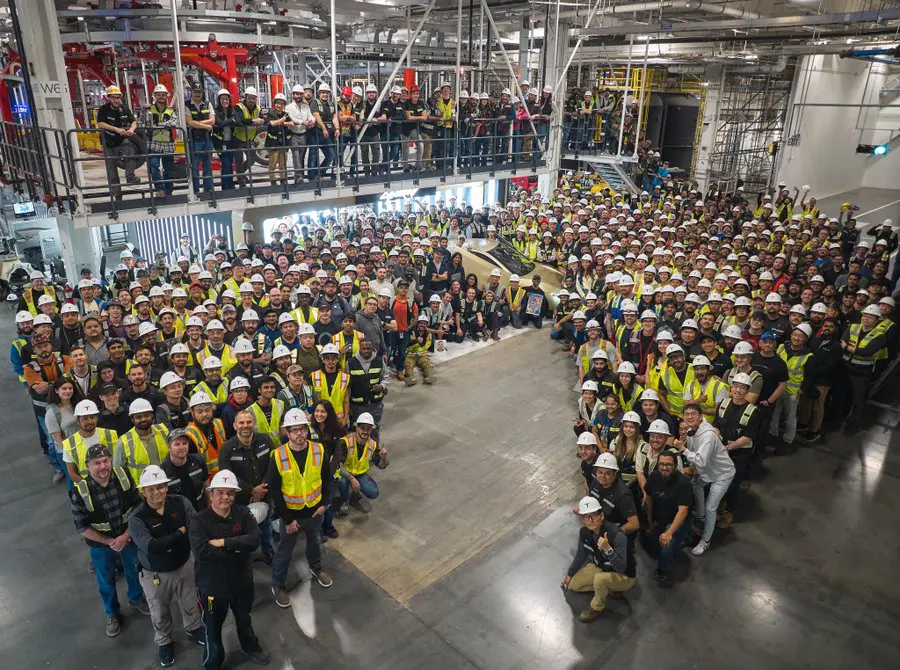
A photograph shared by Tesla on the social media platform X shows a striking gold Cybercab positioned at the end of what appears to be a final inspection and testing tunnel at the Giga Texas facility. The image captures the vehicle with its distinctive scissor doors open, emphasizing its unique two-seater configuration and its readiness for the next phase of development.
The production line scene also reveals Tesla’s engineering, manufacturing, and assembly teams on a mezzanine level above the vehicle, underscoring the collaborative effort behind this advanced project. The presence of these team members highlights the human element involved in bringing this cutting-edge autonomous vehicle to life.
The official announcement was accompanied by a post on Tesla’s X account, stating: “First Cybercab off the production line at Giga Texas.” The image accompanying the post provided a clear view of the vehicle and the celebratory atmosphere at the factory.
First Cybercab off the production line at Giga Texas pic.twitter.com/kY8vCqtrCA
Also Read— Tesla (@Tesla) February 17, 2026

From Concept to Production Line: The Cybercab Journey
Tesla first unveiled the Cybercab at its exclusive, invitation-only “We, Robot” event held in late 2024. During this event, attendees experienced hundreds of fully autonomous test rides using both the Cybercab and Model Y Robotaxis. These demonstrations took place on closed roads within the Warner Bros. studios lot in California, offering a controlled environment to showcase the vehicle’s capabilities.
Since its initial reveal, the golden Cybercab has been sighted on multiple occasions. These sightings have occurred at various locations, including Tesla’s test track near Fremont, California, on public roads, and within Tesla showrooms across the United States. The vehicle also embarked on a promotional tour across six European cities: Paris, London, Berlin, Stockholm, Oslo, and Amsterdam, generating significant international interest.
Affordability and Efficiency: Key Cybercab Attributes
The Cybercab is anticipated to be priced at approximately $A45,000, positioning it as a competitive offering in the self-driving robotaxi market. Beyond its autonomous capabilities, the vehicle is designed with practical considerations, featuring ample boot space and a significantly reduced number of interior components compared to Tesla’s conventional passenger vehicles.
Elaborating on its design efficiency, a lead Tesla engineer previously indicated that the Cybercab is expected to incorporate approximately 50% fewer parts than the Model 3. This reduction in complexity is a strategic move designed to lower manufacturing costs and facilitate scalability, allowing Tesla to compete more effectively against specialized autonomous driving vehicles from companies like Waymo.
Production Ramp-Up and Competitive Landscape
Official confirmation for the Cybercab’s production start date was provided during Tesla’s fourth-quarter shareholder meeting last month, with the company expecting to commence production of the unique two-seater vehicle in April 2026.
With the first production unit now off the line, Tesla is projected to implement a gradual ramp-up strategy for the Cybercab. This measured approach is attributed to the innovative manufacturing and assembly methods being deployed at scale, a process referred to as the “unboxed assembly” method.
Tesla CEO Elon Musk recently reinforced this production strategy in a post on X, stating: “It’s an all-new product and radical redesign of car manufacturing to achieve ~5X higher production rate, which means the output S-curve will be very slow in the beginning, but ultimately super high volume.” This suggests that while initial production volumes may be modest, the long-term outlook aims for substantial output.
It’s an all-new product and radical redesign of car manufacturing to achieve ~5X higher production rate, which means the output S-curve will be very slow in the beginning, but ultimately super high volume
— Elon Musk (@elonmusk) February 16, 2026
As production scales up in the upcoming months, the deployment speed of these early Cybercab units onto Tesla’s Robotaxi network in the US will be closely watched. The competitive landscape for autonomous ride-hailing services is intensifying, with companies like Waymo actively expanding their services internationally in 2026 and beyond, making Tesla’s progress in this sector a key point of interest.
About the author: Riz Akhtar is the founder of carloop, based in Melbourne. He specializes in Australian EV data, insights, and trends. With a background as a mechanical engineer focused on transport infrastructure, Akhtar has a passion for electric vehicles and aims to contribute to reducing transport emissions in Australia. He currently drives a red Tesla Model 3.