
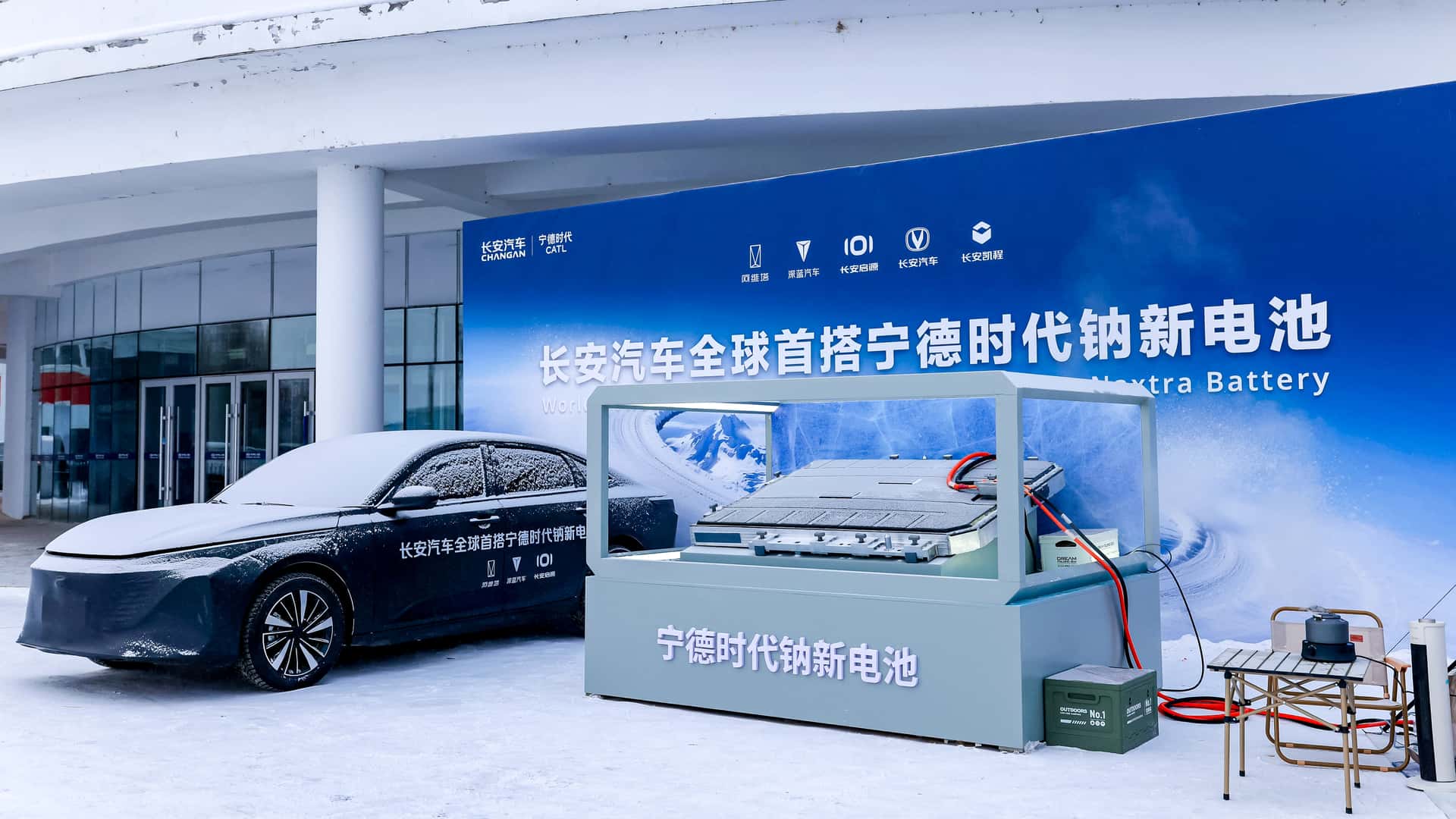
A groundbreaking development in electric vehicle technology is set to hit the public roads. China’s battery giant CATL, in collaboration with automaker Changan Automobile, is preparing to launch the world’s first mass-produced passenger car powered by sodium-ion batteries by mid-2026. This advancement signifies a major shift, potentially enhancing EV safety and performance in extreme climates.
A New Era for EV Batteries
The Changan Nevo A06 sedan will be the inaugural vehicle to feature CATL’s Naxtra sodium-ion battery. This battery technology is expected to offer an estimated range of approximately 400 kilometers (about 249 miles) on the China Light-Duty Test Cycle (CLTC). Following this debut, the sodium-ion battery technology will be expanded across Changan’s diverse portfolio, including models from its Avatr, Deepal, Qiyuan, and Uni brands.
Addressing Key Concerns with Sodium-Ion Technology
CATL has stated that this launch marks the commencement of a “dual chemistry era,” where sodium-ion and lithium-ion batteries will work in tandem to cater to a wide spectrum of consumer requirements. This development is particularly significant as sodium-ion batteries are emerging as a compelling alternative to lithium-iron phosphate (LFP) batteries, which currently hold a dominant position in China’s EV market. Research indicates that sodium-ion batteries pose no risk of thermal runaway and demonstrate considerably less sensitivity to extreme temperatures. Furthermore, sodium is more abundant and substantially less expensive than lithium.
Performance and Future Potential
While the Naxtra battery’s energy density of 175 watt-hours per kilogram is competitive, comparable to LFP batteries and lower than some nickel-rich chemistries, it makes it suitable for cost-effective EVs and stationary energy storage. CATL achieved the 400-kilometer range in the Nevo A06 through a cell-to-pack design, integrating cells directly into the battery pack. Looking ahead, CATL anticipates further improvements, with projected EV ranges reaching up to 600 kilometers (373 miles) as the sodium-ion supply chain matures. Extended-range EVs and hybrids could see ranges of up to 400 kilometers (249 miles).
Exceptional Cold-Weather Performance
The Naxtra battery’s standout feature is its performance in cold conditions. CATL reports that its discharge power at -30 degrees Celsius (-22 degrees Fahrenheit) is three times greater than that of LFP batteries. Crucially, it appears to mitigate the severe range degradation often experienced by EVs in winter, retaining over 90% of its range at -40 degrees Celsius (-40 degrees Fahrenheit). Power delivery is also said to remain stable even at temperatures as low as -50 degrees Celsius (-58 degrees Fahrenheit).
While independent testing will be necessary to confirm these real-world capabilities, the technology presents a promising solution, particularly for regions experiencing harsh winters. The advent of multiple battery chemistries, mirroring the evolution of internal combustion engines, is set to offer consumers greater choice and tailor EV technology to specific needs, driving habits, and climatic conditions.