
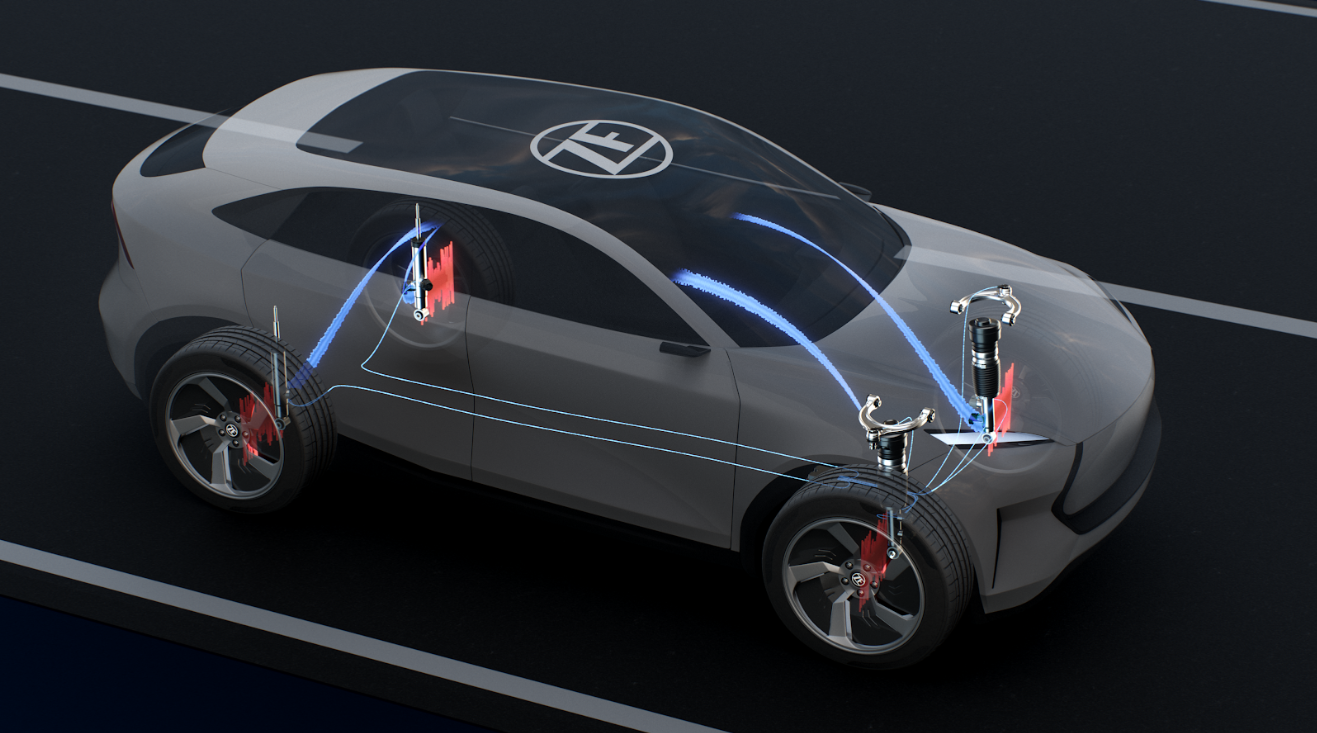
Get ready for a significantly quieter driving experience. At the upcoming Consumer Electronics Show (CES) 2026, automotive technology giant ZF is set to unveil its innovative “Active Noise Reduction” software function. This pioneering technology promises to tackle the persistent issue of in-vehicle tire noise at its source, eliminating the need for additional sound-dampening hardware.
Tire noise, often an unwelcome passenger, can travel through a vehicle’s chassis components like control arms and dampers, disrupting the cabin’s tranquility. ZF’s new software-based solution directly addresses this by minimizing annoying tire noise within the interior, a significant leap forward in automotive comfort technology. The company plans to integrate this function across a wider range of its chassis actuators in the future.

How the Magic of Silence Works
The core of this innovative system lies in ZF’s Smart Chassis Sensor, equipped with an integrated acceleration sensor. This sensor meticulously measures vibrations transmitted from the tires to the vehicle’s chassis. A sophisticated, specially developed algorithm then analyzes this vibration data, identifying the distinct noise patterns of tire cavity noise, typically occurring around 200 hertz. In response, the software generates a precise counter-signal. This signal is delivered via ZF’s cubiX software through the valves of semi-active dampers (CDC). Through subtle micro-movements of the damper, the system effectively cancels out the intrusive noise without compromising the damper’s primary function.
Dr. Peter Holdmann, member of the ZF Board of Management and head of Division Chassis Solutions, highlighted the significance of this development: “Active Noise Reduction is an excellent example of how we use smart algorithms to make ZF components even more efficient. This gives our semi-active CDC dampers a clear unique selling point in the market and sets new standards in comfort – without the need for any additional noise dampening hardware.”

Intelligent Dampers, Brilliant Quietness
The beauty of ZF’s Active Noise Reduction lies in its purely software-based implementation. By intelligently controlling the CDC dampers, the system achieves remarkable quietness without adding extra installation costs or requiring additional space within the vehicle. The current iteration of this technology already delivers an audible noise reduction of over 3 dB, with future enhancements aiming for up to 10 dB reduction – a truly transformative experience for passengers.
A key advantage of this technology is its adaptability. The Active Noise Reduction function can be tailored to various vehicle types and specific customer requirements through software adjustments. This opens up a new market, particularly for more affordable vehicles, as sophisticated acoustic solutions involving microphones and speakers have historically been exclusive to luxury segments. ZF, already a market leader with approximately 40 percent of the global semi-active damper market, anticipates significant growth in this area, especially with the ongoing trend towards automated driving.
Chassis 2.0: The Future of Integrated Vehicle Dynamics
Series production of the Active Noise Reduction system is slated to commence in 2028. Looking ahead, ZF envisions extending this software function to other actuators within its portfolio, potentially addressing issues like brake squeal or enhancing its fully active damping system, sMOTION.
“Thanks to our system expertise, we are able to offer our mechatronic actuators as true innovation drivers with the help of smart algorithms and we will extend our software-based control approach to other ZF actuators in the future. The goal for us is clear: mechatronic actuators that are capable of efficiently reducing both their own and external noise with the help of software,” explained Holdmann.
This new function is a cornerstone of ZF’s “Chassis 2.0” product strategy. Chassis 2.0 represents a paradigm shift, leveraging intelligent and networked actuators to enable novel chassis functions through software. It integrates intelligent actuators for braking, steering, and damping, scalable electronic architectures, and advanced software solutions into a cohesive and flexible system. As Holdmann stated, “With our Chassis 2.0, we are laying the foundation for the software-defined vehicle.”