
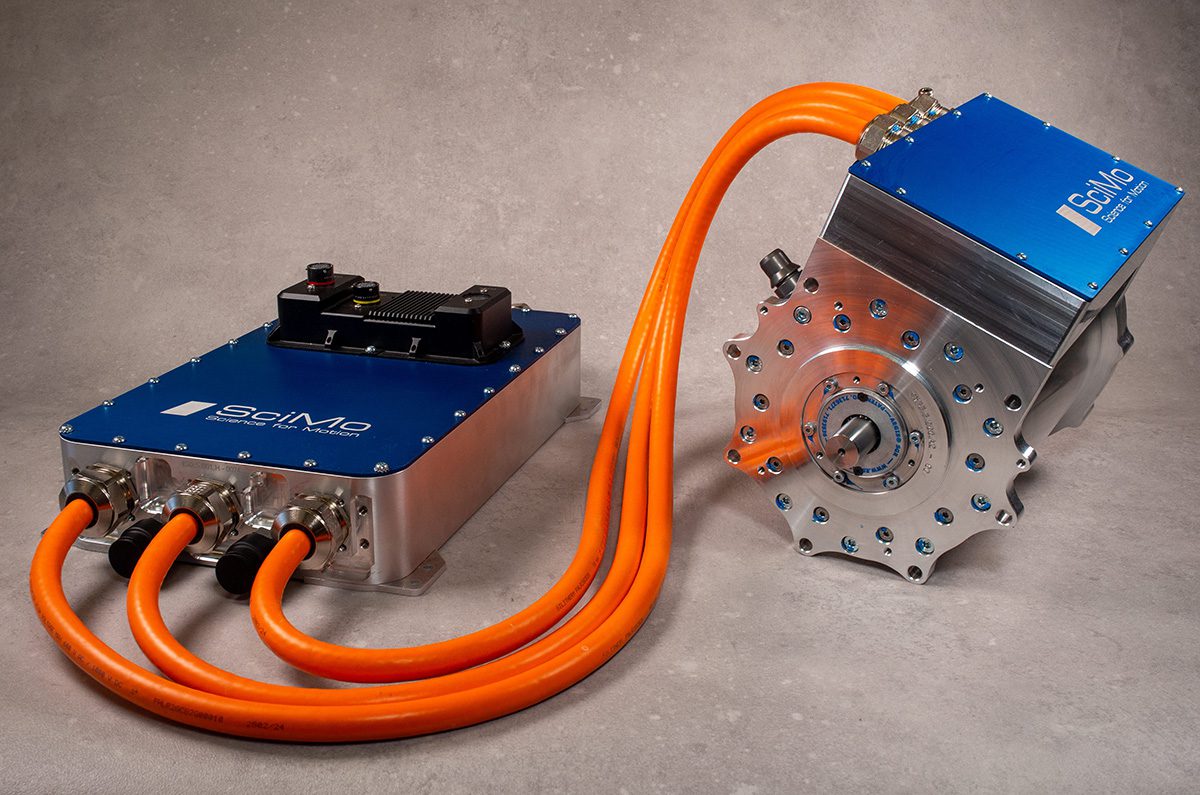
In the intricate world of electric motor engineering, the quest for optimal power density, efficiency, and thermal management is relentless. Copper, the fundamental conductor, plays a pivotal role, and the architecture of its windings is a primary determinant of a motor’s performance envelope. Historically, traditional motors have relied on bundles of round wires, a design that, while cost-effective, leaves significant unused space within the stator, limiting copper fill and ultimately, output.
This conventional approach typically yields a copper volume of around 40% within the wire-filled area. Dr. Florian Kassel, co-founder of Germany-based electric motor developer SciMo, articulated this limitation in an interview with Charged, stating, “If you would take such a motor and cut through and count the surface of the copper compared to the area where the wires are, you will get something of the order of 40% of the volume is copper. This is very cheap to manufacture, but only allows very small currents, and results in poor performance.”

The Fundamental Challenges in Motor Design
The density of copper within the stator is a crucial factor influencing an electric motor’s performance for a given size. A higher copper density allows for a reduced stator diameter, a lighter motor, and a smaller rotor, facilitating increased rotational speeds. However, simply enlarging the motor diameter to accommodate more copper can introduce trade-offs in rotor inertia, mechanical stress, and high-speed design considerations. For high-RPM applications, expanding the diameter to gain copper area might compromise the very speed, packaging, and rotor-dynamics advantages that engineers aim to achieve.
One prominent solution adopted by the automotive industry is hairpin technology. This method involves using thick copper bars, typically 2.5-3 mm across, which are bent into a staple-like shape and inserted into the stator slots. While hairpin windings significantly increase copper fill, they introduce their own set of challenges. Each protruding end on the far side of the stator must be precisely aligned and welded to form the electrical loops.
A notable trade-off with these large rectangular conductors is an increase in AC losses, particularly at elevated electrical frequencies and high-speed operating regimes. This issue, a well-known characteristic of hairpin-style windings, prompts engineers to explore methods for reducing conductor dimensions or mitigating skin- and proximity-effect losses to enhance overall efficiency in electric motor engineering.

SciMo’s Innovative Flat-Wire Winding Architecture
To navigate these inherent limitations, Germany’s SciMo has pioneered a distinct approach within electric motor engineering. The company’s innovation extends beyond merely employing rectangular copper conductors, a feature already present in hairpin motors. SciMo’s strategy centers on utilising thinner rectangular flat wires within a distributed winding architecture, complemented by a bespoke manufacturing process designed for automated, lower-volume production.
This sophisticated methodology allows SciMo to achieve copper filling factors exceeding 70%, while concurrently circumventing some of the design flexibility and AC-loss penalties typically associated with larger-section hairpin conductors. The result is a refined balance between high copper density and improved efficiency, particularly at the upper echelons of a motor’s operational RPM range.
Unpacking the Performance Advantages
SciMo’s winding architecture represents a significant leap forward, achieving copper filling factors above 70%. When juxtaposed with conventional round-wire distributed windings, which the company estimates at approximately 45%, this signifies a substantial enhancement in slot fill. This increased density directly supports higher current loading and greater power density within a predefined motor package, optimising the performance of electric motor engineering.
The strategic choice of smaller conductor cross-sections is specifically engineered to mitigate the high-frequency losses that can plague larger-section hairpin conductors. This careful design ensures that high copper density is coupled with superior efficiency, especially at peak RPMs. Dr. Kassel elaborated on this synergy: “We don’t have these negative effects, so we’re somewhere in between these two worlds and have a really nice tradeoff.”
Furthermore, this innovative winding technique offers a distinct thermal advantage. SciMo asserts that the precise geometric placement of its conductors establishes a shorter and more uniform thermal pathway from the winding directly to the motor’s cooled structure. This design significantly aids in reducing localised hot spots and enhances the motor’s continuous current capability, a critical factor in sustained high performance.
In contrast, traditional round-wire bundles can trap hundreds of strands deep within a coil, far from any effective cooling path. Hairpin motors also present thermal management challenges around their large conductors and welded end connections, often necessitating oil cooling in some designs. SciMo’s precisely arranged flat wires are engineered to optimise heat extraction from the winding, providing engineers with greater thermal headroom before overheating becomes the limiting operational constraint.
The culmination of these advancements is an exceptionally high power density, particularly in peak performance scenarios. SciMo publicly claims peak power densities of up to 17 kW/kg and continuous power densities exceeding 10 kW/kg for certain motor configurations. In demanding motorsport applications, SciMo’s lightweight motors can contribute significantly to achieving very high total system outputs in multi-motor setups. The company describes individual motors weighing approximately 20–30 kg, with total system output capacities comparable to 2,000 horsepower in some configurations, pushing the boundaries of electric motor engineering.
From University Project to Industrial Innovation: The SciMo Journey
The genesis of SciMo can be traced back to 2017, when three PhD students from the Karlsruhe Institute of Technology (KIT) founded the company. Their initial foray into electric motor engineering involved supporting the university’s Formula Student Electric racing team, an annual competition where approximately 60 students develop, build, and race an electric vehicle.
“During that time, we realized that these motors were exceptionally good; they had significantly higher power density compared to all the competitors,” Kassel recounted. “In the following years this team won the World Title of the series and made first places several times—at that point we knew: this technology is really something.” This early success solidified the potential of their innovative winding technology.
Since its inception, the SciMo team has expanded to 25 dedicated professionals, working full-time to advance the technology. The company has meticulously built its business through direct customer engagements, opting to fund its development independently rather than seeking external investor backing, thereby maintaining full control over its cutting-edge electric motor engineering initiatives.
Automating Precision: The Path to Scalability
Despite the initial promise of their motors, the production of these advanced stators was far from straightforward. In the company’s nascent years, each unit demanded weeks of laborious manual work, a process that was both time-consuming and prohibitively expensive. “We started in the beginning doing it by hand. It was highly expensive. It took three weeks for just one stator,” Kassel detailed.
This manual bottleneck severely restricted production to small batches, typically ranging from three to 30 motors per customer, depending on the specific project requirements. Consequently, SciMo’s business was confined to highly specialised niche applications, such as motorsport or early-stage aerospace ventures, where clients were prepared to absorb the substantial labour costs associated with bespoke electric motor engineering.
A pivotal turning point arrived for SciMo in 2022, when the company successfully secured approximately €2 million in EIC Accelerator funding from the European Union. This critical investment enabled SciMo to embark on automating its production process, a crucial step towards transforming their innovative designs into scalable manufacturing capabilities.
The introduction of semi-automation followed, where machines provided support to technicians in winding the stators, effectively reducing the production time for a single unit to one week. Building on this progress, SciMo has now achieved fully automated production, a monumental milestone essential for transcending current niche markets and broadly scaling the underlying technology in the realm of electric motor engineering.
“Since founding SciMo, we have always had this target of having fully automated manufacturing of this winding technology,” Kassel affirmed. He added, “This winding takes up 30-35% of the total manufacturing costs of the motor, and now we can drop that to half. And the more volume we produce, the better the margin gets.” This cost reduction strategy is poised to unlock new market opportunities that were previously beyond reach due to high production expenses.
Robotic Precision vs. Mass Production: A Strategic Niche
SciMo’s new winding line leverages advanced robotic systems, meticulously guided by a sophisticated software stack, a departure from the conventional CNC-style machines prevalent in the motor industry. These robots execute exceptionally fine, force-controlled movements, enabling them to place each delicate rectangular wire into the stator slots with a degree of accuracy surpassing that of even highly skilled human technicians. “There’s no reduction in precision or performance,” Kassel noted. “With automation, it actually gets better.”
However, this unparalleled precision comes with a practical constraint: time. Unlike the hairpin-wound motors common in the automotive industry, which can be produced in approximately 60 seconds per stator, a single SciMo stator is projected to take roughly six hours to wind, even with full optimisation. This significant cycle time makes it challenging for the technology to compete in mass-market production segments.
“It’s still very time-consuming to produce motors with our winding technology,” Kassel conceded. “We will never be a competitor to hairpin technology or anything like that.” SciMo’s strategy, therefore, is not to challenge mass-market solutions but to excel in areas where its unique advantages provide superior value.
Instead, the robotics-based process offers an equally valuable asset for specific sectors: unparalleled flexibility. Because the system relies on software-defined motion paths for precision rather than fixed tooling, engineers can rapidly reconfigure the winding setup. This adaptability allows for seamless accommodation of diverse stator geometries or custom layouts, a critical advantage in high-performance electric motor engineering. Whether producing five units for a research programme, 50 for a specialty vehicle manufacturer, or 500 for an electric bus fleet, the company’s approach thrives within these low-to-medium volume segments.
While the approach has practical limits—scaling to 10,000 units annually would necessitate 20 to 25 winding machines, an investment that might make alternative technologies more cost-effective—it shines in niche markets. In these sectors, where superior performance outweighs ultra-low manufacturing cost, SciMo’s robotic system provides a distinct competitive edge. It enables the delivery of custom, high-performance motors without the rigid tooling requirements and requalification burdens that constrain hairpin or other conventional winding manufacturing technologies. With the winding process now fully automated, SciMo is positioned to target markets with stricter cost constraints while maintaining the exceptional precision indispensable for its motor designs. The primary remaining limitations revolve around cycle time and scale economics, not performance consistency in electric motor engineering.
Forging New Frontiers: Applications Across Industries
The achievement of full automation empowers SciMo to assert dominance in high-performance, low-volume applications where precision, adaptability, and unconventional engineering yield significant returns. This includes the high-end automotive sector, where manufacturers of luxury and performance car brands are willing to invest a premium for enhanced power density and superior characteristics.
“In the motorsport business, where we have batch sizes of 100 to 200 motors per year, we’re a big competitor,” Kassel stated. He further explained the company’s strategic positioning: “because you can either have a cheap, non-custom, mass-produced motor or you go to manually produced custom motors that rely heavily on expensive materials and come with astronomical prices. SciMo is exactly in between these two worlds.”
One of the most promising applications for SciMo’s advanced motors lies in electric aviation, an industry where weight minimisation is paramount. An early SciMo customer was a company engaged in developing electric people-carrying drones. “You want to have as little weight as possible, and therefore we could sell these motors at high prices,” Kassel noted, highlighting the perfect alignment between the sector’s needs and SciMo’s lightweight, high-output motors.
The company’s innovative solutions are currently deployed across a diverse array of industries. “We are in many different industries at the moment. The main customers come from the motorsports and aviation industries, but we also provide electric motors for rocket engines or as dyno motors in test bench applications,” Kassel confirmed, underscoring the broad applicability of their advanced electric motor engineering.
The Future of Electric Motor Engineering: Scaling Innovation
Should SciMo successfully scale its operations, the economic ramifications could be as profound as the performance enhancements. Conventional electric motor engineering typically sees approximately 70% of a motor’s cost attributed to materials, particularly copper and steel. By packing copper more efficiently, SciMo argues it can significantly reduce motor size and overall material demand for a given performance target, all while preserving the crucial thermal and packaging advantages required in high-performance applications.
The company also identifies existing thermal headroom as a promising avenue for future gains, particularly when paired with more advanced magnetic materials or lower-loss electrical steels. These advancements could further push the boundaries of efficiency and power density in electric motor engineering.
“Now if we would say, we need an even higher performance output, we could do this either with advanced magnetic materials for much higher temperature tolerance, or with ultra-thin premium electrical steel to cut stator losses even further,” Kassel elaborated. Electric motors are fundamentally limited by heat, as elevated temperatures can weaken magnets and lead to permanent damage. However, motors constructed with premium, heat-resistant materials can tolerate considerably higher operating temperatures, unlocking new performance thresholds.
Kassel concluded with optimism regarding the company’s current standing and future trajectory: “For us, there’s still lots of room for improvement; but at the moment, we don’t need it. We are just happy that we have now managed to get this winding technology fully automated and can pass on these savings to our customers.” He added, “We’re now at a really interesting point in time for the company where we’ll now try to scale up and find new markets, and we’ll see how it goes. But this is the point we’re standing at. So, exciting times ahead.”