
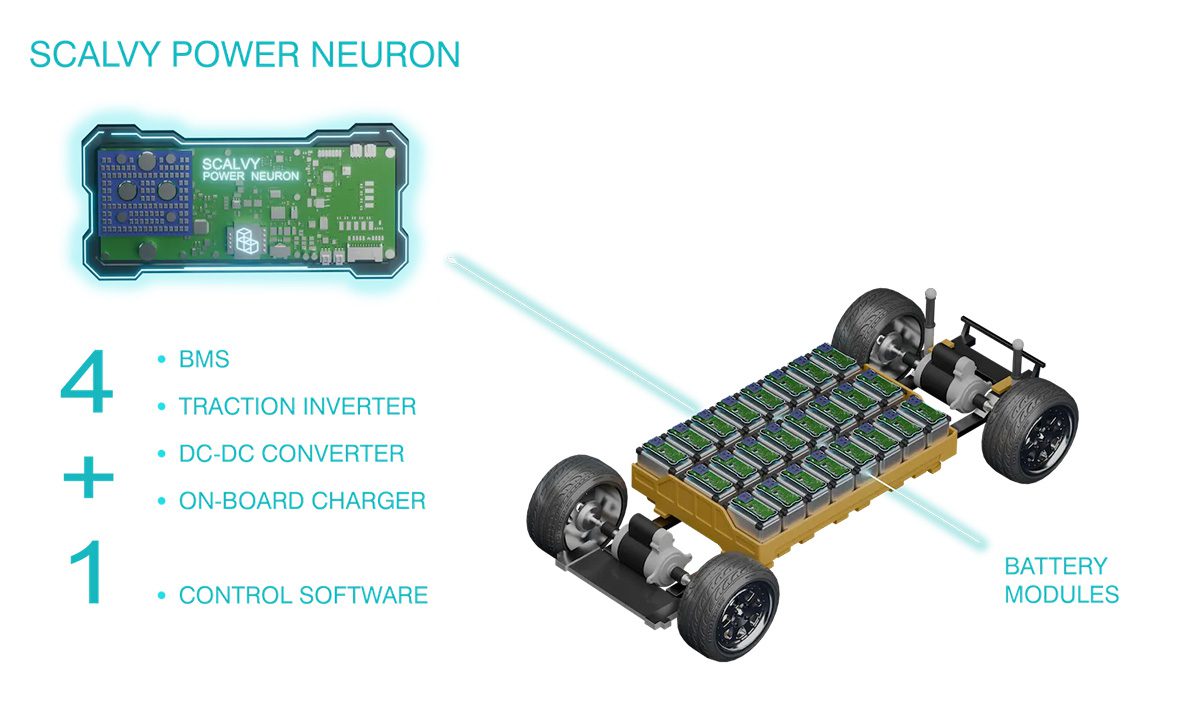
In a significant development for the electric vehicle (EV) industry, Scalvy, an innovator in power electronics, has announced the successful validation of its pioneering modular EV battery architecture. A joint concept evaluation conducted with global automotive supplier Valeo confirmed the robust performance of Scalvy’s battery-integrated power system under rigorous Worldwide Harmonized Light Vehicles Test Cycle (WLTC) operating conditions. This milestone marks a crucial step towards the automotive sector’s adoption of the company’s distributed ‘Power Neuron’ platform.
The evaluation demonstrated Scalvy’s ability to achieve a remarkable 98.3% peak inverter efficiency. Furthermore, the innovative system is designed to extend battery pack life by up to 15%, alongside enabling faster charging capabilities and superior thermal management. These advancements underscore a potential paradigm shift in how power electronics are integrated and managed within electric vehicles.

A Paradigm Shift in EV Power Electronics
Traditionally, electric vehicles rely on a suite of separate, centralized power electronics components, including inverters, DC-DC converters, and onboard chargers. This conventional approach often entails energy losses due to switching and conduction, alongside design complexities and limitations in scalability across diverse vehicle types and battery chemistries.
Scalvy’s ‘Power Neuron’ platform, however, redefines this architecture. It adopts a distributed model where these critical power functions are no longer centralized but instead integrated into compact modules strategically positioned at the edge of each battery pack. This fundamental change in design philosophy is central to unlocking the performance enhancements observed in the recent validation.
Unpacking the Modular EV Battery Architecture
The core innovation lies in this distributed and modular EV battery architecture. By embedding power electronics directly within or adjacent to the battery packs, Scalvy’s system significantly reduces the electrical paths, thereby minimizing losses associated with power transmission. This intelligent distribution also enhances the system’s inherent flexibility.

The modularity ensures that the technology can be seamlessly scaled. Whether for compact urban EVs or larger, high-performance electric vehicles, the ‘Power Neuron’ platform offers a versatile solution. This adaptability is particularly valuable given the industry’s rapid evolution and the continuous introduction of new battery chemistries with varying characteristics and demands.
Rigorous Validation with Valeo Under WLTC Conditions
The joint concept evaluation with Valeo was not merely a theoretical exercise; it involved stringent, lab-based testing under WLTC operating conditions. The WLTC is a globally recognized standard designed to measure fuel consumption and emissions, or in the case of EVs, energy consumption and range, by simulating real-world driving scenarios. Its application lends significant credibility to Scalvy’s reported performance metrics.
Valeo, a prominent player in automotive component manufacturing, brings extensive expertise in validating cutting-edge automotive technologies. Their collaboration with Scalvy indicates a shared vision for advancing EV powertrain efficiency and reliability. The meticulous testing environment ensured that the results obtained are relevant and indicative of performance in practical automotive applications.
Unprecedented Efficiency Benchmarks
A standout achievement from the validation was the recorded peak inverter efficiency of 98.3%. This impressive figure was observed at 10,000 rpm and 65 Nm, conditions that represent substantial power output from the electric motor. Inverters are crucial for converting the direct current (DC) from the battery into alternating current (AC) to power the electric motor, making their efficiency paramount to overall EV performance.
Such high efficiency directly translates into tangible benefits for electric vehicle users and manufacturers. Less energy is wasted as heat during the conversion process, meaning more of the battery’s stored energy can be used to propel the vehicle. This directly contributes to extending the vehicle’s driving range and reducing the overall energy consumption, thereby enhancing the environmental credentials of EVs.
The Significance of High Efficiency
Achieving nearly 99% inverter efficiency is a significant engineering feat in the domain of EV power electronics. It highlights Scalvy’s ability to minimize inherent losses in power conversion, which are often a challenge for traditional systems. For the end-user, this translates into more kilometers per charge and potentially lower electricity costs over the lifetime of the vehicle.
Moreover, highly efficient systems generate less heat, which simplifies cooling requirements for power electronics. This reduction in thermal load can lead to more compact designs, lighter components, and reduced stress on other vehicle systems, all of which are critical factors in the ongoing pursuit of optimal EV design and performance.
Extending Battery Life Through Advanced Management
Beyond efficiency, the modular EV battery architecture demonstrated exceptional battery management capabilities. The evaluation highlighted that the system achieved module-level state-of-charge (SOC) balancing, keeping SOC deviation between battery modules negligible throughout the testing. This precise balancing is vital for maintaining the health and longevity of complex battery packs.
Uneven SOC between modules can lead to premature degradation of individual cells or modules, ultimately limiting the overall pack’s usable capacity and lifespan. Scalvy’s ability to ensure negligible deviation means that all modules are utilized optimally and consistently, preventing localized stress that could otherwise shorten the battery’s operational life. This careful management is a cornerstone of the claimed 15% longer pack life.
Mitigating Thermal and Electrical Stress
Another crucial aspect of the ‘Power Neuron’ platform’s design is its superior thermal management. During testing, the system maintained motor temperatures below 62 °C and power-device temperatures below 65 °C, critically, without any hotspot formation. Hotspots are localized areas of excessive heat that can severely compromise the reliability and lifespan of electronic components and battery cells.
This effective thermal control, combined with tight SOC balancing and pulse-like distributed switching, works synergistically to reduce localized electrical and thermal stress across the entire system. Reduced stress not only prevents premature wear but also facilitates faster charging rates. By preventing overheating and ensuring even electrical load distribution, the system can handle higher currents during charging without risking damage to the battery or power electronics.
Implications for the Electric Vehicle Ecosystem
Scalvy’s modular EV battery architecture holds profound implications for the wider electric vehicle ecosystem. The inherent scalability of the system means it can be adapted to various EV segments, from two-wheelers and passenger cars to commercial vehicles, each with distinct power and energy requirements. This versatility could accelerate the electrification across different transport sectors.
Furthermore, its compatibility with diverse battery chemistries positions Scalvy’s technology as future-proof. As battery technology continues to evolve, the platform’s ability to integrate with new cell types without major redesigns of the power electronics infrastructure presents a significant advantage for manufacturers seeking flexibility and reduced development costs.
Path to Commercial Deployment
With the successful validation complete, Scalvy is now advancing its technology toward commercial deployment. The company is actively field-testing the ‘Power Neuron’ platform with a selection of customers, gathering real-world data and feedback to refine the system further. This practical application phase is critical for ensuring robustness and reliability in diverse operating environments.
Scalvy has set an ambitious target for commercial production in 2027, signaling confidence in its ability to bring this advanced modular EV battery architecture to market within the next few years. Farouk Boudjemai of Valeo endorsed the validation results, stating they were “highly encouraging” and would play a vital role in advancing the concept’s readiness level. This strong endorsement from an industry leader underscores the transformative potential of Scalvy’s innovation.
The combined benefits of heightened efficiency, extended battery life, and enhanced thermal management offered by Scalvy’s distributed power architecture could redefine performance and sustainability benchmarks for future electric vehicles. As the EV market continues its rapid expansion, technologies that maximize efficiency and longevity while streamlining design will be pivotal to achieving widespread adoption and driving the industry forward.