
KEY TAKEAWAYS (TL;DR):
- Fraunhofer IZM has unveiled a compact 500-kW inverter for 800V electric vehicle drives.
- The innovative unit boasts a peak efficiency exceeding 99% and achieves an extraordinary power density of 500 kVA per liter, fitting into a 1-liter package.
- This breakthrough is attributed to four key integrated design approaches: embedded SiC MOSFETs, an advanced extruded aluminum cooler, laser-welded busbar connections, and optimised NanoLam DC-link capacitors.
- The design significantly reduces parasitic inductance to approximately 1 nanohenry, enabling rapid switching speeds of 65 V/ns and minimising losses.
- Compared to current top systems, this new SiC inverter technology offers 2.5 times higher power density, representing a five-fold improvement over common alternatives.
Revolutionising EV Powertrains: A New Benchmark in Power Electronics
In a significant advancement for electric vehicle (EV) technology, researchers at Fraunhofer IZM have successfully developed a groundbreaking 500-kilowatt (kW) inverter that sets new industry standards for compactness and efficiency. Designed specifically for high-performance 800-volt (V) DC drives, this innovative power conversion unit achieves a remarkable peak efficiency of over 99% while occupying a volume of just one liter, translating to an astonishing power density of 500 kVA per liter.

The unit, developed for Mitsubishi Heavy Industries, represents a critical leap forward in SiC inverter technology, a crucial component for the next generation of electric vehicles. Its ability to deliver 500 A RMS per phase with an effective inductance of approximately 1 nanohenry (nH) and switching speeds reaching 65 V/ns underscores its potential to enhance EV performance, range, and reliability.
The Quest for Higher Efficiency and Power Density in EVs
The continuous push towards electrification in the automotive sector demands power electronics that are not only highly efficient but also compact and cost-effective. Inverters, which convert the DC power from an EV battery into AC power for the electric motor, are central to this challenge. Historically, achieving high power output from a small footprint while maintaining superior efficiency has been a significant engineering hurdle.
Fraunhofer IZM’s latest innovation directly addresses these challenges by integrating several cutting-edge design principles. The result is an inverter that not only outperforms existing solutions in terms of power density but also significantly reduces energy losses, thereby increasing the overall efficiency of the EV powertrain.

Integrated Design: Four Pillars of Performance
The exceptional performance metrics of this 500-kW inverter are the culmination of four intricately interacting design approaches. Each element plays a crucial role in minimising losses, reducing parasitic elements, and optimising thermal management—key factors in developing high-power, compact systems.
These innovations collectively allow the silicon carbide (SiC) MOSFETs to operate at their physical limits, enabling faster switching and consequently lower energy dissipation. This holistic approach ensures that every aspect of the inverter contributes to its unprecedented efficiency and power density.
Embedded SiC MOSFETs for Minimal Inductance
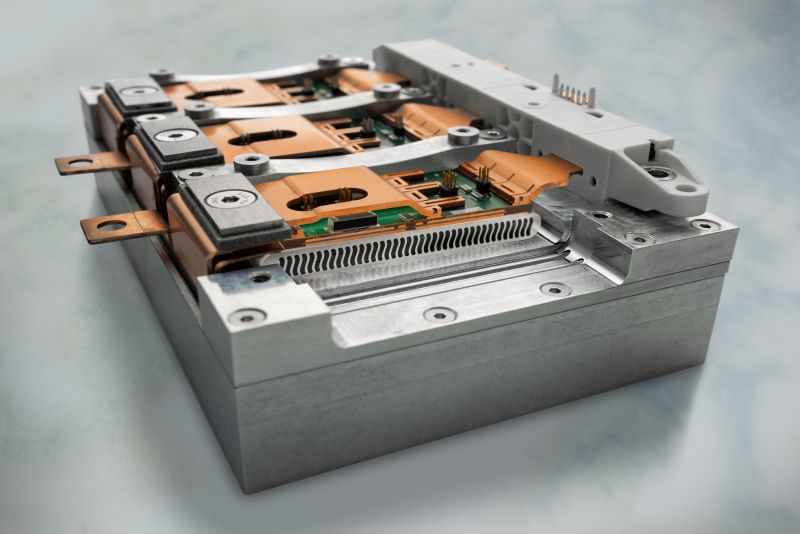
The first critical approach involves the power modules, which utilise a two-level half-bridge topology. Each phase incorporates twelve silicon carbide (SiC) MOSFETs directly embedded onto the printed circuit board (PCB). This innovative embedding technique eliminates the traditional component height associated with discrete packages, a crucial step in reducing the overall form factor.
Crucially, embedding the SiC switches also drastically cuts parasitic inductance. Parasitic inductance, inherent in circuit layouts and component connections, can significantly impede switching speeds and increase energy losses during high-frequency operation. By minimising this, the design enables the MOSFETs to switch at their physical limit, which directly translates to lower operational losses and reduced cooling requirements.
Furthermore, an RC snubber circuit placed between each module and the DC-link capacitor actively dampens oscillations and further enhances switching speed. This precise control over transient effects contributes to the achieved 1 nH effective inductance, a benchmark for high-performance power electronics.
Advanced Thermal Management: A Uniquely Extruded Cooler
Effective thermal management is paramount for high-power density applications. The second innovation lies in the inverter’s cooling system. Beneath the three power modules, a flat, extruded aluminum heat sink is integrated. This heat sink features more than 40 thin, slightly corrugated channels specifically designed to maximise the surface area available for heat exchange with the coolant.
The manufacturing process for this cooler is equally innovative; the entire heat sink is produced in a single extrusion step. This not only minimises manufacturing costs but also contributes significantly to the inverter’s extremely compact form factor. Efficient heat dissipation is vital for maintaining optimal operating temperatures for the SiC devices, ensuring reliability and sustained high performance.
Optimised Busbar Connections for Reduced Parasitics
The third key design element focuses on the busbar connections, which are critical for transmitting high currents with minimal losses and inductance. “The contacts of the busbars were formed just so that we could laser-weld them directly onto the circuit board,” said Wiljan Vermeer of Fraunhofer IZM’s Power Electronic Systems group. “That means we could get rid of screws that would not only eat up valuable space but increase inductance as well.”
The elimination of mechanical fasteners like screws not only saves valuable space within the compact 1-liter package but also removes potential sources of unwanted parasitic inductance. Additionally, the two input busbars are arranged vertically and positioned sufficiently close to each other. This strategic arrangement causes their magnetic fields to partially cancel each other out, further contributing to the overall reduction in inductance within the power loop.
NanoLam Capacitors: Tailored for High-Frequency Demands
The fourth crucial approach addresses the DC-link capacitors, a vital component for energy storage and ripple current filtering. Collaborating with PolyCharge, the Fraunhofer IZM team leveraged NanoLam capacitors, which were specifically configured for this demanding application. These advanced capacitors are arranged alongside the busbars, achieving an impressive 2 nH total DC-link inductance at a capacitance of 300 microfarads.
While NanoLam capacitors offer significant advantages in terms of compactness and performance, they typically produce higher thermal losses compared to conventional types. To mitigate this, the team incorporated copper contacts for enhanced heat dissipation. Furthermore, the entire capacitor unit is intelligently integrated into the casing directly below the aluminum cooler, ensuring that the operating temperature is maintained at a maximum of 130 °C, well within the 150 °C limit for these components.
Setting New Benchmarks for EV Performance
The culmination of these innovative design strategies is an inverter unit that significantly surpasses current market offerings. Fraunhofer IZM reports that the resulting unit outperforms common inverter alternatives by five times in terms of power density. Furthermore, it beats current top systems by 2.5 times, solidifying its position as a leading-edge solution for the burgeoning electric vehicle market.
This achievement signals a transformative step for the automotive industry, promising more compact, lighter, and more efficient powertrains for future EVs, particularly those operating on 800V architectures. Such advancements are crucial for accelerating the adoption of electric vehicles by addressing key consumer concerns related to range, charging speed, and overall vehicle performance.
Future Outlook and Presentation
The public will get a closer look at this pioneering SiC inverter technology when Wiljan Vermeer of Fraunhofer IZM presents the inverter at PCIM Europe, a prominent international exhibition and conference for power electronics, intelligent motion, renewable energy, and energy management. The presentation is scheduled to take place in Nuremberg, Germany, from June 9–11, offering a detailed insight into the technical intricacies and implications of this innovation.
This development reinforces Fraunhofer IZM’s reputation as a leader in advanced packaging and system integration for power electronics. The collaboration with industry partners like Mitsubishi Heavy Industries and PolyCharge highlights the synergistic efforts required to push the boundaries of what is possible in EV engineering.
Frequently Asked Questions (FAQ)
What is the primary breakthrough of Fraunhofer IZM’s new inverter?
The primary breakthrough is achieving 99% peak efficiency and an unprecedented power density of 500 kVA per liter for a 500-kW inverter. It fits into a 1-liter volume, making it significantly more compact and efficient than current market alternatives for 800V electric vehicle drives, enhancing performance and thermal management.
Why is a 99% efficiency rating significant for electric vehicles?
A 99% efficiency rating is crucial because it means minimal energy loss during power conversion. In EVs, higher efficiency translates directly to extended driving range, reduced battery consumption, and less heat generation. This lowers the need for extensive cooling systems, potentially reducing vehicle weight and improving overall system reliability and cost-effectiveness.
What are SiC MOSFETs and why are they used in this inverter?
SiC (Silicon Carbide) MOSFETs (Metal-Oxide-Semiconductor Field-Effect Transistors) are advanced power semiconductors. They are preferred in high-performance inverters due to their superior properties compared to traditional silicon, such as higher breakdown voltage, faster switching speeds, and better thermal conductivity. This enables the inverter to handle higher power with less loss and operate at elevated temperatures.
How does ‘parasitic inductance’ affect inverter performance, and how was it reduced?
Parasitic inductance, unintentional inductance within a circuit, hinders fast switching and increases energy losses. In this inverter, it was reduced through several innovations: embedding SiC MOSFETs directly onto the PCB, designing laser-welded busbar connections to eliminate screws, and arranging busbars vertically for magnetic field cancellation. This brings the effective inductance down to approximately 1 nH.
What role do NanoLam capacitors play in this SiC inverter technology?
NanoLam capacitors from PolyCharge are used as DC-link capacitors, providing 300 microfarads of capacitance with only 2 nH total inductance. Their compact size and low inductance are critical for high-frequency operation. Although they produce more heat, copper contacts and integration into the cooling system ensure they operate reliably below their 150 °C maximum temperature limit.
How does the new inverter compare to existing systems in terms of power density?
The Fraunhofer IZM inverter demonstrates exceptional power density, outperforming common inverter alternatives by five times. Furthermore, it achieves 2.5 times higher power density than current top-tier systems available in the market. This significant improvement allows for more compact and lighter EV powertrains, crucial for enhancing vehicle design and performance.
What is an 800V EV drive, and why is this inverter designed for it?
An 800V EV drive system refers to an electric vehicle architecture that operates at a higher voltage, typically double that of conventional 400V systems. This allows for faster charging times, reduced current levels for a given power output (leading to thinner cables and less weight), and more efficient power delivery. This inverter is designed to leverage these benefits, supporting the next generation of high-performance EVs.