
Key Takeaways (TL;DR)
- Henkel’s Battery Application Center in Michigan functions as a unique ‘factory-in-a-lab,’ providing OEMs and battery manufacturers with real-world production-line testing for EV battery manufacturing adhesives.
- The facility integrates production-intent dispensing equipment, advanced robotics, and pump systems to simulate full-scale manufacturing environments.
- Engineers at the center develop and test critical adhesive solutions, including novel ‘de-bonding on demand’ technologies for easier repair, rework, and recycling of battery packs.
- A core focus is ensuring ‘lab-to-line’ consistency, guaranteeing that adhesive formulations and application parameters perform reliably from prototyping to high-volume production.
- The center fosters co-engineering with partners, accelerating product development and adapting to evolving EV battery chemistries and architectures.
In a significant stride for electric vehicle (EV) battery production, materials giant Henkel has established a cutting-edge Battery Application Center in Madison Heights, Michigan. This facility transcends the traditional laboratory model, operating as a fully-fledged production simulation environment designed to validate adhesive formulations and application processes under real-world conditions. Far from merely shipping samples, Henkel built an actual factory within its lab, fundamentally altering the development paradigm for critical EV battery manufacturing adhesives.

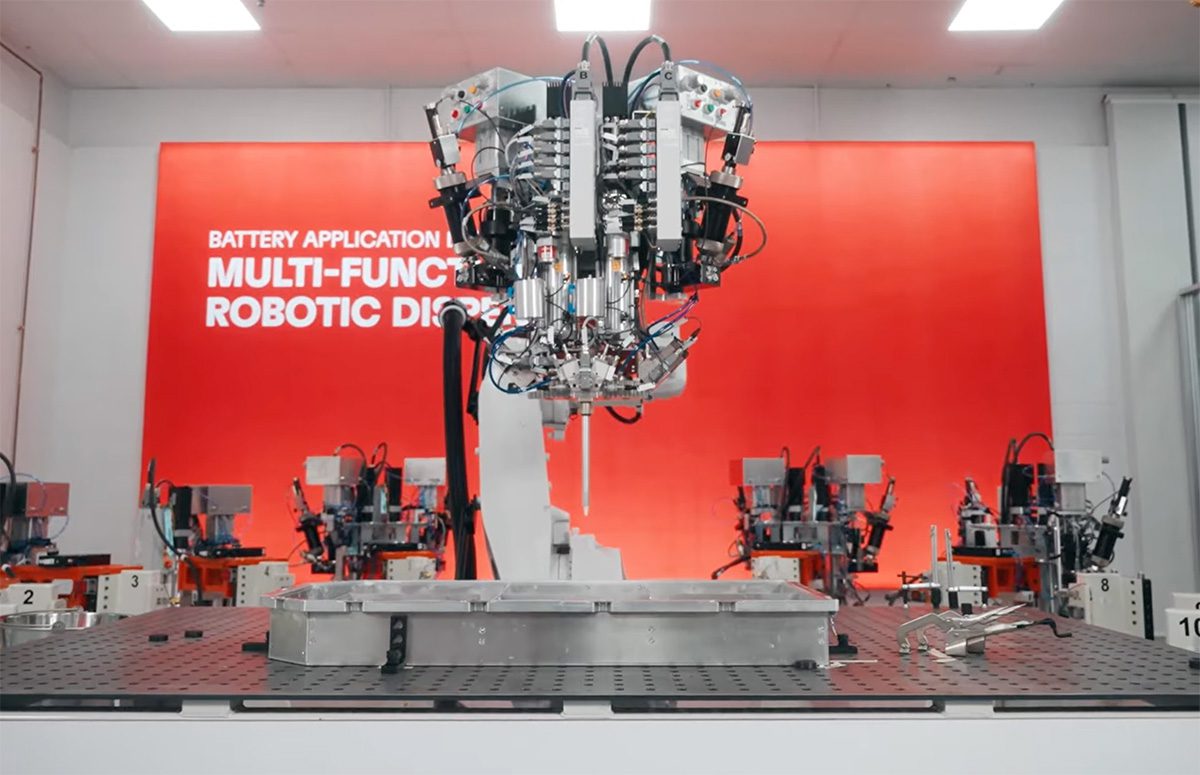
The center is equipped with advanced, production-intent dispensing equipment, featuring a six-axis ABB robot and pump systems scaled for full-sized EV battery housings. This unique setup allows automotive OEMs and battery manufacturers to bring their actual components to the facility. Here, they can run these components through authentic dispensing processes, generating crucial data on bead application, flow rates, temperatures, and material behavior at production-line speeds.
Pankaj Arora, Vice President of Henkel’s electronics, eMobility and automotive components business for North America, underscored the center’s transformative role. “It takes the conversation very quickly from just focused on samples to more of a co-system based co-engineering with our partners and customers,” Arora stated. He further highlighted that the facility integrates application capabilities, technology expertise, and advanced modeling and simulation under one roof, fostering a holistic approach to EV battery manufacturing adhesives development.
A Factory Within a Lab: Bridging the Production Gap
The philosophy behind the Madison Heights facility is to eliminate the inherent disconnect between laboratory testing and high-volume manufacturing. By replicating actual production conditions, Henkel offers its partners an invaluable opportunity to de-risk processes and validate material performance long before committing to full-scale deployments.

Precision Dispensing for Diverse Adhesive Chemistries
Chloe Jindra, a senior application engineer at the center, provided a detailed overview of the sophisticated dispensing setup. The robot cell is engineered to handle both one-component and two-component cartridge and bulk dispensing systems. This versatility extends across a broad spectrum of material types, including polyurethanes, epoxies, thermals, and silicones, which are all vital EV battery manufacturing adhesives.
Crucially, the system features multiple dispense heads, enabling the engineering team to rapidly switch between different material types without the time-consuming process of rebuilding the entire cell. This agility is paramount in an industry constantly innovating with new battery chemistries and pack designs, demanding flexible adhesive solutions.
Jindra elaborated on the granular control offered by the Human-Machine Interface (HMI) tools. “These HMI tools allow us to control certain factors like our flow rates and our pre-pressures as well as our bead size,” Jindra explained. “So that way we make sure we get the perfect bead size for our customer every time.” This meticulous control ensures optimal adhesive application, which is fundamental for structural integrity, thermal management, and overall battery pack safety and longevity.
Optimising Material Viscosity for Production Lines
The pump systems at the center are designed to accommodate various industry-standard container sizes, including German-sized pails (Hobocks), standard pails, and drums. A critical feature of these systems is their heating capability, which is essential for managing the viscosity of the EV battery manufacturing adhesives.
Many advanced adhesives behave differently at room temperature compared to the elevated temperatures (typically 40–60 °C) at which production lines often operate. By precisely controlling material temperature, the center can accurately simulate real-world viscosity profiles, ensuring that the adhesive performs as expected during high-speed application. Furthermore, operators can call and sequence complex dispensing programs from the HMI without needing to enter the robot cell, enhancing safety and efficiency. The integrated safety system intelligently switches between automatic and teach modes, adapting to the presence of customers or engineers on the floor.
The Evolving Challenge: De-bonding on Demand
While the initial focus of EV battery manufacturing adhesives was solely on robust bonding, a new, equally complex engineering challenge has emerged: controlled de-bonding. Gluing a battery pack together securely is one facet of design; ensuring it can be safely and efficiently taken apart is another that is gaining increasing importance.
Matt Boback, the senior manager of the Battery Application Center, highlighted this growing area of research. He noted that an increasing portion of the center’s work is now dedicated to developing adhesive joints that can be purposefully reversed. These applications are critical for in-plant rework of defective units, field service repairs, and ultimately, for end-of-life battery recycling, a key pillar of sustainable eMobility.
Targeted Triggers for Safe Adhesive Release
Boback detailed the strategic approach to de-bonding. “We focused in on two main triggers,” he said. “These are both either electrical or thermal de-bonding triggers to safely remove and de-bond the assemblies.” The goal is to design adhesive systems that maintain their structural integrity and thermal resistance under normal battery operation, yet release cleanly and predictably when subjected to a specific electrical or thermal stimulus.
This collaborative work with customers aims to create “a de-bond on demand type of environment.” Such a system delivers consistent and safe de-bonding, whether for rectifying an issue on the production line or preparing a spent battery pack for efficient material recovery and recycling. This dual requirement—strong adhesion and controlled release—represents a significant material science hurdle for EV battery manufacturing adhesives.
Balancing Reliability with Repairability and Recycling Needs
The engineering complexity of ‘de-bonding on demand’ cannot be overstated. An adhesive that releases too easily poses a severe reliability and safety risk for a high-voltage battery pack. Conversely, an adhesive that cannot be effectively debonded renders the battery pack a single-use assembly. This creates substantial obstacles for meeting emerging repairability requirements and increasingly stringent recycling regulations, particularly in major automotive markets like Europe and North America.
The development of advanced de-bonding EV battery manufacturing adhesives is therefore critical for the circular economy principles being applied to the automotive sector. It directly impacts the lifespan of EV components and the sustainability footprint of electric vehicles.
Ensuring Consistency: From Lab to Line
Another fundamental challenge addressed by the Battery Application Center is ensuring seamless scalability from prototype to mass production. Boback emphasized the importance of this transition: “We want to take something that’s in the lab environment and it’s going to go through pilot lines, through production intent volume. We want to have that consistency throughout the process.”
Maintaining Dispensing Parameters Across Scales
Achieving this consistency means meticulously matching dispensing parameters across different scales. Factors such as temperatures, application speeds, bead geometry, and pressures must be precisely replicated. An adhesive material qualified and optimized in the Madison Heights facility must perform identically when applied at high rates on a customer’s production floor. The center’s robust quality control protocols are specifically designed to manage this critical handoff, minimizing potential variations and ensuring predictable performance of EV battery manufacturing adhesives.
Fueling Future Product Development and Innovation
The unique, production-focused environment of the Battery Application Center also provides invaluable feedback for Henkel’s own product development cycles. By engaging with OEMs early in the design phase, the materials team gains insights into evolving requirements that would otherwise not be apparent from standard datasheet requests alone.
These insights span critical areas, from the demands of new cell chemistries and evolving battery pack architectures to specific manufacturing process constraints. “We are able to dial those learnings back into our development cycles and produce a better product,” Arora noted. Additionally, the center leverages advanced digital twin modeling, which significantly reduces the need for physical iteration cycles, thereby accelerating the development and validation of next-generation EV battery manufacturing adhesives and thermal management solutions.
The Strategic Impact on eMobility Innovation
Henkel’s Battery Application Center represents a strategic investment in the future of eMobility. By providing a collaborative platform where theoretical material science meets practical production engineering, the center accelerates the development and deployment of robust, sustainable, and high-performance battery packs. This direct engagement and co-engineering approach ensure that adhesive technologies are not just theoretical solutions but are meticulously validated for the rigorous demands of mass EV production. Ultimately, this pioneering approach by Henkel is set to play a pivotal role in overcoming key manufacturing challenges, enhancing the reliability and sustainability of electric vehicles globally.
FAQ Section
What is the primary purpose of Henkel’s Battery Application Center?
The center’s main goal is to bridge the gap between lab-scale adhesive development and real-world EV battery manufacturing. It provides OEMs and battery producers with a unique environment to test and validate adhesive formulations and application processes using production-intent equipment, ensuring materials perform reliably at scale before mass production.
How does the center simulate real-world production?
The facility is equipped with full-scale production-intent dispensing equipment, a six-axis ABB robot, and pump systems designed for EV battery housings. This allows for testing of various EV battery manufacturing adhesives under actual production speeds and temperatures, capturing data on bead application, flow rates, and material behavior.
What is ‘de-bonding on demand’ and why is it important?
‘De-bonding on demand’ refers to adhesive systems designed to release cleanly when triggered by specific electrical or thermal stimuli. This technology is crucial for facilitating in-plant rework, field service repairs, and efficient end-of-life recycling of EV battery packs, aligning with increasing sustainability regulations and repairability requirements.
What types of adhesive materials are tested at the center?
The center tests a wide range of EV battery manufacturing adhesives, including one-component and two-component polyurethanes, epoxies, thermal interface materials, and silicones. Its versatile robot cell and multiple dispense heads allow for rapid switching and testing across these diverse material chemistries, adapting to various battery pack designs.
How does the center ensure consistency from lab to production line?
A key focus is on matching dispensing parameters—temperatures, speeds, bead geometry, and pressures—across different scales. This ensures that an adhesive material qualified in the lab performs identically when applied at high volumes on a customer’s factory floor, maintaining quality and reliability in mass production.
How does this facility contribute to future EV technology development?
By engaging with OEMs early in the design phase, the center provides invaluable feedback to Henkel’s material development teams. This direct insight into evolving requirements, new cell chemistries, and pack architectures accelerates the creation of improved EV battery manufacturing adhesives and advanced solutions for the electric vehicle industry.