
Key Takeaways
- Henkel’s Battery Application Center in Michigan features full-scale production equipment, including a six-axis ABB robot, to allow EV manufacturers to test adhesive formulations under real-world conditions.
- The facility enables comprehensive co-engineering, providing data on material behaviour, flow rates, and bead application at production speeds, moving beyond traditional sample-based evaluations.
- A significant focus is on developing ‘de-bond on demand’ adhesive technologies, critical for in-plant rework, field service repairs, and compliance with tightening end-of-life recycling regulations for EV batteries.
- The center prioritizes ensuring seamless transition from lab validation to high-volume production, matching dispensing parameters across scales for consistent material performance.
- Through direct collaboration with OEMs, the facility actively feeds real-world requirements and insights back into Henkel’s product development cycles, leveraging advanced modeling and simulation for faster innovation.
In a significant stride for electric vehicle (EV) battery manufacturing, Henkel has established a cutting-edge Battery Application Center in Madison Heights, Michigan. This facility redefines the traditional approach to material testing, moving beyond mere sample evaluation to offer a full-scale production environment within a laboratory setting. It represents a critical investment in accelerating the development and integration of advanced adhesive solutions essential for the next generation of EV battery packs.
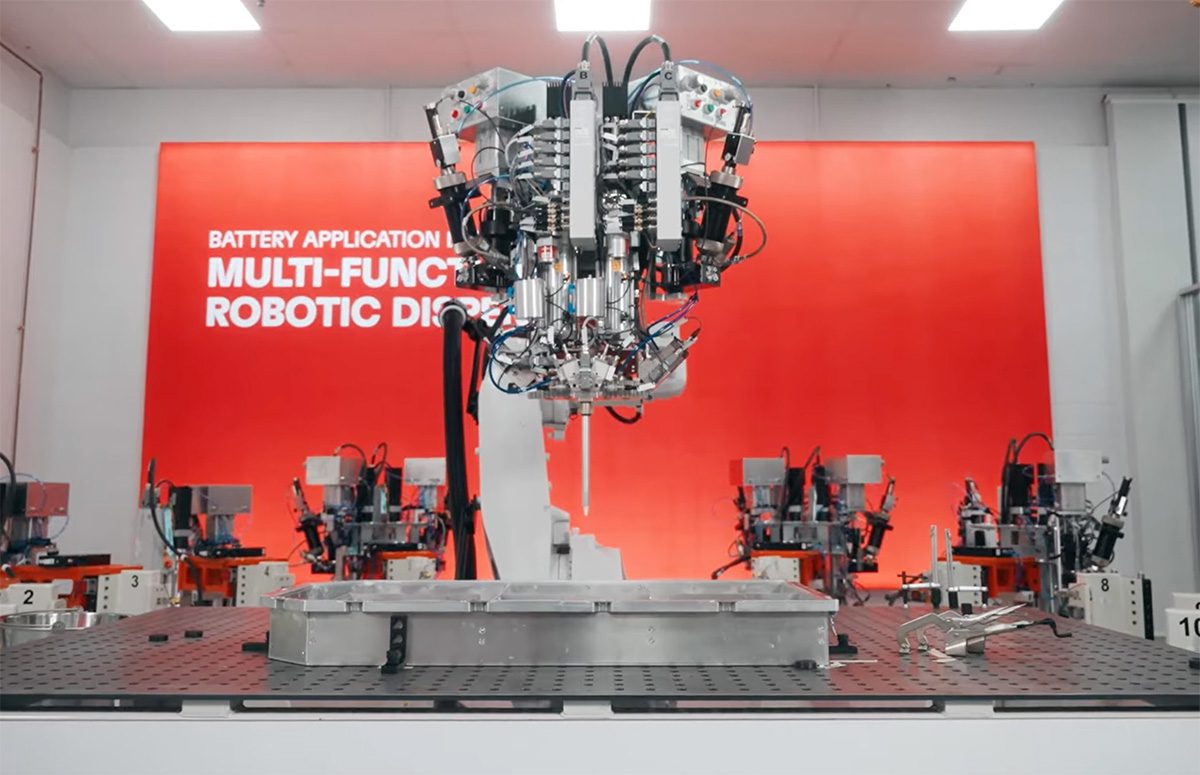
Unlike conventional material companies that typically provide samples for client evaluation, Henkel’s innovative center integrates production-intent dispensing equipment, a sophisticated six-axis ABB robot, and pump systems tailored for full-scale EV battery housings. This unique setup allows original equipment manufacturers (OEMs) and battery producers to conduct rigorous testing with their actual components, generating invaluable data on bead application, flow rates, temperatures, and material behavior under authentic production speeds.

Pankaj Arora, Vice President of Henkel’s electronics, eMobility, and automotive components business for North America, underscored the strategic intent behind the center. “It takes the conversation very quickly from just focused on samples to more of a co-system based co-engineering with our partners and customers,” Arora stated. He further highlighted that the facility synergizes application capabilities, profound technological expertise, and advanced modeling and simulation, all conveniently located under one roof. This integrated approach is pivotal for overcoming the complex engineering challenges inherent in modern EV battery design and assembly.
Replicating Production Realities in a Prototyping Lab
The core philosophy of Henkel’s Battery Application Center is to bridge the gap between theoretical material science and practical manufacturing realities. Chloe Jindra, a senior application engineer at the center, provided insights into the sophisticated dispensing setup during a recent visit by Charged. The robotic cell is adept at handling both one-component and two-component cartridge and bulk dispensing, accommodating a wide array of materials including polyurethanes, epoxies, thermals, and silicones.
The versatility of the system is further enhanced by multiple dispense heads, which facilitate seamless transitions between various material types without requiring extensive reconfiguration of the cell. This flexibility is crucial for rapid prototyping and iterative design cycles in the fast-evolving EV landscape.

Jindra elaborated on the precision afforded by the center’s advanced control systems. “These HMI tools allow us to control certain factors like our flow rates and our pre-pressures as well as our bead size,” she explained. This granular control is paramount in achieving optimal material application. “So that way we make sure we get the perfect bead size for our customer every time,” Jindra added, emphasizing the center’s commitment to precision and customer-specific solutions.
The facility’s pump systems are designed to accommodate diverse container sizes, ranging from German-sized pails (Hobocks) to standard pails and drums. Critically, all these systems are equipped with heating capabilities to meticulously manage material viscosity. This feature is vital because adhesives and sealants can exhibit significantly different behaviors at ambient temperatures compared to the 40–60 °C range typically maintained on high-speed production lines. The ability to simulate these real-world temperature conditions ensures that material performance observed in the lab is directly transferable to actual manufacturing environments.
Furthermore, the Human-Machine Interface (HMI) allows operators to call and sequence complex dispensing programs without needing to physically enter the robot cell, enhancing operational safety and efficiency. A robust safety system intelligently switches between automatic and teach modes, ensuring a secure environment whether customers are observing or actively participating in the processes on the floor. This blend of precision, versatility, and safety underscores the center’s advanced capabilities in EV battery adhesive application.
Pioneering De-bonding on Demand for Sustainable EV Batteries
While the focus on secure adhesion for EV battery packs remains paramount, an emerging and equally critical engineering challenge is the ability to de-bond them on demand. Matt Boback, senior manager of the Battery Application Center, revealed that an increasing proportion of the facility’s work is now dedicated to developing adhesive joints that can be intentionally and reversibly released. This capability is indispensable for several applications: in-plant rework for quality control, field service repairs for battery longevity, and, critically, end-of-life recycling to recover valuable materials and minimize environmental impact.
Boback highlighted the specific triggers being explored for this innovative process. “We focused in on two main triggers,” he stated, identifying them as “both either electrical or thermal de-bonding triggers to safely remove and de-bond the assemblies.” The goal is to engineer adhesive systems that can withstand the intense thermal and mechanical stresses inherent in normal battery operation, yet release cleanly and safely when exposed to the correct stimulus. This balance is a sophisticated material science problem, requiring adhesives to be robust under operational conditions but selectively reversible for maintenance and sustainability.
The development of de-bond on demand solutions is a highly collaborative effort with customers, aiming to create “a de-bond on demand type of environment.” This ensures consistent and safe de-bonding, whether for addressing a minor issue on the production line or for dismantling a battery pack destined for recycling. This capability is becoming increasingly important due to evolving regulatory landscapes, particularly in Europe and North America, where stringent requirements for battery repairability and recycling are being implemented.
The engineering complexity of this task cannot be overstated. An adhesive that releases too easily poses a significant reliability risk, potentially compromising the integrity and safety of the battery pack under normal operating conditions. Conversely, an adhesive that cannot be reliably de-bonded effectively renders the battery pack a single-use assembly. This creates substantial obstacles for repair, leads to increased waste, and directly conflicts with global efforts to establish a circular economy for EV batteries. Henkel’s pioneering work in this area directly addresses these critical sustainability and regulatory challenges, positioning itself at the forefront of responsible EV battery lifecycle management.
From Lab to Line: Ensuring Production Consistency
Another significant challenge that Boback articulated is the critical transition from successful laboratory prototyping to consistent, high-volume production. “We want to take something that’s in the lab environment and it’s going to go through pilot lines, through production intent volume,” he emphasized. The ultimate objective is to achieve “that consistency throughout the process,” ensuring that an adhesive solution proven effective in the controlled environment of the Madison Heights center performs identically when applied at scale on a customer’s production floor.
This requires meticulous matching of dispensing parameters across different scales. Factors such as temperatures, application speeds, bead geometry, and pressures must be precisely replicated from the lab setting to the high-speed manufacturing line. The Battery Application Center’s rigorous quality controls are specifically engineered around this crucial handoff, providing robust validation protocols to guarantee material performance and application consistency throughout the entire production lifecycle.
Beyond immediate production challenges, the facility also plays a pivotal role in informing Henkel’s broader product development strategies, as highlighted by Pankaj Arora. By engaging with OEMs early in the design phase, the center uncovers specific requirements and performance criteria that would not typically be evident from standard datasheet requests alone. These insights encompass a wide spectrum of evolving needs, from compatibility with novel cell chemistries to adapting to new pack architectures and manufacturing processes.
“We are able to dial those learnings back into our development cycles and produce a better product,” Arora stated, underscoring the symbiotic relationship between customer collaboration and internal innovation. Furthermore, the center harnesses the power of digital twin modeling. This advanced simulation technology allows for virtual iteration and optimization, significantly reducing the need for costly and time-consuming physical prototyping cycles. This integration of real-world testing with digital innovation ensures that Henkel’s adhesive solutions are not only effective today but also proactively designed for the future demands of the electric vehicle industry, enhancing both efficiency and sustainability in EV battery thermal management and assembly processes.
Driving Future Innovation: Customer Collaboration and Product Development
The Henkel Battery Application Center serves as more than just a testing ground; it is a critical nexus for collaborative innovation and future product development within the EV ecosystem. The early engagement with OEMs allows Henkel’s materials team to gain unparalleled insights into emerging challenges and specific performance demands that are often unique to new cell chemistries or evolving battery pack designs.
This close partnership ensures that Henkel’s research and development efforts are directly aligned with industry needs, fostering a dynamic feedback loop that accelerates the introduction of next-generation adhesive and thermal management solutions. The center’s capacity for rapid prototyping and iterative testing, combined with its advanced modeling capabilities, positions it as a vital resource for driving continuous improvement and innovation.
Global Implications and the Future of EV Manufacturing
Henkel’s investment in a facility like the Battery Application Center underscores a global trend towards more sophisticated and sustainable manufacturing processes in the electric vehicle industry. As demand for EVs continues to surge, the efficiency, reliability, and recyclability of battery packs become paramount. Advanced adhesive formulations play a foundational role in achieving these goals, from enhancing structural integrity and thermal management to enabling critical repair and recycling pathways.
The insights generated at the Madison Heights facility will undoubtedly influence best practices across the automotive sector, contributing to safer, more efficient, and environmentally responsible EV production worldwide. By addressing complex engineering problems such as de-bonding and ensuring consistency from lab to line, Henkel is helping to shape the future of battery technology and EV manufacturing processes.
Conclusion: A New Era for EV Battery Solutions
Henkel’s Battery Application Center stands as a testament to the company’s commitment to advancing electric vehicle technology. By creating a unique environment where adhesive formulations meet production-line realities, Henkel is not only providing critical support to its partners but also proactively driving innovation in battery pack design, thermal management, and sustainability. This strategic investment is poised to accelerate the development of more efficient, durable, and environmentally friendly EV batteries, playing a crucial role in the ongoing global transition to e-mobility.
Frequently Asked Questions (FAQ)
What is the primary purpose of Henkel’s Battery Application Center?
The center’s main goal is to enable EV OEMs and battery manufacturers to test adhesive and material formulations using production-intent equipment under real-world conditions. It facilitates co-engineering and provides critical data on material performance, moving beyond simple sample testing to full-scale application validation.
How does the center simulate actual production environments?
It is equipped with industrial-grade dispensing equipment, a six-axis ABB robot, and pump systems sized for full-scale EV battery housings. This setup allows for testing materials at production speeds and temperatures (e.g., 40–60 °C), ensuring that lab results accurately reflect real manufacturing line performance.
What is ‘de-bonding on demand’ and why is it important for EV batteries?
‘De-bonding on demand’ refers to adhesive systems designed to hold securely during operation but release intentionally when triggered by electrical or thermal stimuli. This is crucial for in-plant rework, field service repairs, and, significantly, for end-of-life battery recycling, addressing growing regulatory demands for sustainability and repairability.
Which types of materials and adhesives are tested at the facility?
The center handles a wide range of materials, including polyurethanes, epoxies, thermals, and silicones. It can process both one-component and two-component cartridge and bulk dispensing, catering to diverse adhesive and sealant requirements for EV battery components and thermal management.
How does the Battery Application Center contribute to Henkel’s product development?
By collaborating directly with OEMs in the design phase, the center identifies specific requirements and challenges from new cell chemistries and pack architectures. These real-world learnings are then fed back into Henkel’s R&D cycles, enabling the development of better, more relevant products, often accelerated by digital twin modeling and simulation.