
Key Takeaways:
- Wolfspeed has launched its fifth-generation silicon carbide (SiC) MOSFET technology, targeting 1,200 V and 750 V automotive and industrial applications.
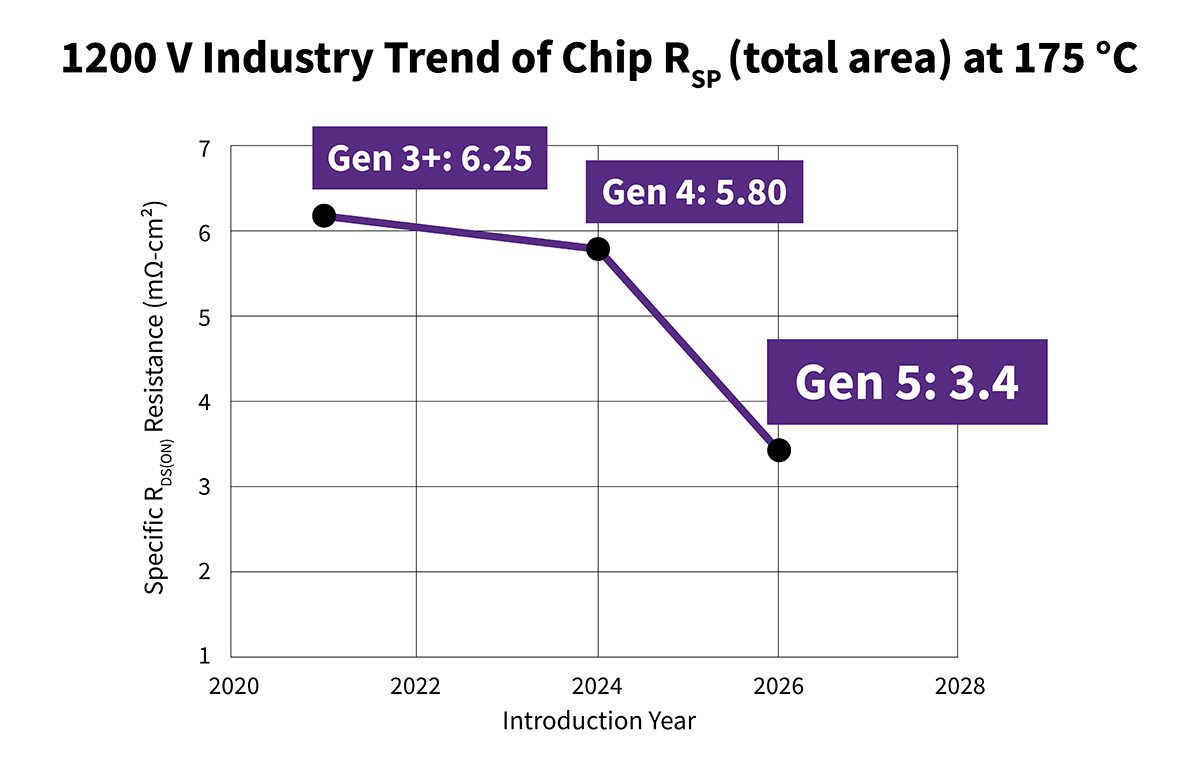
- The new Gen 5 devices boast the industry’s lowest specific on-resistance (RSP) in a compact 5×5 mm SiC footprint, enhancing power density and efficiency.
- Improvements include a continuous junction temperature rating of 200° C, reduced reverse recovery charge, and tight RDS(ON) distribution, optimizing thermal and switching performance.
- These advancements enable smaller, more efficient EV traction inverters, potentially allowing for lighter battery packs and facilitating advanced solid-state circuit breaker designs.
- Manufactured on Wolfspeed’s 200 mm wafer platform, Gen 5 offers a low-risk upgrade path for existing customers, ensuring faster time-to-market.
Pioneering the Future of Electric Mobility with Advanced SiC Technology
In a significant stride for the electric vehicle (EV) industry and broader power electronics landscape, Wolfspeed has officially introduced its fifth-generation silicon carbide (SiC) MOSFET technology. This latest innovation is poised to redefine performance benchmarks for 1,200 V and 750 V automotive and industrial applications, particularly for critical components like EV traction inverters.

The launch underscores Wolfspeed’s continued commitment to advancing SiC technology, which is increasingly vital for achieving higher efficiency, smaller footprints, and enhanced reliability in power conversion systems. With global efforts intensifying to electrify transportation and industrial processes, the demand for high-performance semiconductor solutions is at an all-time high.
Breaking Down the Technology: Gen 5 SiC MOSFETs
The new Gen 5 silicon carbide MOSFETs represent a culmination of extensive research and development, building upon Wolfspeed’s deep expertise in SiC materials and device physics. These chips are engineered to address the most pressing challenges in high-power applications, offering a suite of improvements that translate directly into operational advantages.
Unprecedented On-Resistance Levels
A cornerstone of the Gen 5 technology is its remarkably low specific on-resistance (RSP). This metric is crucial as it quantifies the resistance of a semiconductor device when it is turned on, directly impacting power loss and heat generation. Wolfspeed’s new chips achieve the lowest RSP available within a compact 5×5 mm SiC footprint, allowing for greater current handling capability in a smaller form factor.

Specifically, the 1,200 V QEM50120-025D10 variant demonstrates an impressive chip-level RSP of 3.4 mΩ·cm² at 175° C. For the 750 V QEM50075-025D10, this figure drops to an exceptional 2.0 mΩ·cm² at the same operating temperature. These values signify a substantial reduction in conduction losses, which is paramount for improving the overall energy efficiency of EV traction inverters and industrial power supplies.
Furthermore, Wolfspeed has meticulously engineered these devices to maintain tight control over the RDS(ON) distribution, holding it to a precise ±18%. This consistency across individual components significantly reduces the design margin that engineers typically need to factor in for part-to-part variation, simplifying thermal management and efficiency budget planning for complex systems.
Robust Thermal Performance and Reliability
Thermal management remains a critical consideration in high-power applications. The Gen 5 silicon carbide MOSFETs address this by raising the continuous junction temperature rating to an impressive 200° C, with a limited life rating extending to 215° C. This enhanced thermal resilience allows for operation in more demanding environments and contributes to greater overall system reliability and longevity.
The ability to operate at higher temperatures simplifies cooling system designs, potentially reducing the need for elaborate and costly thermal solutions. This is particularly beneficial for compact EV traction inverters, where space and weight are at a premium. By enduring more strenuous thermal conditions, these MOSFETs ensure consistent performance and extended operational lifespan for critical automotive and industrial systems.
Optimised Switching Dynamics
Beyond conduction losses, switching losses are another key area for efficiency improvement in power electronics. The new Gen 5 technology incorporates a significant reduction in reverse recovery charge, a critical parameter that impacts how efficiently a diode recovers from a conducting state to a blocking state. This reduction directly translates to lower overall switching losses.
The retention of Gen 4’s soft body diode further contributes to improved switching characteristics. A soft body diode minimizes voltage and current overshoot during switching transitions, reducing electromagnetic interference (EMI) and improving system robustness. The combined reduction in both conduction and switching losses makes these SiC MOSFETs highly efficient across a wide range of operating conditions.
Transformative Impact on EV Design
The performance enhancements delivered by Wolfspeed’s Gen 5 silicon carbide MOSFETs have far-reaching implications for the design and capabilities of electric vehicles and associated infrastructure.
Smaller, More Efficient Traction Inverters
One of the most immediate benefits is the ability to design smaller and more efficient traction inverters. The lower specific on-resistance in a fixed die area means that a given inverter footprint can now pass more current. This higher power density directly enables inverter manufacturers to shrink the physical size of their components without compromising performance.
Smaller traction inverters translate into reduced weight and more flexible packaging options within the constrained spaces of an electric vehicle chassis. Furthermore, the improved efficiency, particularly at high temperatures, reduces energy waste, allowing for better overall vehicle range and performance. For EV manufacturers, this can mean an opportunity to downsize battery packs, as less capacity is needed to compensate for inverter losses, leading to lighter vehicles and potentially lower manufacturing costs.
Enabling Advanced EV Architectures
Beyond traditional inverter applications, Gen 5 SiC MOSFETs unlock new possibilities for advanced EV architectures. Wolfspeed specifically highlights that this technology allows for the design of solid-state circuit breakers to replace conventional mechanical relays in electric vehicle systems.
Solid-state circuit breakers offer numerous advantages over their mechanical counterparts, including faster response times, greater reliability, quieter operation, and significantly longer lifespan due to the absence of moving parts. Their integration can enhance safety and system responsiveness in high-voltage EV battery management and distribution systems, representing a key step towards more robust and intelligent vehicle electronics.
Strategic Manufacturing and Seamless Integration
A crucial aspect of Wolfspeed’s Gen 5 launch is its manufacturing readiness and customer-centric integration strategy. This marks the second generation of Wolfspeed’s MOSFETs to be built on the company’s advanced 200 mm wafer platform located in Mohawk Valley, New York.
Crucially, this new generation requires no new manufacturing toolsets for volume production. This was a deliberate design choice, strategically positioned by Wolfspeed as a low-risk upgrade path for its extensive customer base already qualified on the Gen 4 platform. This continuity in manufacturing processes ensures a smoother transition for partners, minimizing re-qualification efforts and accelerating product integration cycles.
Dr. Adam Barkley, VP of Power Device and Package Development at Wolfspeed, underscored the importance of this seamless integration. He stated, “For customers facing compressed development timelines, that means faster validation, faster qualification, and faster time to market—without sacrificing the performance they know and trust.” This commitment to ease of adoption is vital in the fast-paced automotive industry, where development cycles are constantly shrinking and time-to-market is a critical competitive advantage.
Industry Perspective and Future Outlook
The introduction of Wolfspeed’s fifth-generation silicon carbide MOSFETs reinforces the pivotal role of SiC technology in driving the evolution of electric vehicles and industrial power systems. As the automotive industry pushes towards higher voltage architectures (e.g., 800V systems) and greater power density requirements, advanced SiC devices become indispensable.
These innovations are not just about incremental improvements; they represent foundational advancements that enable new levels of performance, efficiency, and system design flexibility. By continually pushing the boundaries of SiC technology, Wolfspeed contributes significantly to the broader sustainability goals of reducing energy consumption and carbon emissions across various sectors.
The robust performance, combined with a streamlined manufacturing and integration path, positions Wolfspeed’s Gen 5 SiC MOSFETs as a critical enabler for the next wave of electrification, promising more powerful, efficient, and reliable systems for the global market.
Frequently Asked Questions (FAQ)
What is the primary innovation of Wolfspeed’s Gen 5 SiC MOSFETs?
The main innovation is the achievement of the lowest specific on-resistance (RSP) in a 5×5 mm SiC footprint for 1,200 V and 750 V devices. This significantly boosts power density and efficiency, crucial for high-performance applications like EV traction inverters.
How do these new MOSFETs improve EV traction inverters?
Lower RSP enables more current handling in a given area, allowing for smaller and lighter traction inverters. Improved efficiency at high temperatures also reduces energy losses, potentially leading to smaller battery pack requirements and enhanced vehicle range.
What are the thermal performance improvements in Gen 5?
Gen 5 SiC MOSFETs feature a continuous junction temperature rating of 200° C, with a limited life rating up to 215° C. This enhanced thermal capability allows for more reliable operation in demanding conditions and simplifies thermal management system designs.
Can Gen 5 SiC MOSFETs be used for applications other than EV traction inverters?
Yes, while specifically highlighted for EV traction inverters, these 1,200 V and 750 V silicon carbide MOSFETs are also designed for a wide range of industrial applications requiring high efficiency, power density, and robust thermal performance.
What does the term ‘low-risk upgrade path’ mean for customers?
It means that Gen 5 MOSFETs are manufactured on Wolfspeed’s existing 200 mm wafer platform and require no new toolsets. This allows customers already qualified on Gen 4 to transition to Gen 5 more easily, reducing validation, qualification, and time-to-market efforts.
What is the significance of the reduced RDS(ON) distribution?
The tight ±18% RDS(ON) distribution minimizes part-to-part variation. This consistency reduces the safety margins engineers must account for in their designs, allowing for more optimized and predictable thermal and efficiency budgets in complex power systems.
How do these MOSFETs contribute to new EV architectural possibilities?
The advanced performance and reliability of Gen 5 SiC MOSFETs facilitate the design of solid-state circuit breakers. These electronic alternatives can replace traditional mechanical relays in EVs, offering faster response, higher reliability, and improved safety features for high-voltage systems.