
TL;DR Key Takeaways:
- Wolfspeed has launched its fifth-generation silicon carbide MOSFET technology, targeting 1,200 V and 750 V applications in electric vehicles (EVs) and industrial sectors.
- The new chips offer the lowest specific on-resistance (RSP) for their 5×5 mm SiC footprint, enhancing power density and efficiency.
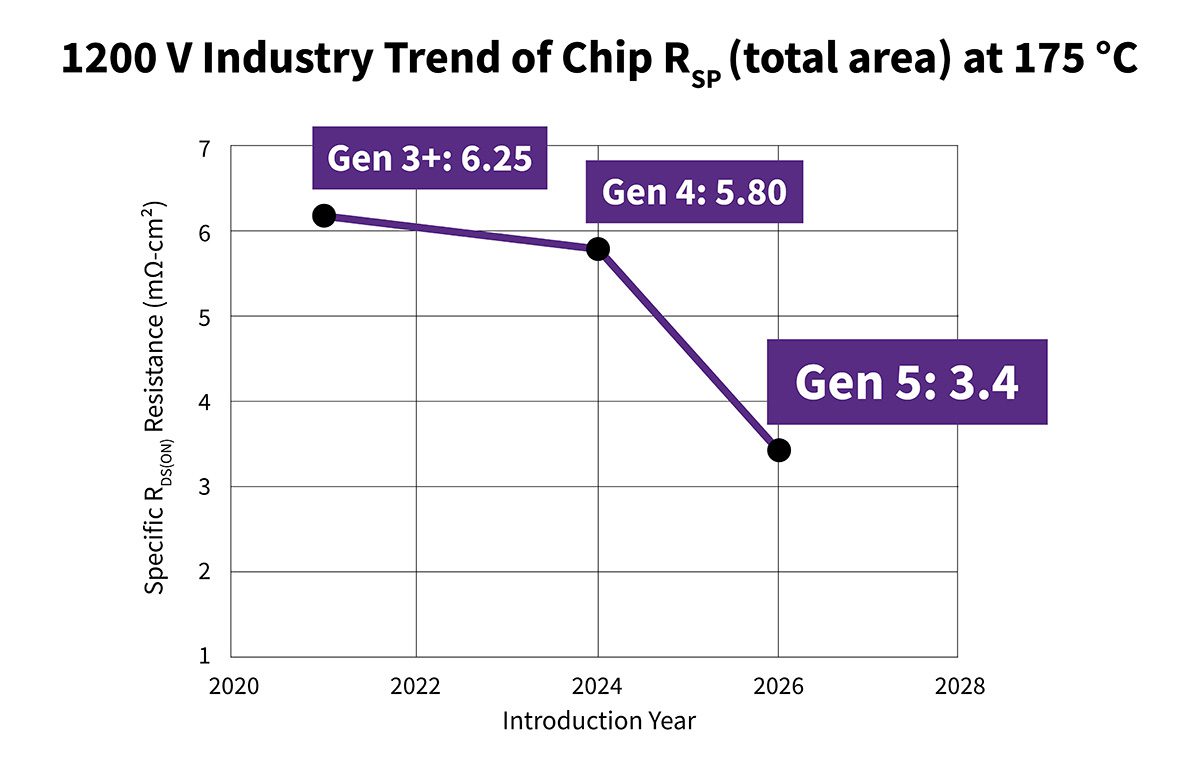
- Key improvements include a chip-level RSP of 3.4 mΩ·cm² for 1,200V and 2.0 mΩ·cm² for 750V variants, measured at 175°C.
- These advancements enable smaller traction inverters, improved efficiency at high temperatures, and potential for reduced battery pack sizes.
- The Gen 5 MOSFETs are built on Wolfspeed’s established 200 mm wafer platform, ensuring a low-risk and rapid qualification path for existing customers.
- The technology also supports innovative solid-state circuit breaker designs, offering a modern alternative to traditional mechanical relays in EV architectures.
Wolfspeed Introduces Fifth-Generation SiC MOSFET Technology
Wolfspeed, a global leader in silicon carbide technology, has officially unveiled its fifth-generation silicon carbide (SiC) MOSFET technology. This pivotal advancement is engineered to cater to high-performance 1,200 V and 750 V automotive and industrial applications, promising a significant leap in efficiency and power density.

The introduction of these new chips marks a crucial development for the electric vehicle (EV) sector, particularly for traction inverters. The superior characteristics of this silicon carbide MOSFET technology are poised to drive enhanced performance, streamline designs, and foster greater reliability in next-generation power electronics.
Unprecedented On-Resistance in a Compact Footprint
A hallmark of Wolfspeed’s Gen 5 silicon carbide MOSFET technology is its claim to the lowest specific on-resistance (RSP) available within a standard 5×5 mm SiC footprint. This attribute is critical for engineers seeking to maximise power output while minimising energy losses in demanding applications.
The 1,200 V QEM50120-025D10 variant achieves a remarkable chip-level RSP of 3.4 mΩ·cm² when operating at an elevated temperature of 175° C. Similarly, the 750 V QEM50075-025D10 demonstrates an impressive RSP of 2.0 mΩ·cm² at the same operating temperature, setting new benchmarks for efficiency.

Beyond the low RSP, both new components exhibit a tight RDS(ON) distribution, maintained within ±18%. This consistency is invaluable for design engineers, as it significantly reduces the margin they traditionally need to allocate for part-to-part variation when budgeting for inverter thermal management and overall efficiency.
Enhanced Thermal Management and Switching Efficiency
The new generation of Wolfspeed silicon carbide MOSFETs also brings substantial improvements in thermal performance and switching characteristics. The continuous junction temperature rating has been elevated to 200° C, with a limited life rating extending to 215° C, offering greater resilience in harsh operating conditions typical of automotive environments.
Crucially, the Gen 5 technology retains the soft body diode feature that was characteristic of its Gen 4 predecessor. This feature is vital for smooth operation and reduced stress on the device during reverse recovery events.
Furthermore, engineers have achieved a reduction in reverse recovery charge. This improvement directly translates to lower overall switching losses, complementing the gains made in conduction loss reduction through superior specific on-resistance. The synergistic effect of these enhancements leads to a more efficient power conversion system.
Driving Innovation in EV Traction Inverters and Battery Systems
The lower specific on-resistance in a fixed die area means that a given inverter footprint can now manage and pass a greater amount of current. This capability empowers manufacturers to design smaller, more compact traction inverters for electric vehicles, which is a key advantage in space-constrained automotive designs.
Moreover, the enhanced efficiency at high temperatures allows for better thermal management solutions within the inverter system. This directly impacts vehicle performance, potentially leading to increased range or enabling the option to downsize battery packs. Instead of compensating for inverter losses with extra battery capacity, designers can now optimise for lighter, more cost-effective energy storage solutions.
Beyond traditional inverter applications, Wolfspeed highlights that its latest silicon carbide MOSFET technology facilitates the adoption of solid-state circuit breaker designs. These can serve as a modern and more reliable replacement for conventional mechanical relays within advanced EV architectures, enhancing safety and responsiveness.
Leveraging Established Manufacturing for Rapid Market Adoption
The Gen 5 silicon carbide MOSFET technology represents the second generation of Wolfspeed’s MOSFETs to be fabricated on the company’s advanced 200 mm wafer platform located in Mohawk Valley, New York. A deliberate strategic decision was made to ensure that this new technology requires no new manufacturing toolsets for high-volume production.
This approach positions Gen 5 as a low-risk upgrade path for Wolfspeed’s existing customer base, particularly those already qualified on Gen 4 products. The continuity in manufacturing processes simplifies adoption and accelerates market entry for automotive and industrial partners.
Dr. Adam Barkley, Vice President of Power Device and Package Development at Wolfspeed, underscored this benefit. He stated, “For customers facing compressed development timelines, that means faster validation, faster qualification, and faster time to market—without sacrificing the performance they know and trust.” This commitment to a seamless transition reinforces Wolfspeed’s dedication to customer success and rapid innovation.
The Enduring Impact of Silicon Carbide MOSFET Technology
The continuous evolution of silicon carbide MOSFET technology is fundamentally reshaping the landscape of power electronics. Wolfspeed’s Gen 5 MOSFETs exemplify this trend by offering unparalleled performance metrics that directly address the escalating demands of the electric vehicle market and sophisticated industrial applications.
These advancements contribute significantly to making EVs more efficient, powerful, and ultimately more accessible. As the automotive industry increasingly shifts towards electrification, the role of high-performance components like these silicon carbide MOSFETs becomes ever more critical in achieving sustainable and efficient mobility solutions.
The push for smaller, lighter, and more powerful components continues unabated, and Wolfspeed’s latest offering positions it at the forefront of this technological frontier. The Gen 5 silicon carbide MOSFETs are set to play a crucial role in enabling the next generation of power conversion systems.
Frequently Asked Questions (FAQ)
What are Wolfspeed’s new Gen 5 SiC MOSFETs designed for?
Wolfspeed’s fifth-generation silicon carbide (SiC) MOSFETs are primarily designed for high-performance 1,200 V and 750 V applications. These include critical components like traction inverters in electric vehicles (EVs) and various high-power industrial systems, aiming to enhance efficiency and power density significantly.
What is specific on-resistance (RSP) and why is it important for these new chips?
Specific on-resistance (RSP) is a key metric indicating how efficiently a power semiconductor conducts current. A lower RSP, as achieved by Wolfspeed’s Gen 5 SiC MOSFETs (3.4 mΩ·cm² for 1,200V and 2.0 mΩ·cm² for 750V at 175°C), means less energy is lost as heat, leading to higher efficiency and allowing more current to pass through a smaller device footprint.
How do Gen 5 SiC MOSFETs improve EV traction inverter design?
The improved specific on-resistance and reduced switching losses of the Gen 5 silicon carbide MOSFET technology enable the design of smaller and more efficient traction inverters. This allows for increased power density, better thermal performance, and potentially the use of smaller, lighter battery packs, reducing overall vehicle weight and cost.
What is the significance of the 200°C continuous junction temperature rating?
A continuous junction temperature rating of 200°C signifies enhanced thermal robustness for the Gen 5 SiC MOSFETs. This allows the devices to operate reliably under more extreme temperature conditions, which are common in demanding automotive and industrial environments, extending their lifespan and improving system stability.
What benefits do customers already qualified on Gen 4 SiC MOSFETs gain from Gen 5?
Customers already qualified on Wolfspeed’s Gen 4 products benefit from a low-risk upgrade path to Gen 5. Since Gen 5 is manufactured on the same 200 mm wafer platform and requires no new tooling, it ensures faster validation, qualification, and time to market, preserving trusted performance with enhanced capabilities.
Can these new SiC MOSFETs be used beyond EV traction inverters?
Yes, while a significant focus is on EV traction inverters, Wolfspeed’s Gen 5 silicon carbide MOSFET technology is also applicable to a broad range of industrial applications requiring high-voltage and high-efficiency power conversion. Additionally, the technology supports the development of solid-state circuit breakers as a modern alternative to mechanical relays.