
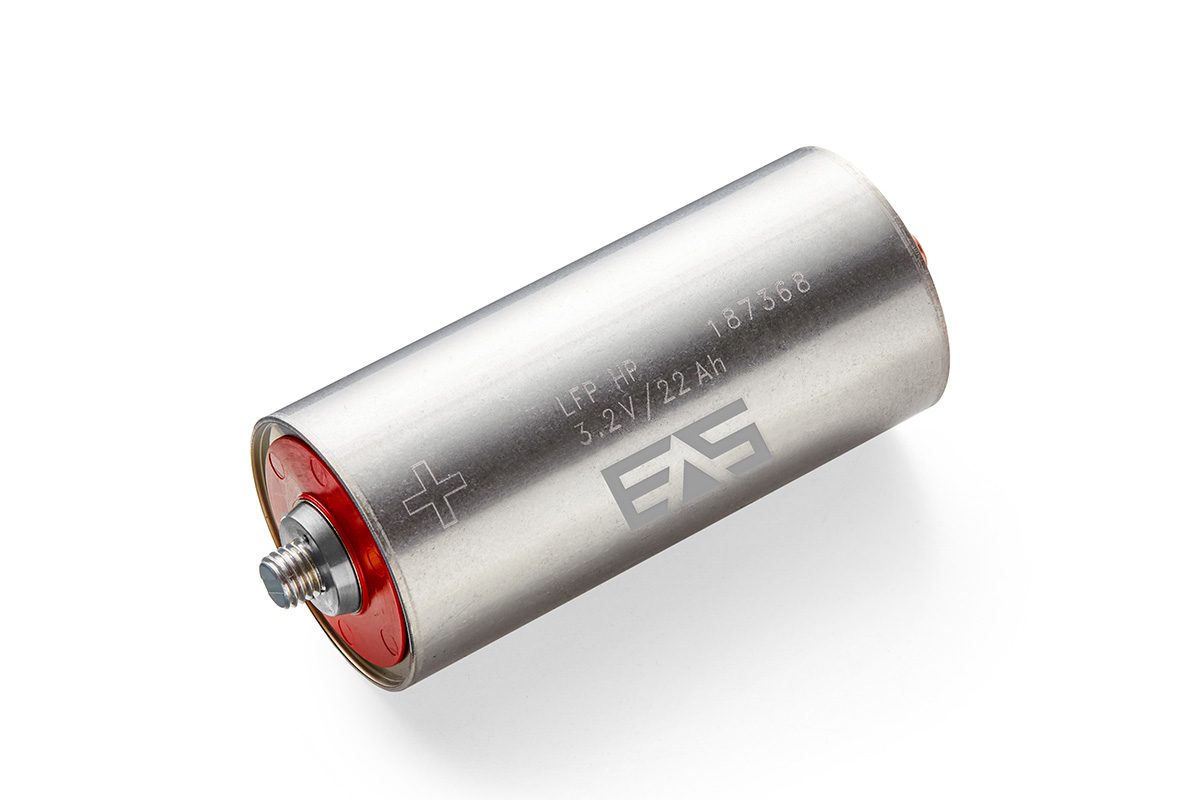
German battery innovator EAS Batteries has announced the commercial launch of its UHP601300 LFP 22, a groundbreaking large-format cylindrical LFP cell. This advanced cell integrates Asahi Kasei’s proprietary Acetolyte, an acetonitrile-based electrolyte, which promises to redefine performance benchmarks for LFP battery technology across various demanding applications. The collaboration between EAS Batteries and Japanese chemical giant Asahi Kasei marks a significant leap forward in battery engineering.
According to both companies, the Acetolyte electrolyte delivers superior ionic conductivity, substantially lower internal resistance, and enhanced rate capability across a broader spectrum of temperatures. These characteristics are poised to address several long-standing limitations associated with conventional carbonate-solvent-based electrolytes, paving the way for more robust and efficient power solutions.

Key Takeaways (TL;DR)
- EAS Batteries has launched a new LFP cell (UHP601300 LFP 22) featuring Asahi Kasei’s acetonitrile-based Acetolyte electrolyte.
- This new LFP battery technology offers a 60% improvement in continuous power compared to conventional EAS cells.
- The Acetolyte electrolyte provides higher ionic conductivity, lower internal resistance, and better rate capability over a wider temperature range.
- Key benefits include enhanced performance at low temperatures and improved durability at high temperatures.
- The cell boasts an impressive cycle life of 2,400 cycles at 5C/5C, 100% DoD, with 80% capacity retention.
- Target applications include high-rate sectors like motorsport, aerospace, and heavy industrial equipment.
- EAS Batteries and Asahi Kasei are actively developing a 46xxx cylindrical format, targeting low-voltage EV batteries and aiming for sublicensing to global OEMs.
Unpacking the Acetolyte Advantage for LFP Battery Technology
The core innovation lies in the acetonitrile-based Acetolyte electrolyte. Electrolytes are the lifeblood of a battery, facilitating the movement of ions between the anode and cathode. Traditional lithium-ion batteries often rely on carbonate-based electrolytes, which can face challenges in extreme temperatures and may contribute to higher internal resistance, thereby limiting power output and overall efficiency.
The introduction of Acetolyte represents a critical advancement. Its inherent properties allow for faster ion transport within the battery, translating directly into the reported performance enhancements. This is particularly crucial for the adoption and widespread success of LFP battery technology, which is already valued for its safety, cost-effectiveness, and long cycle life.
Enhanced Power Delivery and Endurance
The performance metrics of the UHP601300 LFP 22 cell, when compared to EAS cells using conventional electrolytes, highlight a remarkable leap forward. The nominal capacity stands at a robust 22 Ah.
A staggering 60% improvement in continuous power is observed, with the new cell achieving 2,550 W/kg and 880 A (40C) compared to 1,550 W/kg and 550 A (25C) for its conventional counterpart. This substantial gain in sustained current delivery is a game-changer for applications requiring prolonged, high-rate power output, where momentary peaks are less critical than consistent energy flow.
While the pulse discharge gain is a more modest 10%, reaching 3,760 W/kg and 1,320 A (60C) versus 3,420 W/kg and 1,320 A (60C), it still signifies enhanced capability for brief, intense bursts of power. This balanced improvement across both continuous and pulse discharge profiles makes the new LFP battery technology versatile for a wide array of demanding power requirements.
Unprecedented Temperature Resilience
A common challenge for conventional lithium-ion cells, particularly LFP variants, has been their performance degradation in extreme temperatures. Asahi Kasei asserts that Acetolyte directly addresses these persistent issues by enabling superior power output in cold conditions and significantly improving durability during high-temperature operation.
This thermal resilience is a vital characteristic, especially for equipment deployed in diverse global climates or applications exposed to significant thermal stress. Enhanced low-temperature performance ensures reliable operation in cold environments, which has historically been a weak point for LFP battery technology. Simultaneously, improved high-temperature durability extends the battery’s lifespan and maintains performance even under rigorous operating conditions, enhancing the overall safety and reliability of the power system.
Longevity and Durability Metrics
The UHP601300 LFP 22 cell also sets a high standard for longevity. It boasts an impressive cycle life of 2,400 cycles at 5C/5C, with 100% Depth of Discharge (DoD) and maintaining 80% capacity retention. This metric is crucial for defining the operational lifespan of a battery and signifies exceptional durability under challenging charge and discharge rates. Such robust cycle life performance makes this LFP battery technology an economically viable and dependable choice for long-term power solutions, reducing the frequency of replacements and associated costs.
Strategic Applications and Industry Impact
The performance characteristics of these new cells are tailored for sectors where sustained power and reliability are paramount. EAS Batteries confirms that samples are currently undergoing rigorous customer evaluation across multiple industries, signaling strong potential for adoption.
High-Performance Demands Met
High-rate applications such as motorsport, aerospace, and heavy industrial equipment stand to benefit immensely from this innovative LFP battery technology. In motorsport, the ability to deliver sustained, high power output is critical for competitive performance. For aerospace, consistent and reliable power under varying environmental conditions is non-negotiable for safety and operational efficiency. Similarly, heavy industrial machinery demands robust batteries capable of enduring continuous heavy loads without performance degradation, where the 60% improvement in continuous power will be a significant advantage.
The Future: 46xxx Format and EV Integration
Looking ahead, EAS Batteries and Asahi Kasei are actively exploring the integration of this advanced electrolyte into the 46xxx cylindrical format. Prototypes of these larger cells are already available, with commercial launch anticipated later this year.
Accelerating EV Battery Innovation
This 46xxx format is specifically designed with low-voltage Electric Vehicle (EV) batteries in mind. The move into this standardized, larger cylindrical cell format holds significant implications for the automotive industry, which is increasingly seeking high-performance, cost-effective, and safe battery solutions. By targeting low-voltage EV applications, this advanced LFP battery technology could unlock new possibilities for vehicle designs, performance enhancements, and overall EV adoption rates.
EAS and Asahi Kasei express ambitions to sublicense this combined technology to global original equipment manufacturers (OEMs) and other battery manufacturers. This strategy could accelerate the widespread integration of acetonitrile-based electrolytes into next-generation EV platforms, fundamentally impacting the global EV battery supply chain and performance standards.
A Testament to Collaborative Innovation
The rapid progression from concept to commercialization underscores the efficacy of the partnership between EAS Batteries and Asahi Kasei. Osamu Matsuzaki, Senior Executive Officer and Head of Corporate R&D and IP at Asahi Kasei, highlighted the efficiency of this collaboration: “The short time from signing our license agreement in November 2025 to the start of serial production in March 2026 reflects the focused and highly collaborative efforts between EAS Batteries and Asahi Kasei.” This swift turnaround from agreement to production demonstrates a shared commitment to accelerating battery innovation and bringing cutting-edge LFP battery technology to market.
Conclusion
The commercial launch of EAS Batteries’ UHP601300 LFP 22 cell, powered by Asahi Kasei’s Acetolyte electrolyte, represents a significant milestone in LFP battery technology. By offering superior continuous power, enhanced temperature resilience, and exceptional cycle life, this innovation is set to address critical performance gaps in high-rate applications and pave the way for advancements in the broader EV market. The strategic collaboration between these two industry leaders underscores a powerful synergy aimed at pushing the boundaries of what LFP batteries can achieve, ultimately driving forward the electrification of various industrial and automotive sectors.
Frequently Asked Questions (FAQ)
What is the primary innovation in the new EAS Batteries LFP cell?
The key innovation is the integration of Asahi Kasei’s Acetolyte, an acetonitrile-based electrolyte, into a large-format cylindrical LFP cell. This electrolyte significantly enhances battery performance, particularly in terms of power output and temperature stability, advancing LFP battery technology.
How does Acetolyte improve battery performance compared to conventional electrolytes?
Acetolyte offers higher ionic conductivity, lower internal resistance, and superior rate capability across a wider temperature range. This results in a 60% improvement in continuous power, better performance in low temperatures, and increased durability at high temperatures.
Which industries are expected to benefit most from this new LFP battery technology?
Industries requiring high-rate, sustained power delivery are key beneficiaries. These include motorsport, aerospace, and heavy industrial equipment, where consistent current and reliable performance under challenging conditions are crucial for operational success.
What is the cycle life of the UHP601300 LFP 22 cell?
The UHP601300 LFP 22 cell demonstrates an impressive cycle life of 2,400 cycles. This is achieved at 5C/5C, 100% Depth of Discharge (DoD), while retaining 80% of its initial capacity, indicating exceptional long-term durability for this LFP battery technology.
What are the future plans for this LFP battery technology in the EV sector?
EAS Batteries and Asahi Kasei are developing prototypes in the 46xxx cylindrical format, targeting low-voltage EV batteries. They aim to launch this product soon and sublicense the combined technology to global OEMs and battery manufacturers to accelerate EV innovation.