
Key Takeaways (TL;DR):
- An independent test reveals the Rivian R2 charges from 10% to 80% in 26 minutes and 51 seconds, surpassing Rivian’s official 29-minute claim by over two minutes.
- The electric vehicle achieved a peak charging power of 226 kilowatts (kW) during the test.
- Optimising the Rivian R2 charging speed requires specific knowledge of charger amperage capabilities, as the R2 can accept over 600 amps.
- Utilising a high-amp CCS connector with an appropriate adapter, even for the R2’s native NACS port, was key to unlocking this performance.
- While not class-leading among all EVs, the R2’s charging performance is deemed ‘acceptable’ and comparable to a Tesla Model Y, positioning it well for road trips.
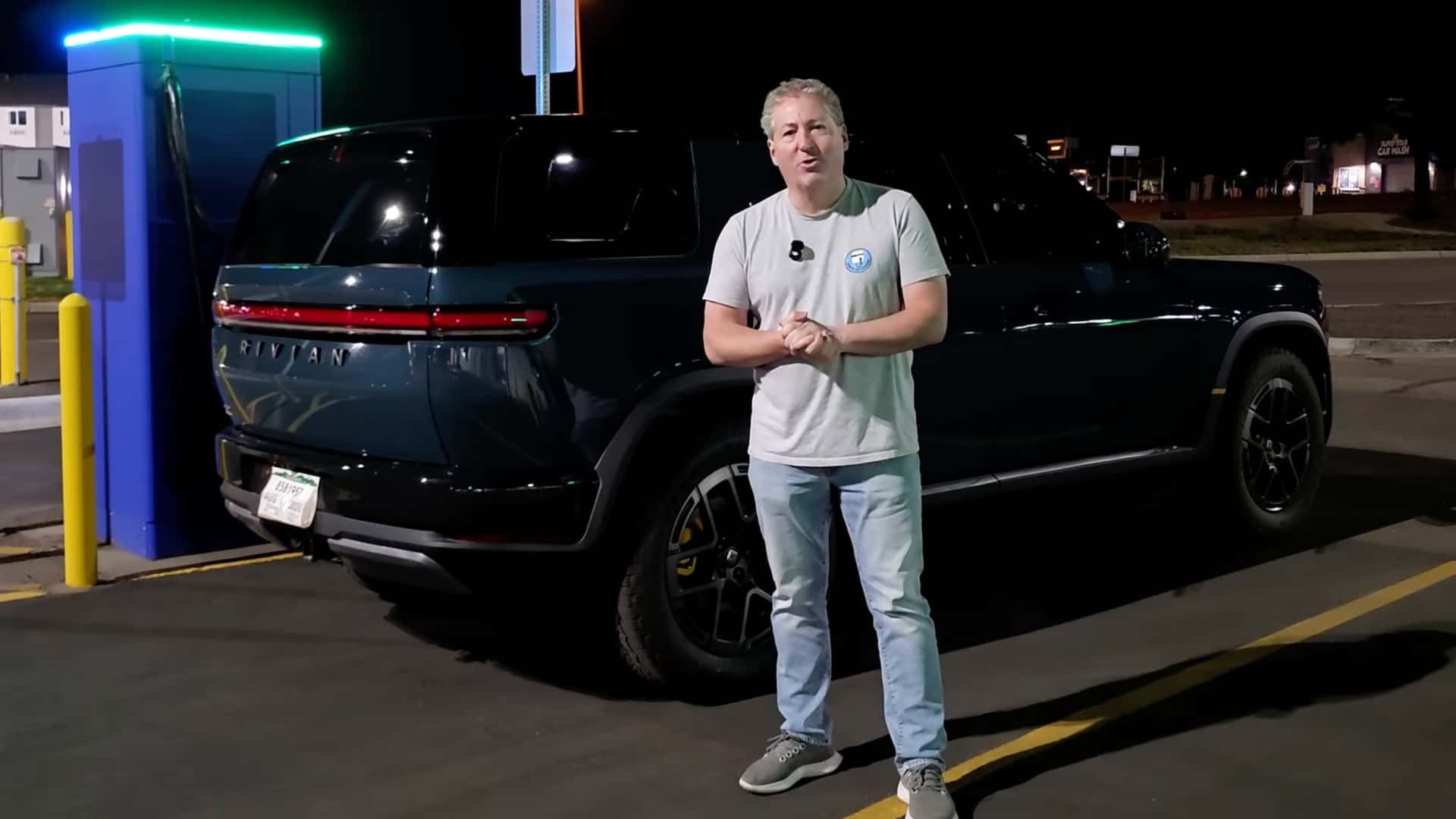
The Rivian R2, one of the most anticipated electric vehicles (EVs) of the year, is finally reaching customer hands, moving beyond controlled media previews. With this transition, real-world performance data is emerging, offering critical insights into its capabilities. A recent independent fast-charging evaluation has shed significant light on the vehicle’s rapid charging performance, revealing that it can charge from 10% to 80% battery capacity even faster than the manufacturer’s stated figures, provided a specific charging technique is employed.
This comprehensive test, conducted by Tom Moloughney of the reputable State of Charge YouTube channel, offers a detailed look at the R2’s all-important 10-80% charging cycle. This particular range is crucial for electric vehicle owners, especially those embarking on long-distance journeys, as it represents the most efficient and practical window for public DC fast charging.
Unpacking the Rivian R2’s Charging Performance
The Rivian R2 has garnered considerable excitement since its announcement, and its real-world performance validation is vital for consumer confidence. The charging speed of an electric vehicle is a primary concern for potential buyers, directly influencing convenience and usability, particularly for those who plan to use their EVs for extensive travel.
The Critical 10-80% Charging Window
For most electric vehicle owners, the sweet spot for DC fast charging typically falls between 10% and 80% State of Charge (SoC). Below 10%, battery performance can be stressed, and charging is often initiated to avoid complete depletion. Above 80%, the charging rate typically slows down significantly to protect battery health and extend its lifespan. Therefore, the duration it takes to charge within this 10-80% window is a key metric for evaluating an EV’s practical fast-charging capabilities on a road trip.
Exceeding Manufacturer’s Promises: The Key Findings
Rivian had officially claimed a 10-80% charge time of 29 minutes for the R2. However, Moloughney’s independent evaluation demonstrated a superior result, with the R2 completing the 10-80% charging cycle in an impressive 26 minutes and 51 seconds. This achievement represents a notable improvement of approximately two minutes over Rivian’s advertised time, offering a pleasant surprise for prospective owners and underscoring the Rivian R2 charging speed potential.
The Charging Curve Analysed: A Minute-by-Minute Breakdown
Understanding the charging curve – how charging power (in kilowatts) changes as the battery’s state of charge increases – is crucial for assessing an EV’s real-world usability. A flat, consistent curve is generally preferred, but most vehicles see power taper off as the battery fills. The R2’s performance demonstrated a robust initial phase followed by a managed decline.
Initial Surge: Breaking 200 kW
The test revealed the Rivian R2’s impressive ability to rapidly escalate its charging power. Within a mere 38 seconds of plugging in, the vehicle was already charging at a rate exceeding 200 kilowatts. This quick ramp-up is vital for minimising overall charging time and ensuring efficient power delivery from the outset of a charging session, particularly when drivers are keen to get back on the road swiftly.
Peak Performance: 226 kW at 31% State of Charge
The charging power continued its upward trajectory, reaching a peak of 226 kW when the battery was at 31% SoC. Following this peak, the charging power began its gradual step-down, a common characteristic designed to protect the battery and manage thermal conditions. Despite the subsequent tapering, this high peak rate highlights the R2’s capability to absorb substantial power in its prime charging window.
Sustained Power for Mid-Range Travel
The R2 demonstrated commendable sustained charging rates throughout the mid-range of its battery capacity. After approximately 10 minutes, the vehicle achieved a 45% state of charge, drawing 171 kW. According to Moloughney’s separate 70 mph range test results, this charge level translates to roughly 100 miles of highway driving in moderate temperatures, making it a highly efficient stop for adding significant range quickly. By the 15-minute mark, the R2 had recouped about half its battery capacity, reaching a 60% SoC while pulling 135 kW.
Approaching Full Charge: Efficiency Tapering
As the battery approached an 80% state of charge, the power delivery naturally tapered down. It took an additional five minutes for the R2 to reach 70% SoC, at which point it was accepting 116 kW. Upon hitting the 80% mark, after the full 26 minutes and 51 seconds, the charging power had decreased to 68 kW. This controlled reduction in power is standard practice across EVs to preserve battery health and ensure longevity, even if it means slower top-offs.
Real-World Range Recovery: Miles Added Per Minute
Translating charging speed into practical driving range added per minute offers a tangible metric for drivers. Based on his 70 mph range test, Moloughney calculated that the Rivian R2 was able to add approximately 50 miles of driving range in about five minutes of charging. Furthermore, it regained 100 miles of range in roughly 11 minutes, and a substantial 150 miles of range in around 19 minutes. These figures underscore the R2’s capability to quickly replenish sufficient range for continued journeying, reinforcing its suitability for road trips.
Benchmarking Rivian R2 Charging Speed Against Competitors
While the R2’s charging performance is commendable, it’s important to view it within the broader context of the evolving EV market. Moloughney, an experienced EV tester, offered a balanced perspective on the vehicle’s standing. He stated, “This is not a top-of-class characteristic of R2. But as far as I’m concerned it is acceptable.”
This assessment suggests that while the Rivian R2 charging speed is strong, it does not set new industry benchmarks. The performance roughly aligns with what can be expected from a Tesla Model Y, a popular and well-regarded competitor in the electric SUV segment. However, it is noted to be several minutes slower than 800-volt EVs, such as the Hyundai Ioniq 5. Vehicles with 800-volt architectures typically allow for significantly faster charging rates, particularly in the lower to mid-SoC ranges, due to their ability to handle higher voltages and currents more efficiently.
Unlocking Optimal Rivian R2 Charging Speed: The Amperage Advantage
A crucial detail emerged from the testing: to achieve the fastest possible charging times with the Rivian R2, drivers need to be aware of the charging station’s amperage capabilities. The R2 is designed to accept over 600 amps of current. However, not all public fast chargers are equipped to dispense such high levels of amperage, even if their kilowatt rating appears sufficient.
Moloughney highlighted that certain chargers, specifically Alpitronic units often found at Walmart and Ionna charging networks, are capable of delivering this high current. The ABB A400 unit used for the test also possesses a 600-amp capability, but with a critical distinction: this high current is delivered via its Combined Charging System (CCS) connector, not through its North American Charging Standard (NACS) plug.
Given that the Rivian R2 features a native NACS port, this posed a challenge. To circumvent this, Moloughney ingeniously employed a NACS-to-CCS adapter, rated for 500 amps, and connected it to the CCS side of the ABB A400 charger. This strategic choice allowed him to leverage the charger’s higher amperage output, thereby maximising the current flowing into the R2 and unlocking its superior Rivian R2 charging speed. This ‘trick’ demonstrates that a deeper understanding of charging infrastructure can significantly enhance the EV ownership experience.
The Broader Implications for EV Road Tripping
The Rivian R2’s validated charging performance, especially its ability to beat claimed times with an informed approach, positions it as a highly capable vehicle for long-distance travel. For many potential EV buyers, range anxiety and charging times remain significant concerns. The R2’s demonstrated efficiency in replenishing its battery quickly means less downtime on journeys, making it a practical choice for road trips.
The discovery of optimal charging strategies also underscores the evolving sophistication of the EV ecosystem. As vehicles become more advanced and charging infrastructure expands, knowing how to best utilise available resources will become increasingly valuable for drivers seeking the ultimate convenience and efficiency from their electric vehicles.
Conclusion
The independent fast-charging test of the Rivian R2 provides compelling evidence of its robust performance. By achieving a 10-80% charge in under 27 minutes—surpassing Rivian’s own claims—the R2 demonstrates strong capabilities for real-world driving. While its overall Rivian R2 charging speed might not eclipse every competitor, it offers highly acceptable performance, on par with vehicles like the Tesla Model Y. The key takeaway for owners and enthusiasts is the importance of understanding charger specifications, particularly amperage, to fully harness the R2’s rapid charging potential. This attention to detail can transform a standard charging session into an optimised experience, further solidifying the R2’s appeal as a formidable contender in the rapidly expanding electric vehicle market.
FAQ Section
How fast does the Rivian R2 charge from 10% to 80%?
An independent test by State of Charge revealed the Rivian R2 can charge from 10% to 80% in 26 minutes and 51 seconds. This is notably faster than Rivian’s official claim of 29 minutes, offering a more efficient experience for drivers on longer journeys.
What is the peak charging rate achieved by the Rivian R2?
During the comprehensive fast-charging evaluation, the Rivian R2 achieved a peak charging power of 226 kilowatts (kW) when its battery reached approximately 31% State of Charge (SoC). This high power delivery contributes significantly to its rapid charging times.
How does the Rivian R2’s charging speed compare to its rivals?
The Rivian R2 charging speed is considered ‘acceptable’ in today’s EV market, roughly matching that of a Tesla Model Y. However, it is several minutes slower than advanced 800-volt electric vehicles like the Hyundai Ioniq 5, which generally offer superior charging rates.
What is the ‘trick’ to achieve faster Rivian R2 charging speed?
To maximise charging speed, it’s crucial to use a charger capable of delivering high amperage. The R2 can accept over 600 amps. By using a high-amp CCS connector with a suitable NACS adapter (as its native port is NACS), testers achieved faster rates, leveraging specific charger capabilities like those on certain Alpitronic or ABB A400 units.
Why is the 10-80% charging window important for electric vehicles?
The 10-80% charging window is vital for EV drivers because it represents the most efficient and practical range for DC fast charging. Below 10%, batteries are often stressed; above 80%, charging rates typically slow significantly to protect battery health, making higher percentages less time-efficient at fast chargers.
Which types of charging stations are best suited for the Rivian R2?
Charging stations that can dispense over 600 amps are best suited for the Rivian R2 to achieve its optimal charging speed. Examples include certain Alpitronic chargers (found at Walmart and Ionna) and the CCS side of high-power units like the ABB A400, especially when using an appropriate NACS adapter.