
In the realm of automotive luxury, innovation often manifests in power, performance, or opulent interiors. Rarely, however, does a breakthrough redefine the fundamental sensory experience of a vehicle as profoundly as the latest advancement in in-car audio. Range Rover has unveiled a pioneering sound system featuring the world’s first electrostatic speakers in a production vehicle, an engineering feat that promises a concert hall experience for its discerning clientele.
This groundbreaking technology, integrated into the Range Rover SV Ultra, eschews conventional speaker designs in favour of a radically simplified yet immensely powerful approach. After an initial 20-minute immersion in its capabilities, the system stands out as the most impressive car audio system encountered to date, offering an unparalleled level of audio fidelity and immersion.

Key Takeaways (TL;DR)
- Range Rover has introduced the world’s first electrostatic speakers in a production vehicle, specifically the SV Ultra trim.
- Developed by Warwick Acoustics, this technology replaces traditional voice coils and magnets with a 1-millimeter membrane suspended between charged plates.
- The system offers unparalleled audio precision, zero perceptible distortion, and a unique, immersive soundstage, akin to a recording studio experience.
- These speakers respond 1,000 times faster and consume 90% less energy than conventional units, while also reducing mass and eliminating rare-earth materials.
- Beyond exceptional sound, the technology promises improved EV efficiency, potentially saving up to 20 miles of WLTP range on a 100 kWh battery.
- Currently standard on the SV Ultra and a $12,570 option on other SV trims, this innovation sets a new benchmark for luxury automotive sound.
The Dawn of Electrostatic Sound in Automobiles
For decades, advancements in automotive audio have been incremental, building upon the foundational principles of dynamic drivers. These systems, while impressive in their own right, have largely adhered to a core design involving voice coils, magnets, and diaphragms attached to cones. Manufacturers have continuously refined materials, enhanced tuning algorithms, and deployed more powerful amplifiers and sophisticated software to improve sound quality.
Luxury marques have indeed pushed these boundaries, with systems like the Bowers & Wilkins Diamond Surround Sound in Volvos and BMWs, Burmester 3D spatial audio in Mercedes-Benz models, and AKG systems with Dolby Atmos in Cadillacs offering highly immersive and entertaining listening experiences. However, the underlying technology remained largely consistent, representing an evolution rather than a revolution.
Redefining Audio Engineering
Range Rover’s introduction of electrostatic speakers marks a significant departure from this century-old paradigm. It represents a bold step towards reinventing in-car audio, offering a radically different approach to sound reproduction that promises to elevate the automotive acoustic landscape.

Beyond Conventional Audio: How Electrostatic Speakers Work
To appreciate the innovation, it is crucial to understand the mechanics of traditional speakers versus their electrostatic counterparts. In a conventional dynamic driver, an electrical signal passes through a voice coil, which is situated within a magnetic field. This interaction causes the coil to move back and forth, pushing an attached cone. The cone’s movement then displaces air, creating the sound waves that we perceive.
While planar magnetic headphones offer a slight variation by eliminating cones, they still rely on magnets and coils. This reliance on moving mass, inherent in magnets and voice coils, can introduce inertia and distortion, limiting the ultimate precision of sound reproduction.
The Electrostatic Principle Explained
The Range Rover’s electrostatic speakers operate on an entirely different principle. Instead of magnets and voice coils, the core component is an ultra-thin, 1-millimeter membrane suspended between two electrically charged metal plates. This elegant design dramatically simplifies the hardware required for sound generation.
When an electrical audio signal is applied, it causes the membrane itself to vibrate directly. This significantly lower moving mass allows for sound reproduction with extraordinary precision and virtually zero perceptible distortion. Tilesh Karania, Senior Electrical Innovation Engineer at Jaguar Land Rover, emphasised this during the demonstration, highlighting the system’s ability to reproduce sound with unparalleled clarity.
The Warwick Acoustics Innovation: Simplified Design, Superior Performance
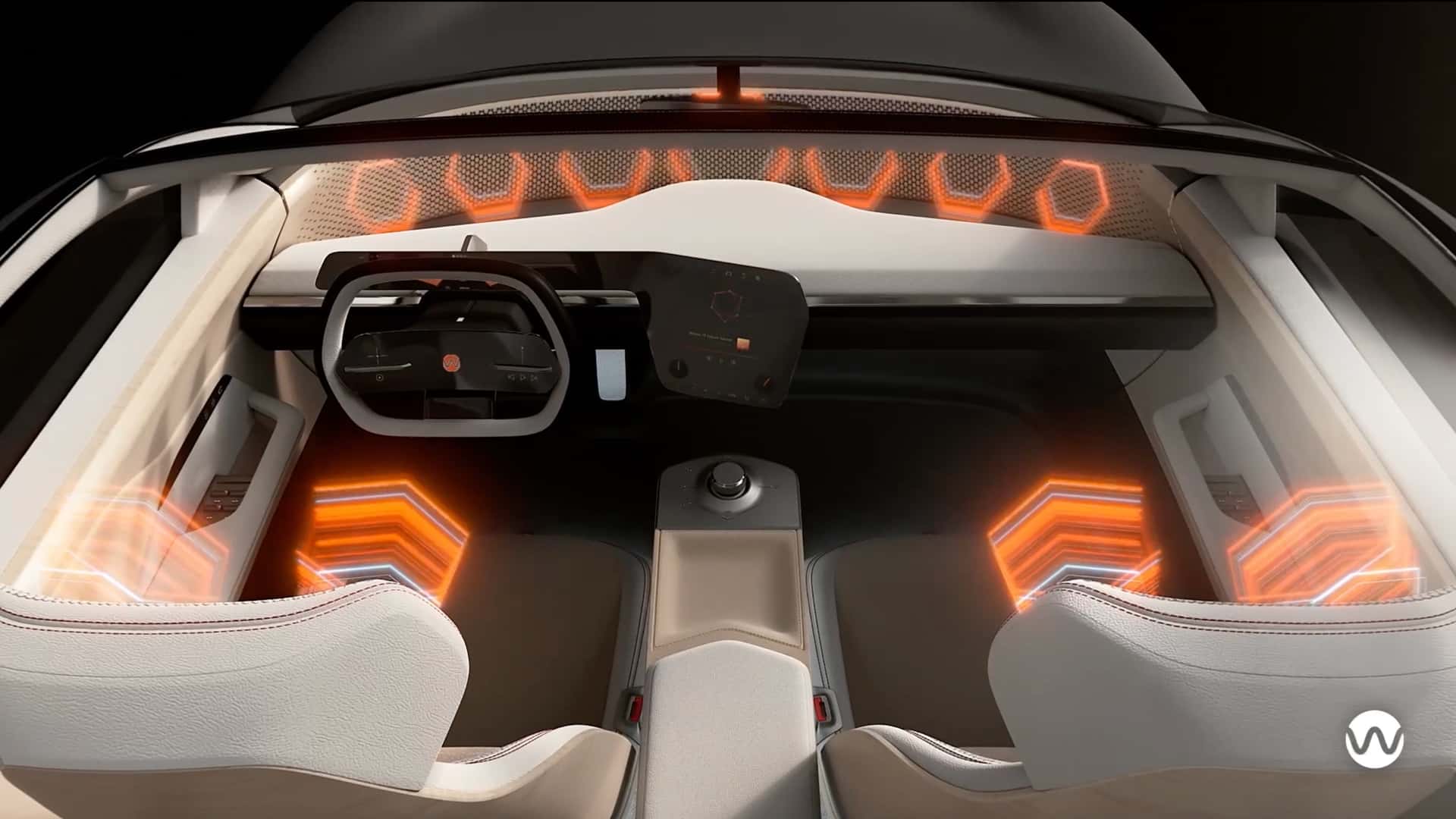
The technology behind these advanced Range Rover electrostatic speakers was developed by U.K.-based Warwick Acoustics. The SV Ultra trim integrates 21 of these compact, palm-sized membranes throughout the cabin, creating a comprehensive sound environment.
While the membranes excel at crisp, precise sound, the system still incorporates five additional bass speakers to move larger volumes of air for the full acoustic effect. Furthermore, the vehicle features ‘Body and Soul’ seats and a ‘Haptic Floor,’ which utilise transducers to generate bass-like vibrations. While the haptic feedback in the seats is adjustable and can be disengaged, the inherent clarity of the electrostatic speakers themselves is the primary draw.
Technological Advantages and Environmental Impact
Beyond the auditory benefits, the Range Rover electrostatic speakers boast several impressive technical specifications. Land Rover states these speakers respond 1,000 times faster than conventional units, leading to instantaneous and accurate sound reproduction. Crucially, they consume 90% less energy and weigh 90% less than traditional premium audio setups. This reduction in mass is significant, as Land Rover noted it contributes to improved overall vehicle efficiency, particularly for electric vehicles.
Furthermore, the design eliminates the need for magnets and rare-earth materials, addressing environmental concerns associated with their extraction and use. Warwick Acoustics estimates that this lower power consumption and reduced weight could translate to a saving of up to 20 miles of WLTP range on an EV equipped with a 100-kilowatt-hour battery, a compelling advantage for the growing electric vehicle market.
Redefining the Listening Experience: Clarity, Precision, and Soundstage
The true impact of these Range Rover electrostatic speakers is best understood through direct experience. The audition began with Susanne Vega and DNA’s “Tom’s Diner.” Mr. Karania’s observation, “You can hear her breathe,” was remarkably accurate. Every subtle inhale before each phrase was rendered with an astonishing level of clarity, revealing nuances rarely heard in automotive audio.
Subsequent tracks, including “Hotel California,” further showcased the system’s capabilities. The acoustic guitar, electric guitars, bass, drums, and percussion were distinctly reproduced without any discernible overlap or muddiness. Every individual note was brought to life, creating an immersive soundscape free from compression or distortion. The experience closely mirrored that of a professional recording studio, where the speakers disappear, leaving only the music.
A Unique Sense of Space
Beyond mere detail, what truly distinguished the electrostatic system was its unique sense of spatial presentation. Unlike traditional setups where sound often feels directed from specific speakers, this system created an auditory environment that transcended the physical confines of the cabin. The music seemed to exist beyond the vehicle’s interior, diffused evenly and naturally, akin to a scent filling the air.
This cohesive soundstage made it difficult to pinpoint the origin of individual sounds, whether from the front, rear, or pillar-mounted tweeters. The result was a beautifully integrated and expansive sound field. This expansive quality also contributed to a remarkable listening comfort, even at higher volumes, significantly reducing listener fatigue. The Range Rover electrostatic speakers demonstrated an impressive dynamic range, faithfully reproducing everything from intricate acoustic passages to the expansive soundscapes of modern pop, such as Taylor Swift’s “Lavender Haze,” with consistent clarity.
Exclusivity and Future Prospects
Currently, the revolutionary Range Rover electrostatic speakers are standard on the opulent SV Ultra trim of the gas-powered Range Rover. For buyers of other SV trims, this extraordinary audio system is available as an option at a cost of $12,570. While this figure is substantial, it is contextualized by the overall price point of a quarter-million-dollar Range Rover SV, where such an investment in a superior audio experience is often considered commensurate with the vehicle’s luxury positioning.
While today’s premium audio systems in luxury vehicles are already highly impressive, these electrostatic speakers undoubtedly raise the bar to an unprecedented level. Industry observers anticipate that other luxury automakers may soon seek collaborations with Warwick Acoustics to integrate this advanced technology into their own flagship models, recognizing the significant competitive advantage it offers.
The broader hope within the automotive audio community is that this transformative technology will not remain exclusively within the ultra-luxury segment. As manufacturing processes mature and economies of scale are achieved, there is potential for these electrostatic speakers to eventually trickle down to a wider range of vehicles. Should this occur, it would represent one of the most significant leaps in automotive audio innovation in decades, fundamentally altering expectations for in-car sound quality across various vehicle segments.
Frequently Asked Questions (FAQ)
1. What are electrostatic speakers in a car?
Electrostatic speakers in a car, pioneered by Range Rover, represent a novel audio technology. Unlike traditional speakers that use magnets and voice coils, they employ a thin, electrically charged membrane suspended between two metal plates. This membrane vibrates directly in response to an audio signal, producing sound with exceptional precision and minimal distortion, setting a new benchmark for in-car fidelity.
2. How do Range Rover’s new speakers differ from conventional car audio systems?
Range Rover’s new electrostatic speakers fundamentally differ by eliminating traditional components like voice coils, magnets, and cones. This simplified design, featuring a vibrating membrane, results in a system that responds 1,000 times faster, consumes 90% less energy, and contains 90% less mass than conventional units. This delivers unparalleled clarity and a unique, expansive soundstage.
3. What benefits do electrostatic speakers offer for electric vehicles (EVs)?
Electrostatic speakers offer significant benefits for EVs due to their lower power consumption and reduced weight. Warwick Acoustics estimates that on an EV with a 100-kWh battery, its system could save up to 20 miles of WLTP range. Additionally, the technology avoids the use of rare-earth materials, contributing to more sustainable vehicle manufacturing.
4. What is the sound quality like with Range Rover electrostatic speakers?
The sound quality is described as exceptionally precise, with zero perceptible distortion and jaw-dropping clarity, akin to a recording studio experience. Listeners report hearing subtle details like breathing in vocals, and instruments are distinctly reproduced without muddiness. A unique sense of spaciousness creates an immersive, non-directional sound field that reduces listening fatigue.
5. Are these new Range Rover electrostatic speakers widely available?
Currently, the Range Rover electrostatic speakers are standard on the SV Ultra trim of the gas-powered Range Rover. For other SV trims, they are available as an optional upgrade for $12,570. While currently exclusive to high-end luxury models, there is anticipation that the technology could eventually become more accessible to a wider market.
6. Who developed the electrostatic speaker technology for Range Rover?
The innovative electrostatic speaker technology integrated into the Range Rover SV Ultra was developed by U.K.-based Warwick Acoustics. Their expertise in advanced audio solutions has enabled Jaguar Land Rover to implement this world-first in a production vehicle, pushing the boundaries of in-car acoustic engineering and luxury sound experiences.