
Key Takeaways
Range Rover has introduced the world’s first production vehicle equipped with electrostatic speakers, setting a new benchmark for in-car audio technology. Developed in collaboration with Warwick Acoustics, this innovative system dramatically simplifies speaker design by replacing traditional cones, voice coils, and magnets with a 1-millimeter vibrating membrane. The result is exceptionally precise, distortion-free sound reproduction and a remarkable sense of spatial audio. These Range Rover electrostatic speakers also boast significant advantages in energy efficiency and reduced material usage, offering potential benefits for electric vehicle range. Currently exclusive to the Range Rover SV Ultra trim, this groundbreaking technology promises a concert-hall experience within the confines of a luxury SUV, with hopes for broader adoption in the future.
A Paradigm Shift in Automotive Audio Technology
In a significant advancement for premium in-car audio technology, Land Rover has unveiled a revolutionary sound system featuring electrostatic speakers in its latest Range Rover SV Ultra. This marks a global first for a production vehicle, positioning the luxury SUV at the forefront of automotive acoustic innovation. The new system promises an unparalleled auditory experience, akin to a live concert hall within the vehicle’s cabin.

For decades, advancements in automotive audio have primarily refined the conventional dynamic driver, focusing on material improvements, sophisticated tuning, powerful amplifiers, and advanced software. However, the introduction of electrostatic technology represents a fundamental departure from this established paradigm, offering a glimpse into the future of high-fidelity sound reproduction in vehicles.
The Engineering Behind Electrostatic Speakers
Traditional dynamic speakers, the cornerstone of audio systems for over a century, operate on a principle involving three core components: a voice coil, a magnet, and a diaphragm attached to a cone. An electrical signal energizes the voice coil, creating a magnetic field that causes it to move back and forth. This motion, in turn, pushes the attached cone, disrupting the surrounding air to generate sound waves.
While modern premium systems like Bowers & Wilkins Diamond Surround Sound, Burmester 3D spatial audio, and AKG systems with Dolby Atmos have pushed the boundaries of immersion and entertainment using these fundamentals, the Range Rover electrostatic speakers adopt a radically different approach. Their design eliminates the need for cones, voice coils, and magnets, simplifying the hardware considerably.

At the heart of each electrostatic speaker is a wafer-thin, 1-millimeter membrane suspended between two electrically charged metal plates. Instead of moving a heavy cone, the membrane itself vibrates in response to an electrical signal, directly producing sound. This dramatically lower moving mass is crucial to the system’s ability to reproduce sound with exceptional precision and virtually zero perceptible distortion, as explained by Tilesh Karania, Senior Electrical Innovation Engineer at Jaguar Land Rover, during a recent demonstration.
Collaboration with Warwick Acoustics
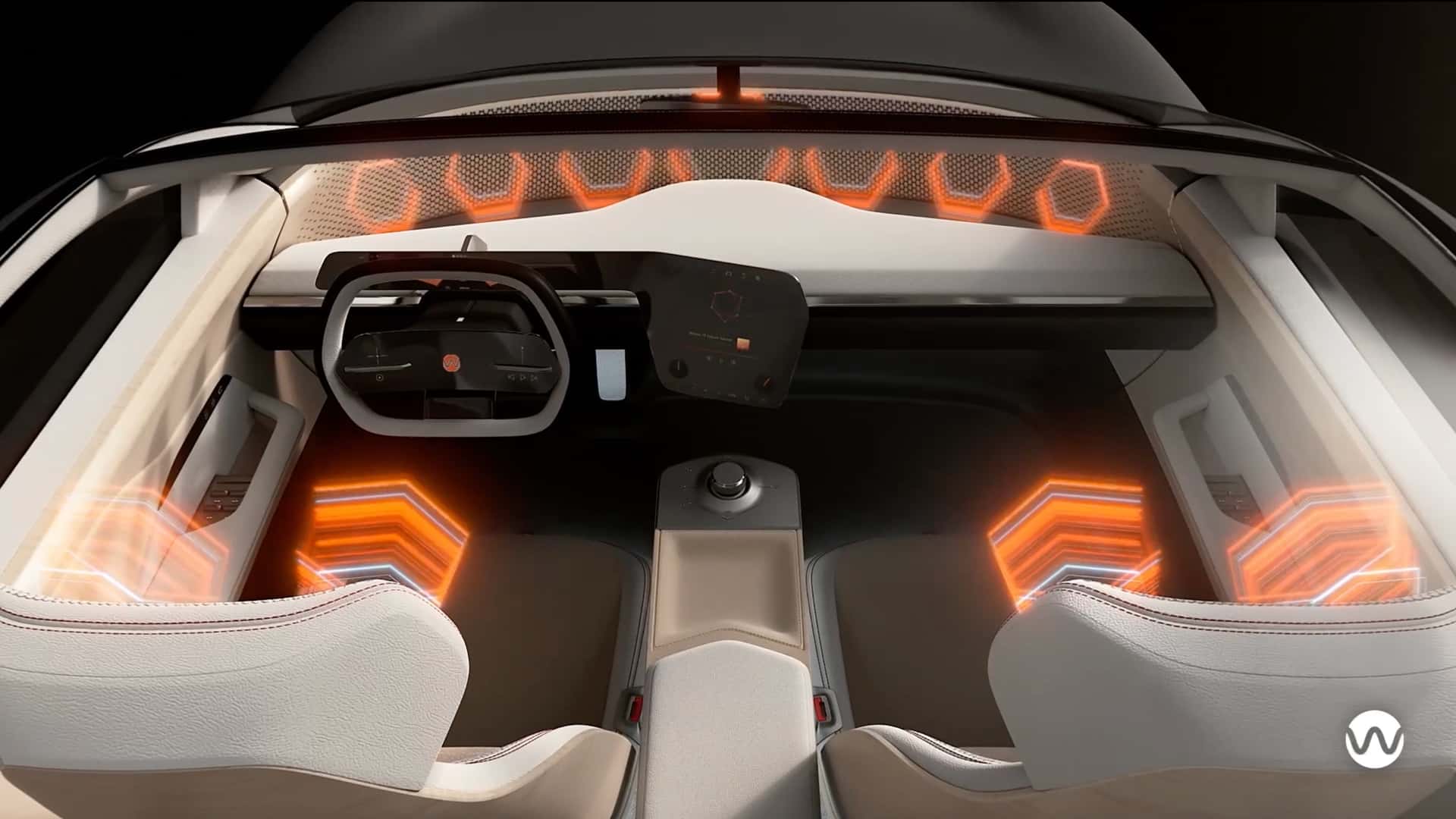
This groundbreaking in-car audio technology is the result of a collaboration with U.K.-based Warwick Acoustics, a specialist in advanced electrostatic transducer technology. The partnership has brought years of research and development in high-fidelity audio to the automotive sector, culminating in the integration of 21 such membranes strategically placed throughout the Range Rover SV Ultra cabin.
To complement the electrostatic membranes and ensure a full-spectrum audio experience, the system incorporates five additional bass speakers. Furthermore, it features what the company describes as “Body and Soul” seats and a “Haptic Floor.” These elements are designed to enhance the low-frequency experience, with the floor vibrating via “transducers” and four transducers embedded in each seat. While the haptic feedback offers an additional dimension, users can adjust its intensity or deactivate it based on personal preference.
Efficiency and Environmental Advantages
Beyond acoustic performance, Range Rover electrostatic speakers present significant operational and environmental benefits. Land Rover reports that these speakers respond an astonishing 1,000 times faster than conventional units, leading to instantaneous and accurate sound reproduction. Crucially, they consume 90% less energy and contain 90% less mass compared to traditional counterparts.
The removal of magnets and rare-earth materials from the speaker design also contributes to a more sustainable manufacturing process. Warwick Acoustics highlights the potential for improved electric vehicle efficiency, estimating that on an EV equipped with a 100-kilowatt-hour battery, its electrostatic system could save up to 20 miles of WLTP range. This considerable saving is attributed to the system’s lower power consumption and reduced overall weight, though Land Rover has not yet specified the exact weight savings compared to a mainstream premium audio setup.
An Unrivalled Auditory Experience
The impact of the Range Rover electrostatic speakers on the listening experience is profound. During an exclusive demo, the system’s capabilities were showcased with remarkable clarity and depth. Playing Susanne Vega and DNA’s “Tom’s Diner,” the detail was immediately apparent. “You can hear her breathe,” noted Karania, highlighting the system’s ability to render even the most subtle vocal nuances with jaw-dropping precision. Every inhale before each sentence was discernible, creating an intimate connection with the recording.
The intricate layers of “Hotel California” further demonstrated the system’s prowess. Acoustic guitars, electric guitars, bass, drums, and percussion each emerged with striking clarity, meticulously separated yet harmoniously integrated. The sound was neither muddy nor compressed, resembling the pristine environment of a professional recording studio where every note comes alive without distortion. This level of sonic fidelity often makes listeners forget they are hearing sound from speakers at all.
A Distinctive Sense of Spatiality
Perhaps the most compelling aspect of the Range Rover electrostatic speakers is their unique rendition of spatial audio. Unlike conventional 3D spatial audio systems that create distinct sounds from different directions, this technology fosters a cohesive and expansive soundstage. The music does not feel like it’s being directed from specific points like doors, the dashboard, or pillar-mounted tweeters.
Instead, the sound appears to emanate from beyond the confines of the cabin, floating naturally and evenly diffused throughout the interior, much like a subtle scent. This immersive quality creates a calming effect, rendering even high volumes unusually comfortable and significantly less fatiguing for extended listening sessions. The system’s impressive dynamic range ensures that diverse genres, from rock classics like “Hotel California” to contemporary pop like Taylor Swift’s “Lavender Haze,” are reproduced with consistent, pristine clarity.
Availability and Future Outlook
Currently, the Range Rover electrostatic speakers are a standard feature on the opulent SV Ultra trim of the gas-powered Range Rover. For non-ultra SV trims, this exceptional audio system is available as an option at a considerable sum of $12,570. While this investment is significant, it aligns with the quarter-million-dollar price point of a Range Rover SV, where an additional five figures for an extraordinary audio system may not substantially impact the overall financial consideration for discerning buyers.
The debut of Range Rover electrostatic speakers marks a pivotal moment in automotive audio. While today’s premium audio systems are already highly impressive, this new technology raises the bar to an unprecedented level. Industry observers anticipate that more luxury automakers will likely pursue collaborations with Warwick Acoustics to integrate and tailor similar electrostatic speaker solutions for their flagship models.
The broader hope within the automotive and audio communities is that this cutting-edge technology will not remain exclusive to high-end luxury vehicles. If these advanced speakers can eventually trickle down to a wider range of vehicles, they could represent one of the most transformative leaps in automotive audio in several decades, making concert-hall quality sound accessible to a broader audience of car enthusiasts.
FAQ
What are electrostatic speakers?
Electrostatic speakers are a type of audio transducer that produces sound using a thin, electrically charged membrane suspended between two perforated metal plates. Unlike traditional dynamic speakers, they do not use magnets or voice coils. The membrane vibrates uniformly across its entire surface in response to electrical signals, resulting in highly accurate and low-distortion sound reproduction.
How do Range Rover electrostatic speakers differ from traditional car audio systems?
Range Rover electrostatic speakers differ fundamentally by replacing heavy cones, voice coils, and magnets with a lightweight 1-millimeter membrane. This design allows for significantly faster response times, up to 1,000 times quicker, and produces sound with exceptional precision and virtually no distortion. Traditional systems rely on the pistonic movement of cones, which inherently introduces more mass and potential for distortion.
What are the key benefits of this new in-car audio technology?
The primary benefits include unparalleled sound clarity, minimal distortion, and a distinctive sense of spatial audio that creates an immersive, non-fatiguing listening experience. Additionally, Range Rover electrostatic speakers consume 90% less energy and contain 90% less mass than conventional speakers, contributing to improved vehicle efficiency and reduced use of rare-earth materials.
Which Range Rover models feature these electrostatic speakers?
The revolutionary electrostatic speaker system is currently offered as standard equipment on the Range Rover SV Ultra trim. For other non-ultra SV trims, it is available as an optional upgrade. This exclusivity positions the technology within the ultra-luxury segment of the Range Rover lineup, catering to customers seeking the absolute pinnacle of automotive sound quality.
Who developed the electrostatic speaker technology for Range Rover?
The electrostatic speaker technology integrated into the Range Rover models was developed by U.K.-based Warwick Acoustics. Land Rover collaborated with Warwick Acoustics to adapt and implement their specialized electrostatic transducer expertise for automotive application, resulting in the world’s first production vehicle to feature this advanced audio system.
Can electrostatic speakers improve an electric vehicle’s range?
Yes, electrostatic speakers can contribute to an electric vehicle’s range due to their significantly lower power consumption and reduced mass. Warwick Acoustics estimates that on an EV with a 100-kilowatt-hour battery, their system could save up to 20 miles of WLTP range. This makes the technology not only an acoustic advancement but also a practical one for EV efficiency.