
Key Takeaways
- The Range Rover SV Ultra introduces the world’s first production vehicle integration of electrostatic speakers, marking a significant leap in automotive audio technology.
- Developed by Warwick Acoustics, these speakers utilise a simplified design with a 1-millimeter membrane, eliminating traditional cones, voice coils, and magnets.
- The system delivers unparalleled sonic clarity, precision, and a unique sense of spatial audio, offering a concert-hall-like experience.
- Electrostatic speakers respond 1,000 times faster, consume 90% less energy, contain 90% less mass, and avoid rare-earth materials, potentially boosting EV range.
- While currently exclusive to high-end Range Rover SV trims, this innovation sets a new benchmark for luxury in-car entertainment and holds promise for broader automotive application.
In a groundbreaking advancement for automotive luxury, the Range Rover SV Ultra is poised to transform the in-car audio landscape with the integration of the world’s first electrostatic speakers in a production vehicle. This innovative system, developed in collaboration with Warwick Acoustics, promises an auditory experience previously confined to high-end home systems or concert halls, fundamentally redefining expectations for vehicle sound reproduction.
The introduction of these advanced electrostatic speakers represents more than just an upgrade; it signifies a radical departure from conventional speaker design, offering a level of clarity and immersive sound that automotive audio enthusiasts have long yearned for. Early experiences with this technology suggest it creates a sensory environment so captivating, it could establish a new benchmark for luxury automotive sound.

The Evolution of Automotive Audio Systems
For decades, advancements in in-car audio have largely revolved around refining the fundamental principles of dynamic driver technology. Traditional speakers, or dynamic drivers, operate on a relatively consistent mechanical foundation: an electrical signal traverses a voice coil, generating a magnetic field that propels the coil and an attached cone, thereby creating sound waves through air displacement.
Over the past century, innovations within this framework have brought remarkable improvements. These include the development of superior materials for cones and voice coils, sophisticated acoustic tuning, more potent amplifiers, and increasingly intelligent software processing. Brands like Bowers & Wilkins, Burmester, and AKG have elevated these conventional systems to deliver impressive 3D spatial audio and highly immersive listening experiences in premium vehicles from Volvo, BMW, Mercedes-Benz, and Cadillac.
However, despite these continuous enhancements, the core mechanics of sound production have remained largely unchanged. This established paradigm has now been challenged by the arrival of electrostatic technology in the automotive sphere, ushering in a new era of acoustic precision and efficiency.

Understanding Electrostatic Speaker Technology
The electrostatic speakers featured in the Range Rover SV Ultra diverge significantly from their dynamic counterparts. The fundamental difference lies in their operational mechanism, which discards the conventional components that have defined speaker design for a century.
Instead of a voice coil, magnet, and cone, these revolutionary speakers utilise an ultra-thin, 1-millimeter membrane suspended precisely between two electrically charged metal plates. This dramatically simplified hardware eliminates moving parts traditionally associated with generating sound, leading to a host of performance advantages.
When an electrical audio signal is applied, the charged plates interact with the membrane, causing it to vibrate directly and produce sound waves. This direct, low-mass movement is key to the system’s exceptional performance characteristics. Jaguar Land Rover’s senior electrical innovation engineer, Tilesh Karania, highlighted during a demonstration that “That dramatically lower moving mass allows the speakers to reproduce sound with exceptional precision and zero perceptible distortion.”
Engineering Innovation in the Range Rover SV Ultra
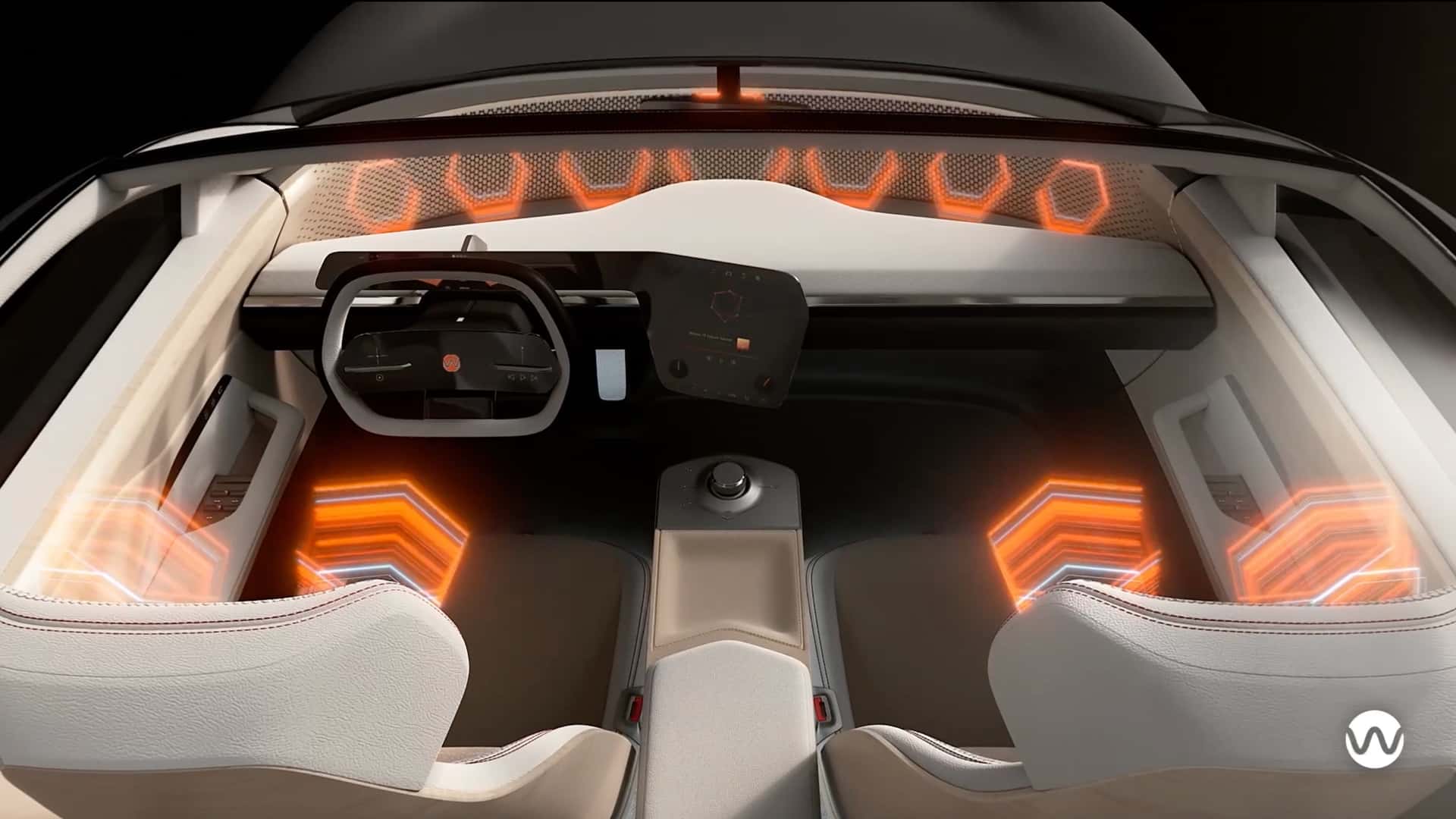
The Range Rover SV Ultra’s advanced audio system integrates 21 of these compact electrostatic membranes strategically placed throughout the cabin. While the electrostatic units handle the mid and high frequencies with unparalleled clarity, the system acknowledges the need for substantial air movement to deliver a full-bodied audio experience, especially for lower frequencies.
To achieve this, the system is complemented by five additional dedicated bass speakers. Furthermore, Range Rover has incorporated innovative haptic feedback elements through its “Body and Soul” seats and a “Haptic Floor.” These components utilise transducers to induce vibrations, enhancing the tactile dimension of bass frequencies. While this feature can be adjusted or deactivated according to user preference, the core electrostatic speakers remain the star of the show.
Beyond their sonic capabilities, the electrostatic speakers offer compelling technical advantages. They boast a response rate 1,000 times faster than conventional units, leading to instantaneous and accurate sound reproduction. Crucially, they consume 90% less energy and contain 90% less mass than traditional speaker setups. This reduction in energy demand and weight not only contributes to the vehicle’s overall efficiency but also eliminates the reliance on magnets and rare-earth materials, aligning with more sustainable manufacturing practices.
Environmental and Efficiency Advantages
The inherent design efficiencies of electrostatic speakers extend their benefits beyond pure audio performance, offering significant environmental and operational advantages, particularly for electric vehicles (EVs).
The technology’s developer, U.K.-based Warwick Acoustics, underscores these eco-conscious attributes. The company states, “The technology was developed by U.K.-based Warwick Acoustics, which claims the speakers can even improve an EV’s efficiency. The company estimates that on an EV with a 100-kilowatt-hour battery, its electrostatic system could save up to 20 miles of WLTP range. That’s thanks to the system’s lower power consumption, less mass, and reduced weight.” This potential range extension represents a tangible benefit for EV owners, distinguishing the system as not merely a luxury but also an efficiency enhancer.
While Land Rover has not specified the exact weight savings of its system compared to a mainstream premium audio setup, the reported reductions in mass and power consumption indicate a forward-thinking approach to automotive component design that prioritizes both performance and environmental responsibility.
An Unparalleled Listening Experience
Experiencing the Range Rover SV Ultra’s electrostatic speakers reveals a profound transformation in in-car sound. The system delivers an astonishing level of sonic clarity, capturing nuances that often go unheard with conventional setups. During a demonstration, the distinct ability to perceive every detail, such as an artist’s breath before a vocal line, was immediately apparent.
Musical pieces, whether intricate acoustic arrangements or multi-layered rock anthems, are reproduced with remarkable separation and definition. Each instrument occupies its own precise space within the soundstage, preventing any muddiness or compression often associated with complex audio. The result is a sound profile that feels entirely uncolored and transparent, akin to being present in a recording studio.
Beyond individual note clarity, the most striking characteristic is the extraordinary sense of space the electrostatic speakers create. Unlike conventional systems where sound can feel directed from specific points, this technology generates an expansive audio environment that appears to transcend the physical boundaries of the vehicle cabin. The music seems to float naturally, diffusing evenly throughout the interior, creating an enveloping yet gentle presence.
This unique diffusion contributes to a less fatiguing listening experience, even at higher volumes, and showcases the system’s impressive dynamic range across diverse musical genres, from subtle acoustic tracks to vibrant pop anthems.
Market Position and Future Outlook
The innovative electrostatic speakers are currently a hallmark feature of the Range Rover SV Ultra trim, where they are included as standard equipment. For discerning buyers of the non-ultra SV trims, this advanced audio system is available as an exclusive option, commanding a price of $12,570. While this represents a significant investment, it aligns with the premium positioning of the Range Rover SV, a vehicle that typically starts in the quarter-million-dollar range.
This introduction in a high-end luxury SUV underscores Range Rover’s commitment to offering an unparalleled driving and passenger experience. The technology’s debut in such a prestigious segment often serves as a proving ground for future wider adoption.
There is considerable optimism within the industry that this pioneering technology will not remain exclusive to ultra-luxury vehicles. The inherent advantages of electrostatic speakers — from superior sound fidelity and efficiency to environmental benefits — suggest a strong potential for them to eventually trickle down to a broader range of vehicles. Should this occur, it would represent one of the most significant leaps in automotive audio innovation in decades, fundamentally reshaping the sound experience for a wider consumer base.
Conclusion
The integration of electrostatic speakers in the Range Rover SV Ultra is a pivotal moment for in-car audio, pushing the boundaries of what is acoustically possible within a vehicle cabin. By moving beyond traditional speaker designs, Range Rover and Warwick Acoustics have delivered a system that combines unprecedented clarity, spatial immersion, and efficiency.
This technological leap not only enhances the luxury experience but also sets a compelling precedent for future automotive sound engineering. As the industry continues to innovate, the widespread adoption of such advanced audio solutions could redefine consumer expectations for vehicular entertainment and contribute to more sustainable vehicle designs, promising a richer, more engaging, and environmentally conscious journey for all.
FAQ Section
What are electrostatic speakers?
Electrostatic speakers are a type of audio transducer that produces sound using a thin, electrically charged membrane suspended between two perforated metal plates. Unlike conventional speakers, they do not use magnets, voice coils, or cones, resulting in highly accurate sound reproduction with minimal distortion and exceptional clarity.
How do electrostatic speakers differ from traditional car speakers?
Traditional car speakers, known as dynamic drivers, use a magnet and a voice coil to move a cone, displacing air to create sound. Electrostatic speakers, conversely, vibrate a lightweight membrane directly using an electrical field. This fundamental difference leads to faster response, greater precision, and significantly lower mass and energy consumption.
Which Range Rover model features these new electrostatic speakers?
The cutting-edge electrostatic speakers are currently integrated as a standard feature in the Range Rover SV Ultra trim. For buyers of other Range Rover SV trims, this advanced audio system is available as an optional upgrade, allowing a wider range of luxury customers to experience its premium sound.
What are the benefits of using electrostatic speakers in a vehicle?
Beyond superior sound quality, benefits include exceptional clarity, distortion-free audio, a wide soundstage, and rapid response. They also offer practical advantages like 90% less energy consumption, 90% less mass, and the elimination of rare-earth materials, potentially extending the range of electric vehicles.
Are these electrostatic speakers available for all vehicle models?
Currently, the electrostatic speakers from Warwick Acoustics are exclusive to select high-end Range Rover SV models. While their debut is within the luxury segment, the technology’s efficiency and performance advantages suggest a strong potential for future adoption across a broader range of vehicles, including mainstream EVs, should costs and integration challenges be optimized.
What is the cost of the electrostatic speaker option?
For Range Rover SV trims that do not include them as standard, the electrostatic speaker system is available as an optional upgrade at a price of $12,570. This premium pricing reflects the advanced nature of the technology and its current exclusivity within the ultra-luxury automotive market segment.