
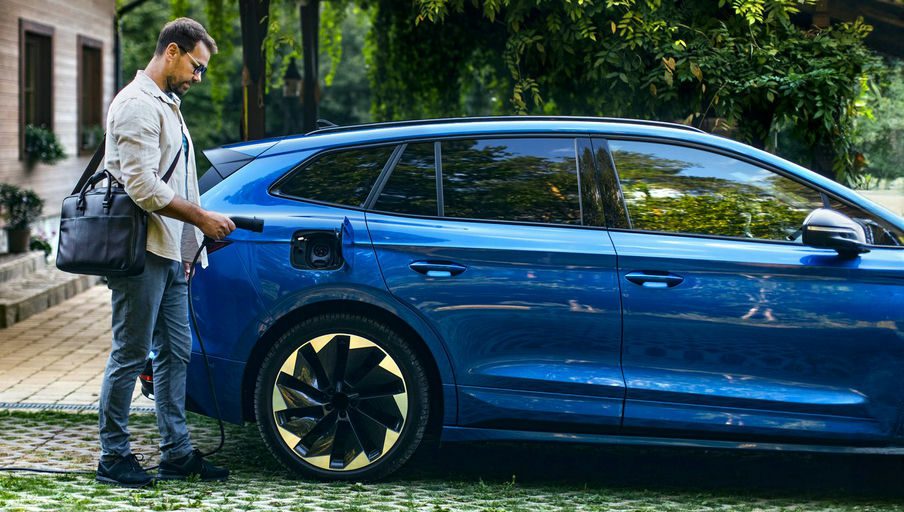
The electric vehicle (EV) industry is in a perpetual state of innovation, constantly seeking advancements that enhance performance, reduce costs, and accelerate adoption. A critical component in this evolution is the on-board charger (OBC), which directly impacts charging efficiency, vehicle range, and overall system integration. Infineon Technologies is at the forefront of this transformation, leveraging its cutting-edge gallium nitride (GaN) technology to redefine OBC architectures.
The company is poised to unveil its automotive basic qualified CoolGaN™ Automotive Bidirectional Switch, a breakthrough component designed to enable next-generation single-stage on-board chargers. This development promises significant improvements in power density, efficiency, and cost-effectiveness for electric vehicle charging systems.

Key Takeaways
- Infineon’s CoolGaN™ Automotive Bidirectional Switch is set to revolutionise EV on-board charging.
- The technology enables high-performance single-stage OBC architectures, enhancing efficiency and reducing system complexity.
- Proprietary Gate Injection Transistor (GIT) and monolithic die design ensure robustness and simplify integration.
- The switch supports both single-phase and three-phase single-stage OBC topologies, offering broad application flexibility.
- A demonstration platform will showcase tangible benefits in power density, efficiency, and overall system cost.
- This innovation will be a central topic at the Virtual Conference on EV Engineering, highlighting its impact on the wider EV ecosystem.
The Evolution of EV Charging: Towards Single-Stage Architectures
Current EV charging systems often rely on multi-stage power conversion, which involves several steps to convert AC grid power into the DC power required by the vehicle’s battery. While effective, this approach can lead to energy losses, increased component count, and larger form factors for the on-board charger.
The industry’s drive for greater efficiency and compactness has led to a push for single-stage on-board charger architectures. These designs aim to perform the entire power conversion process in one seamless step, significantly reducing energy losses and streamlining the system.
Overcoming Challenges in Single-Stage Design
Implementing single-stage OBCs, however, presents considerable engineering challenges. Achieving high power density and efficiency in a single stage traditionally required compromises on robustness, thermal management, and overall system cost. This is where advanced semiconductor materials like Gallium Nitride (GaN) come into play.
GaN devices offer superior switching speeds and lower conduction losses compared to conventional silicon-based components. Their inherent capabilities allow for higher operating frequencies, which in turn enable the use of smaller passive components like inductors and capacitors, directly contributing to more compact and lighter OBC designs.
Infineon’s CoolGaN™ Automotive Bidirectional Switch: A Deep Dive
Infineon’s new CoolGaN™ Automotive Bidirectional Switch is specifically designed to address the complexities of single-stage on-board charging. This automotive-qualified component is central to enabling a more efficient and integrated charging solution for electric vehicles.
The core of this innovation lies in Infineon’s proprietary Gate Injection Transistor (GIT) technology and its monolithic die design. GIT technology is crucial for enhancing the reliability and performance of GaN devices, particularly in demanding automotive environments.
The Role of GIT Technology and Monolithic Design
Gate Injection Transistor (GIT) technology provides precise control over the GaN device, ensuring stable operation and improved thermal management. This is vital for automotive applications where reliability under varying conditions is paramount. The monolithic die design further contributes to system simplicity and robustness.
By integrating multiple functionalities onto a single chip, the monolithic design reduces parasitic inductances and resistances, leading to better performance and fewer external components. This approach ensures that the high-performance single-stage architectures can be realised without compromising on durability or ease of integration into existing EV platforms.
Connecting Innovation to Real-World Application
The versatility of the CoolGaN™ Automotive Bidirectional Switch is a key factor in its potential impact. It is engineered to support a broad range of single-phase and three-phase single-stage OBC topologies. This adaptability means that the technology can be deployed across various EV models and charging infrastructure types globally, from residential single-phase charging to commercial three-phase solutions.
Such comprehensive support is critical for manufacturers looking to streamline their supply chains and develop scalable charging solutions. The ability to use a single foundational technology across different power requirements simplifies design processes and reduces development cycles.
Practical Insights from Demonstration Platforms
To showcase the tangible benefits of its advanced GaN technology, Infineon will feature practical insights from its single-stage demonstration platform. These demonstrations are designed to illustrate the real-world performance gains achievable with the new bidirectional switch.
Key areas of focus will include how this approach significantly improves power density, allowing for smaller and lighter OBC units, which in turn reduces vehicle weight and increases available cargo space. Furthermore, the efficiency gains translate directly into faster charging times and less energy wasted during the charging process. Ultimately, these advancements contribute to a lower overall system cost for EV manufacturers and, by extension, consumers.
The Broader Context: Virtual Conference on EV Engineering
Infineon’s groundbreaking work with the CoolGaN™ Automotive Bidirectional Switch will be a highlight at the upcoming Virtual Conference on EV Engineering. This comprehensive event, scheduled from September 14 to 17, 2026, serves as a pivotal platform for professionals across the electric vehicle supply chain.
The conference content spans the entire EV engineering ecosystem, covering crucial aspects such as motor and power electronics design and manufacturing, advanced cell development, battery systems, rigorous testing methodologies, efficient powertrains, sophisticated thermal management solutions, essential circuit protection, high-performance wire and cable, and critical EMI/EMC considerations.
Participating in this virtual conference offers attendees a unique opportunity to gain in-depth knowledge and connect with leading experts driving the future of electric mobility.
Register for the Webinar: Shaping Single-Stage On-Board Chargers
Industry professionals, engineers, and researchers keen on understanding the future of EV charging technology are encouraged to attend a dedicated webinar hosted by Infineon. Scheduled for September 15, 2026, at 9:15 am EDT, this session will provide a detailed exploration of the CoolGaN™ Automotive Bidirectional Switch and its applications.
Attendees will gain insights into:
- Practical examples and observations derived from Infineon’s single-stage demonstration platform.
- The intricate mechanisms by which Infineon’s CoolGaN™ Automotive Bidirectional Switch facilitates the development of next-generation single-stage OBC architectures.
- How Infineon’s distinctive and innovative CoolGaN™ technology establishes new benchmarks for power density, efficiency, and cost-effectiveness in EV charging solutions.
Registration for this informative webinar is free, offering an accessible pathway to stay updated on the latest advancements in automotive power electronics.
FAQs on Infineon’s CoolGaN™ Automotive Bidirectional Switch
What is a single-stage on-board charger (OBC)?
A single-stage OBC converts AC grid power to DC power for the EV battery in one step, unlike multi-stage chargers. This approach aims to reduce component count, improve efficiency, and create more compact, lighter charging systems, directly benefiting the overall electric vehicle design and performance.
How does Infineon’s CoolGaN™ Automotive Bidirectional Switch improve OBCs?
The CoolGaN™ Automotive Bidirectional Switch enhances OBCs by enabling single-stage architectures with high efficiency and power density. Its superior switching speeds and low losses, inherent to GaN technology, allow for smaller, lighter, and more cost-effective charging solutions without compromising robustness or integration simplicity, crucial for modern EVs.
What is Gate Injection Transistor (GIT) technology?
GIT (Gate Injection Transistor) is a proprietary technology developed by Infineon for its GaN devices. It is critical for ensuring stable and reliable operation of the GaN switch, particularly in demanding automotive applications. GIT technology offers enhanced control and robustness, which is vital for high-performance power electronics in electric vehicles.
What does ‘monolithic die design’ mean for EV charging?
Monolithic die design means integrating multiple circuit components onto a single semiconductor chip. For EV charging, this design in the CoolGaN™ Automotive Bidirectional Switch reduces parasitic effects, improves performance, and simplifies the overall system. It contributes to smaller, more robust, and easier-to-integrate on-board chargers.
Which OBC topologies does the new switch support?
The CoolGaN™ Automotive Bidirectional Switch is designed to support a broad range of both single-phase and three-phase single-stage OBC topologies. This versatility makes it suitable for various global charging standards and EV models, providing manufacturers with flexible and scalable solutions for different power requirements and grid infrastructures.
What benefits will be highlighted in the webinar’s demonstration platform?
The webinar’s demonstration platform will highlight tangible benefits such as improved power density, leading to smaller and lighter OBCs. It will also showcase enhanced efficiency, translating to faster charging and reduced energy waste, and overall system cost reduction. These aspects are critical for advancing EV technology and market adoption.
When and where can I attend the webinar?
The webinar, “Shaping single-stage on-board chargers with CoolGaN™ automotive bidirectional switch,” is scheduled for September 15, 2026, at 9:15 am EDT. It will be broadcast live as part of the Virtual Conference on EV Engineering. Registration is free and provides access to detailed insights into this innovative technology.