
Key Takeaways
- Range Rover has introduced the world’s first production vehicle equipped with electrostatic speakers in its SV Ultra trim.
- This groundbreaking in-car audio technology, developed by Warwick Acoustics, eliminates traditional cones, voice coils, and magnets, relying instead on a 1-millimeter membrane.
- The new system promises exceptional sound precision, zero perceptible distortion, and a significantly faster response time—1,000 times quicker than conventional units.
- Beyond superior sound, these electrostatic speakers consume 90% less energy and weigh 90% less, potentially boosting EV range by up to 20 miles (WLTP).
- Currently exclusive to the Range Rover SV Ultra and available as a premium option on other SV trims, this innovation sets a new benchmark for luxury automotive sound.
In the realm of automotive luxury, the pursuit of perfection often extends beyond performance and aesthetics to the very sensory experience within the cabin. For discerning audiophiles and casual listeners alike, a truly immersive sound system can transform every journey. Recently, a significant leap in this domain was unveiled by Range Rover, integrating a revolutionary in-car audio system that promises to redefine acoustic excellence.
The British automaker has pioneered the inclusion of electrostatic speakers in a production vehicle, a world-first achievement that sets a new standard for sound reproduction on the road. This cutting-edge technology, showcased in the Range Rover SV Ultra, delivers an auditory experience akin to a concert hall, distinguished by unparalleled clarity and a remarkable sense of space.

The Paradigm Shift: Understanding Electrostatic Speaker Technology
For nearly a century, automotive audio systems have largely relied on the foundational principles of dynamic drivers. These conventional speakers operate with three primary components: a voice coil, a magnet, and a diaphragm attached to a cone. An electrical signal activates the voice coil within a magnetic field, causing it to move rapidly, pushing the cone to create sound waves by displacing air.
Improvements over the decades have focused on refining these fundamentals—better materials, advanced tuning algorithms, more powerful amplifiers, and sophisticated software. High-end systems today, such as Bowers & Wilkins in Volvos and BMWs, Burmester 3D spatial audio in Mercedes-Benz, or AKG with Dolby Atmos in Cadillacs, offer impressive soundscapes, enhancing the listening experience for drivers and passengers.
Traditional Audio vs. Electrostatic Innovation
However, the new electrostatic speakers introduced by Range Rover represent a radical departure from this established formula. Their design is vastly simplified, eliminating the cones, voice coils, and magnets integral to dynamic drivers. Instead, the core of this innovative technology is a mere 1-millimeter membrane suspended between two electrically charged metal plates.

This fundamental shift in driver technology allows for a dramatically lower moving mass. Rather than moving a heavy cone, the ultra-thin membrane itself vibrates in response to electrical signals to produce sound. This engineering marvel results in sound reproduction with exceptional precision and virtually zero perceptible distortion, as highlighted by Tilesh Karania, Senior Electrical Innovation Engineer at Jaguar Land Rover, during a recent demonstration.
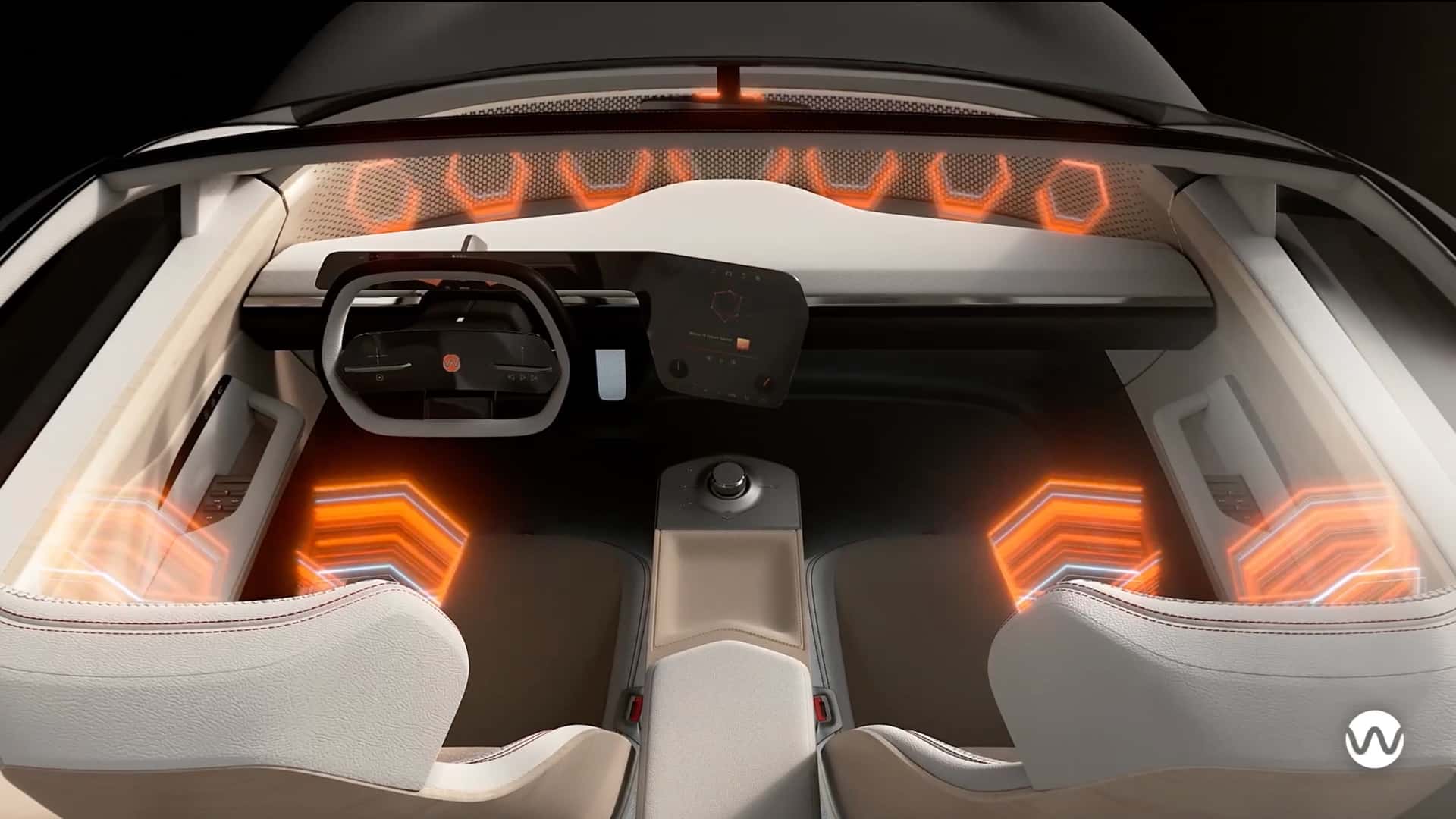
The Range Rover SV Ultra integrates 21 of these delicate membranes throughout its cabin, each contributing to a rich and detailed acoustic performance. To ensure a full-bodied sound experience, particularly in the lower frequencies, the system is complemented by five additional bass speakers. Furthermore, it incorporates what the company terms “Body and Soul” seats and a “Haptic Floor,” which use transducers to create a bass-like vibrational effect.
Beyond Sound: Efficiency and Environmental Impact
The advancements offered by electrostatic speakers extend far beyond mere audio fidelity. Their streamlined design and operational characteristics bring significant benefits in terms of efficiency and sustainability, aligning with modern automotive trends, particularly in the electric vehicle (EV) sector.
Energy Savings and Weight Reduction
Land Rover reports that its new electrostatic speakers respond an astonishing 1,000 times faster than conventional units. Crucially, they achieve this while consuming 90% less energy and possessing 90% less mass. This substantial reduction in power consumption and weight is a critical factor for automotive manufacturers striving to enhance vehicle performance and range.
Moreover, the technology eliminates the need for magnets and rare-earth materials, components that often raise environmental concerns due to their extraction and processing. This makes the electrostatic system a more sustainable choice in an era increasingly focused on eco-friendly manufacturing.
Implications for Electric Vehicles
The developer of this technology, UK-based Warwick Acoustics, underscores its potential to improve an EV’s overall efficiency. The company estimates that for an electric vehicle equipped with a 100-kilowatt-hour battery, integrating their electrostatic system could lead to a saving of up to 20 miles in WLTP range. This considerable gain is directly attributed to the system’s lower power consumption, reduced mass, and overall decreased weight, making it an attractive proposition for the burgeoning EV market.
An Unprecedented Auditory Experience: The Range Rover SV Ultra
Experiencing the electrostatic speakers in the Range Rover SV Ultra is described as nothing short of transformative. During a hands-on demonstration, the system’s capabilities were vividly showcased with diverse musical selections, revealing its extraordinary attributes.
Clarity, Precision, and Immersive Soundstage
Listening to Susanne Vega and DNA’s “Tom’s Diner,” the clarity was astounding. As Tilesh Karania remarked, “You can hear her breathe,” a testament to the system’s ability to reproduce even the subtlest nuances of a recording with jaw-dropping fidelity. Every inhale before each sentence was rendered with a level of detail that felt like being in the recording studio.
The acoustic performance continued to impress with “Hotel California,” where the intricate interplay of acoustic guitar, electric guitars, bass, drums, and percussion was presented with remarkable separation and clarity. No instrument overpowered another; every single note came to life, free from muddiness, compression, or distortion. This profound sense of detail created an incredibly immersive listening experience.
Beyond the meticulous reproduction of individual notes, the most striking aspect was the expansive sense of space created within the cabin. Unlike conventional systems where sound often feels directed from specific speakers, the electrostatic setup produced music that seemed to exist beyond the confines of the car itself. The sound floated naturally, evenly diffused throughout the interior, creating a cohesive and enveloping soundstage that defied discernible origin points.
This unique acoustic environment contributed to a calming effect, rendering even high volumes unusually comfortable and less fatiguing over extended listening periods. The impressive range of these electrostatic speakers allowed diverse genres, from the intricate layers of “Hotel California” to the pop sensibilities of Taylor Swift’s “Lavender Haze,” to be reproduced with consistent, pristine clarity.
The Role of Haptic Feedback
While the pure acoustic output of the electrostatic speakers was overwhelmingly praised, the integrated haptic feedback system, comprising transducers in the seats and floor, evoked a mixed response. The floor vibrates with a bass-like effect, and four transducers are installed in each seat to amplify this sensation. While adjustable in intensity or completely deactivatable, the added transducer effect felt somewhat supplementary given the already exceptional crispness of the speakers themselves.
Pioneering Luxury: Availability and Market Outlook
For now, this groundbreaking in-car audio technology is exclusively available as standard equipment on the Range Rover SV Ultra trim of the gas-powered model. For those opting for non-ultra SV trims, the electrostatic speaker system is offered as an option at a considerable sum of $12,570. While a significant investment, it is likely to be a considered upgrade for buyers already committing a quarter-million dollars to a Range Rover SV.
The introduction of these electrostatic speakers by Range Rover signifies a new pinnacle in automotive acoustics, raising the bar for premium audio systems. It is anticipated that other luxury automakers will closely observe this development and potentially seek collaborations with Warwick Acoustics to integrate similar technology into their flagship models.
The Future of Automotive Acoustics
While currently residing in the rarefied air of ultra-luxury vehicles, the potential for electrostatic speaker technology to trickle down to more mainstream segments holds significant promise. Should this advanced in-car audio system become more widely adopted and accessible, it could represent one of the most substantial advancements in automotive audio in decades. This innovation not only enhances the auditory journey but also offers tangible benefits in energy efficiency and sustainable manufacturing, pointing towards an exciting future for sound in motion.
Frequently Asked Questions (FAQ)
What are electrostatic speakers?
Electrostatic speakers are an advanced type of audio transducer that produce sound using a thin, electrically charged membrane suspended between two perforated metal plates. Unlike traditional speakers that use magnets and voice coils to move a cone, electrostatic speakers vibrate the entire membrane directly, offering exceptional clarity and precision.
How do Range Rover’s new electrostatic speakers differ from conventional car audio systems?
Range Rover’s electrostatic speakers are radically simplified, lacking the heavy cones, voice coils, and magnets found in traditional dynamic drivers. This design allows for a much lighter moving mass, resulting in significantly faster response times, minimal distortion, and an unparalleled level of acoustic detail and spatial separation.
What are the benefits of electrostatic speakers in terms of efficiency?
These speakers offer substantial efficiency advantages, consuming 90% less energy and possessing 90% less mass compared to conventional units. For electric vehicles, this reduction in power draw and weight can translate into tangible benefits, with Warwick Acoustics estimating a potential gain of up to 20 miles in WLTP range for a 100-kWh battery EV.
Is the haptic feedback system in the Range Rover SV Ultra optional?
Yes, while the Range Rover SV Ultra incorporates transducers in the seats and floor for haptic feedback, creating a bass-like vibration, users have the flexibility to dial down the intensity of these transducers or completely turn them off according to their personal preference. This allows for a customizable listening experience.
What is the availability and cost of the electrostatic speaker system?
The world-first electrostatic speaker system is currently standard on the gas-powered Range Rover SV Ultra trim. For other non-ultra SV trims, it is available as an optional upgrade, priced at $12,570. Its current exclusivity reflects its status as a premium, cutting-edge in-car audio innovation.