
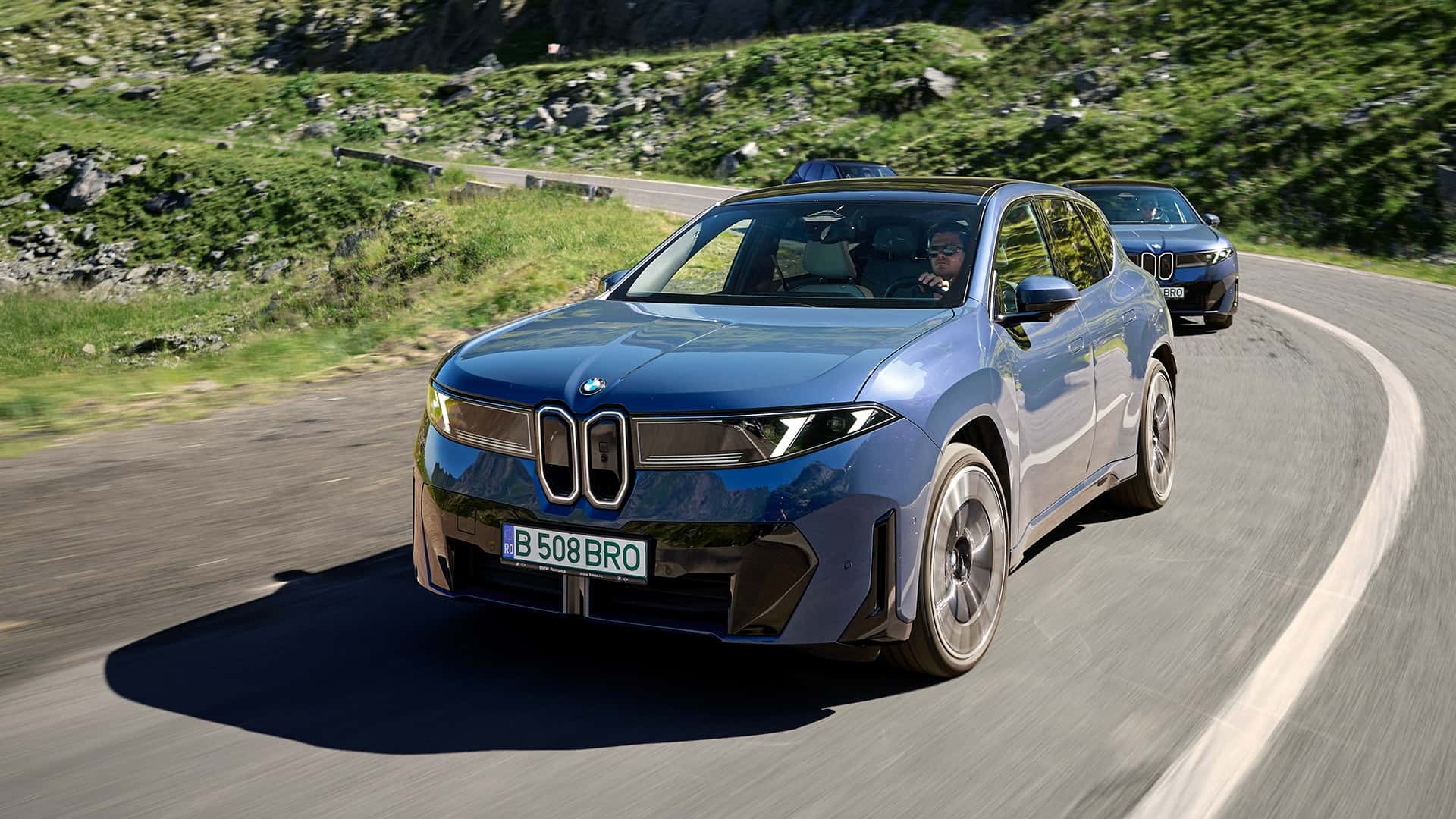
Key Takeaways (TL;DR):
- A rigorous 500-mile road trip across Romania, including the challenging Transfăgărășan mountain road, demonstrated the BMW iX3 electric vehicle’s exceptional real-world range and performance.
- The electric SUV completed the journey without requiring the driver to compromise on speed, conserve energy, or meticulously plan charging stops.
- Despite varied driving conditions, including high-speed highway stretches and demanding mountain ascents, the iX3 maintained strong efficiency, arriving with a significant battery reserve.
- The vehicle’s 108.7-kWh battery and dual-motor powertrain delivered both impressive longevity and dynamic driving capabilities, comparable to, or even surpassing, its combustion counterparts.
- The experience suggests that for sophisticated electric vehicles like the BMW iX3, traditional range anxiety is becoming increasingly outdated.
Bucharest, Romania – A comprehensive 500-mile test drive across Romania, navigating a challenging mix of highways, winding country roads, and the formidable Transfăgărășan mountain pass, has robustly demonstrated the long-distance capabilities of the BMW iX3 electric vehicle. This extensive journey aimed not merely to confirm the electric SUV’s ability to complete such a feat, but to ascertain whether it could do so without compelling the driver to modify their driving style, conserve energy, or plan the entire expedition around charging infrastructure availability.
The ambitious itinerary, proposed by BMW Romania, involved a two-day excursion. It commenced from Bucharest in the country’s south, extending to Șona, a quaint central Romanian village known for its contemporary art and unique ‘pyramids.’ The return leg presented an even greater challenge, encompassing the iconic Transfăgărășan mountain road, renowned for its dramatic twists and elevation changes. This provided an unparalleled opportunity to evaluate the BMW iX3 electric vehicle’s range and efficiency claims under real-world, demanding conditions, far removed from controlled test environments.
The Challenging Romanian Itinerary
The route was specifically designed to mirror the diverse driving scenarios a typical owner might encounter. Day one comprised approximately 220 miles, focusing on extra-urban national roads and initial highway sections. Day two involved slightly more mileage, critically including the strenuous ascent and descent of the Transfăgărășan. This varied landscape offered an ideal testing ground for the BMW iX3 electric vehicle, moving beyond urban commuting to evaluate its touring prowess.
Unlike many range tests that prioritize hypermiling, this assessment maintained a consistent driving approach akin to a combustion-engine vehicle, with efficiency not being the sole determinant of driving style. This deliberate choice aimed to provide a more realistic insight into the daily usability and performance of the BMW iX3 electric vehicle. While BMW has previously recorded an iX3 covering over 620 miles (1,000 km) on a single charge in a Hungary-to-Germany run, the current test focused on dynamic, unrestrained driving.
Day One: Unveiling Real-World Efficiency
The journey commenced from Bucharest in the early morning, with the BMW iX3 xDrive50’s substantial 108.7-kWh battery indicating a 97% charge and a predicted range of 353 miles (568 km). This initial prediction, while robust, was set to be tested against the realities of Romanian road conditions and an uninhibited driving style.
The first segment of the day predominantly involved extra-urban driving, with speeds maintained around 62 mph (100 km/h) after an initial highway sprint. By the midway point, covering 112 miles (180.4 km), the electric SUV registered an average efficiency of 3.31 miles/kWh (18.8 kWh/100 km). This figure underscores the BMW iX3’s capability to deliver solid efficiency in typical cruising scenarios, a critical factor for long-distance EV travel.
Reaching the Overnight Stop
As the route incorporated more narrower, slower country roads, the efficiency metrics improved further. Upon reaching the overnight destination, the BMW iX3 electric vehicle had covered an impressive 217.5 miles (350.1 km). The average efficiency for this leg stood at 3.53 miles/kWh (17.6 kWh/100 km), with a notable 40% battery charge still remaining. The onboard computer projected an additional 173 miles (279 km) of range, raising the question of whether the return journey could have been attempted without an overnight charge.
While the BMW iX3 likely possessed the capacity to complete the entire round trip on a single charge under extremely conservative driving conditions—involving lower speeds, gentle acceleration, and potentially foregoing air conditioning—such an approach would have detracted from the core objective of the test. The allure of tackling the Transfăgărășan mountain road aggressively ultimately led to the decision to fully charge the vehicle overnight, prioritizing an uncompromised driving experience over a hypermiling experiment. The following morning, the iX3 was ready with a 98% charge and an optimistic 437-mile (703-km) predicted range, reflective of the previous day’s favorable efficiency.
Conquering the Transfăgărășan: Performance and Agility
Departing from the picturesque town of Sibiu, the journey proceeded towards the base of the Transfăgărășan. During the initial, slow-speed ascent to the more challenging winding sections, the BMW iX3 electric vehicle demonstrated remarkable frugality, achieving an average efficiency of approximately 4.44 miles/kWh (14 kWh/100 km). This figure is particularly noteworthy for a heavy, dual-motor electric SUV, weighing over 5,000 pounds (2.3 tons) and boasting 463 horsepower, with acceleration capable of producing considerable G-forces.
Dynamic Driving in Sport Mode
Engaging Sport mode on the Transfăgărășan transformed the range test into a dynamic performance evaluation, albeit a less scientific one. The BMW iX3 felt like a quintessential BMW, adeptly concealing its substantial mass through the mountain’s numerous bends. It exhibited minimal understeer and responded with eagerness to accelerator inputs, allowing for precise line adjustments. The low-mounted battery pack significantly reduced the top-heavy sensation often associated with large SUVs, enhancing its handling characteristics.
Through the Transfăgărășan’s demanding switchbacks, the BMW iX3 maintained exceptional composure. It felt planted, delivered a neutral balance, and displayed a willingness to engage that belied its size and family-oriented design. This spirited performance suggested an experience more engaging than its combustion-powered counterpart, the BMW X3, particularly in such challenging environments.
Rigorous Mountain Ascents and Efficiency
The test extended beyond a single pass. After reaching Bâlea, the vehicle descended to Cârțișoara for lunch before undertaking the entire road again, ascending approximately 5,200 feet (1,580 meters) for a second time. Upon emerging on the southern side, roughly 100 miles (160 km) into the day’s driving, the battery still held a reassuring 57% charge.
At this juncture, the trip computer displayed an average consumption of 2.1 miles/kWh (29.6 kWh/100 km), having briefly touched 1.64 miles/kWh (37.8 kWh/100 km). These figures encompassed the entire drive from Sibiu, two energetic mountain ascents, and the significant regenerative braking during the descent between them, showcasing the BMW iX3 electric vehicle’s ability to manage energy effectively even under extreme loads.
The Return Journey: Sustained Performance Without Compromise
The journey continued down the other side of the mountain, where traffic had considerably intensified. Critically, the BMW iX3 managed to complete the entire return leg to Bucharest without any further charging stops. The second day’s driving amounted to approximately 250 miles (400 km), which included the hard-driven Transfăgărășan ascents and approximately 90 miles (150 km) of highway cruising at speeds up to 87 mph (140 km/h). Upon arrival home, a comfortable 16% battery charge remained.
This final data point proved to be the most compelling validation of the entire trip. The BMW iX3 electric vehicle’s ability to cover such a substantial distance, including highly demanding mountain driving and high-speed highway sections, while still retaining a meaningful energy buffer, redefined expectations for long-distance EV travel. It categorically demonstrated that modern electric vehicles, particularly those with advanced engineering like the iX3, no longer necessitate the compromises—such as reduced speeds or deactivated climate control—once associated with electric mobility.
Redefining EV Travel: Beyond Range Anxiety
The rigorous 500-mile journey through Romania with the BMW iX3 electric vehicle provided unequivocal evidence that range anxiety, while still a concern in areas with nascent charging infrastructure, is becoming increasingly obsolete for capable EVs. The test highlighted the vehicle’s enormous battery capacity, which undeniably plays a crucial role. However, it also underscored that sheer capacity is only part of the equation.
The BMW iX3 distinguishes itself through a combination of strong real-world efficiency, a consistently reliable and realistic range prediction system, and effortlessly accessible performance. These attributes collectively eliminate the constant need for the driver to actively monitor and conserve energy, allowing for a driving experience that closely mirrors or even surpasses that of a conventional petrol or diesel vehicle. The vehicle’s ability to deliver exhilarating performance and dynamic handling when the road becomes engaging, yet seamlessly transition back into an efficient long-distance cruiser, underscores its versatility.
This capability makes the BMW iX3 electric vehicle a compelling option for those considering the switch to electric. It offers an experience where the pleasure of driving and the convenience of long-distance travel are not sacrificed for environmental benefits, effectively removing a significant barrier to EV adoption.
FAQ Section
Q1: How challenging was the Transfăgărășan mountain road for the BMW iX3 electric vehicle?
A1: The Transfăgărășan, with its steep ascents, hairpin turns, and elevation changes, presented a significant challenge. However, the BMW iX3 performed exceptionally, demonstrating remarkable agility, stability, and handling that made it feel more engaging than its combustion equivalent, even with its substantial weight.
Q2: Did the driver need to modify their driving style to conserve battery range?
A2: No, a key aspect of the test was driving the BMW iX3 electric vehicle without consciously conserving energy. This included using Sport mode for aggressive mountain driving and maintaining highway speeds, proving that long-distance EV travel can be effortless and enjoyable without compromise.
Q3: What was the real-world efficiency observed during the journey?
A3: Efficiency varied with driving conditions. On open country roads, it averaged around 3.53 miles/kWh (17.6 kWh/100 km). During slow mountain cruising, it reached approximately 4.44 miles/kWh (14 kWh/100 km). Even with aggressive mountain driving, it maintained respectable figures, peaking around 2.1 miles/kWh (29.6 kWh/100 km).
Q4: How did the BMW iX3’s predicted range compare to its actual performance?
A4: The iX3’s range prediction proved reliable and not overly optimistic. Starting with 353 miles (568 km) predicted range, and later recalculating to 437 miles (703 km) based on initial efficiency, the vehicle consistently delivered on its estimates, concluding the 500-mile trip with a comfortable 16% battery reserve.
Q5: Is the BMW iX3 electric vehicle suitable for long road trips?
A5: Absolutely. The 500-mile Romanian road trip unequivocally proved the BMW iX3’s suitability for long-distance travel. Its large 108.7-kWh battery, combined with strong real-world efficiency and engaging performance, ensures that journeys can be completed without the stress of frequent charging or range limitations, effectively mitigating range anxiety.
Q6: What makes the BMW iX3 stand out as an EV touring option?
A6: The BMW iX3 electric vehicle excels due to its blend of a large battery, impressive real-world efficiency, and a driving experience that is genuinely enjoyable and dynamic. It avoids making the driver constantly think about energy conservation, offering a smooth, powerful, and reliable touring experience that rivals traditional luxury SUVs.