
Key Takeaways
- Porsche initially resisted, but now offers optional simulated gears and engine sounds in some EVs, including the Taycan and Cayenne Electric.
- Despite industry trends and advanced simulation systems, the inherent driving excellence of vehicles like the Porsche Taycan means a silent, authentic EV driving experience can be superior.
- The Taycan’s chassis, neutrality, and predictable handling provide immense confidence, making artificial engine noises and gear shifts unnecessary for engaging high-performance driving.
- Auditory feedback in an EV primarily serves to gauge speed and modulate acceleration, not necessarily to mimic internal combustion engines.
- The absence of engine noise amplifies crucial tire sounds, offering drivers clearer feedback on grip limits and enhancing control.
- The debate extends to the future of EV nostalgia, suggesting a preference for unique, original electric vehicle characteristics over software-driven imitations of past technologies.
In a notable shift for a brand synonymous with precision engineering, Porsche has integrated simulated gears and engine sounds into some of its electric vehicle (EV) offerings. This move has spurred considerable discussion among automotive enthusiasts and experts alike, prompting a closer look at whether such artificial enhancements genuinely elevate the EV driving experience or detract from the unique strengths of electric powertrains.
While industry peers like Hyundai and Mercedes-AMG have embraced sophisticated simulation technologies to imbue their EVs with a traditional feel, Porsche’s implementation has been met with a nuanced reception. The underlying question remains: in an era of rapidly advancing EV technology, do high-performance electric vehicles truly benefit from mimicking their fossil-fueled predecessors?

The Evolving Landscape of EV Auditory Feedback
The introduction of simulated engine sounds and gear changes in electric vehicles marks a significant trend within the automotive industry. Manufacturers are exploring various avenues to enhance driver engagement, addressing a common perception that EVs, with their silent and linear power delivery, lack the visceral connection often associated with internal combustion engine (ICE) vehicles.
Porsche’s decision to offer these optional features represents a strategic pivot from its traditional emphasis on pure, unadulterated driving dynamics. The brand’s commitment to real engineering and vehicle handling has historically defined its ethos, leading many to question the rationale behind adopting a simulated experience.
Porsche’s Approach to Powertrain Simulation
Extensive development has undoubtedly gone into Porsche’s simulated engine and gear system, reflecting the brand’s unwavering commitment to quality. Despite the evident engineering prowess, the system’s impact on the overall EV driving experience in models like the Taycan appears less definitive compared to offerings from other manufacturers.

For instance, Mercedes-AMG has meticulously crafted its fake V-8 sound to be exceptionally realistic, arguably setting a benchmark for believability in EV audio simulation. Hyundai, in its Ioniq 5 N, adopts an approach that clearly presents the sound as a video game-esque simulation, distinct from a direct imitation of an ICE. Porsche’s solution, while refined, leans closer to Hyundai’s strategy, making it clear to the driver that the auditory feedback is an augmentation, not a replication.
The Taycan: A Masterclass in Unadulterated Performance
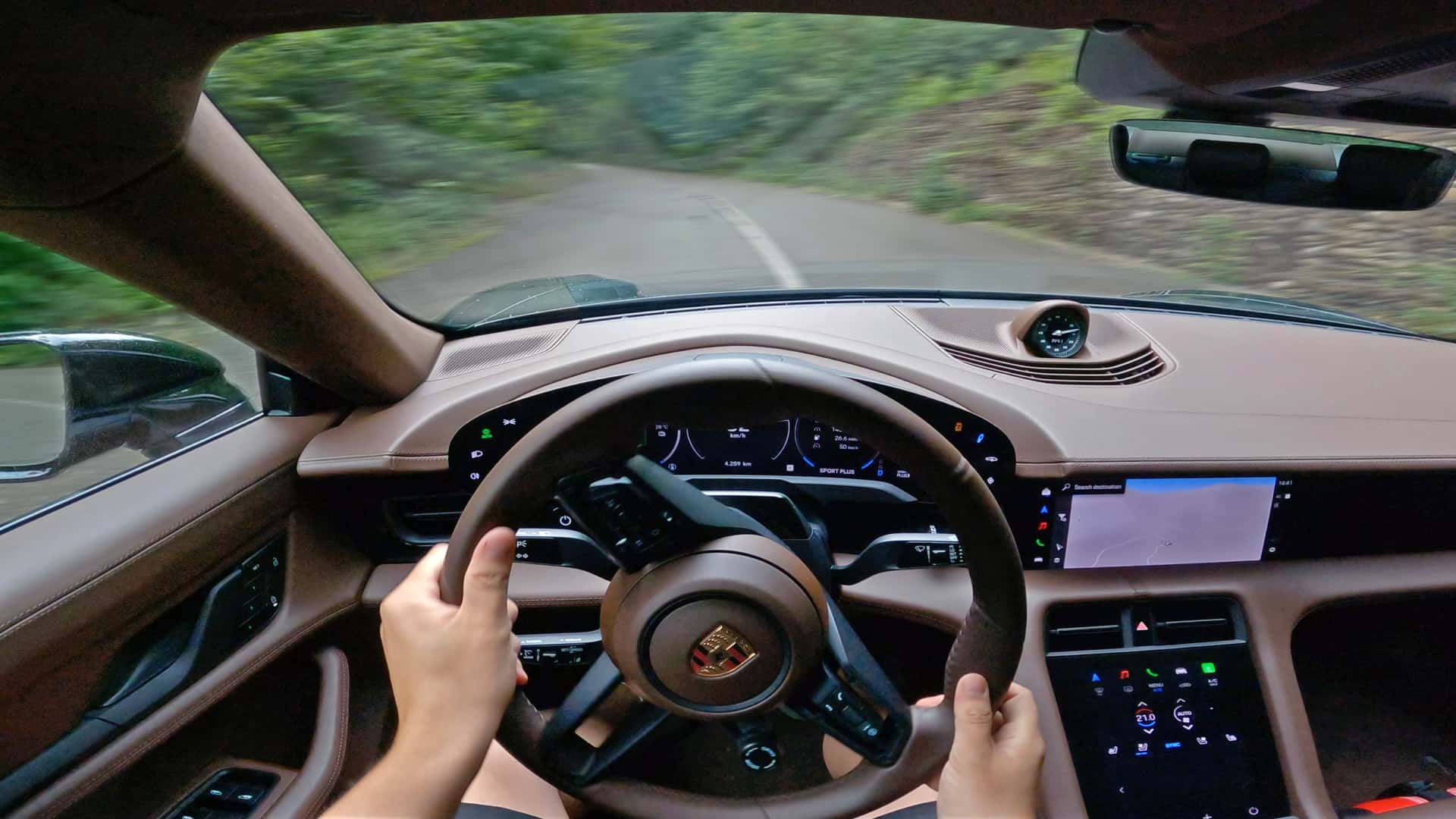
Recent evaluations of the refreshed 2026 Porsche Taycan, specifically models without the optional simulated engine and gear-swapping features, underscore a critical insight: the Taycan’s inherent driving prowess transcends the need for artificial enhancements. This electric sedan delivers an accomplished EV driving experience that rewards the most discerning drivers, even in complete silence.
The Taycan stands out as a formidable corner-carving machine, consistently outperforming many other high-performance vehicles, irrespective of their powertrain. Its chassis exhibits exceptional neutrality, poise, and predictability, instilling immense confidence in the driver. This allows for a seamless flow through challenging roads, where the absence of engine noise or gear shifts becomes an irrelevant detail.
The Practicality of Auditory Cues in EVs
While the purest EV driving experience might be silent, a subtle auditory reference serves a functional purpose, particularly for gauging speed and modulating inputs. As observed during a test drive, the Taycan 4, equipped with a basic spaceship-like acceleration sound, provides this essential feedback. This sound helps drivers to better assess their velocity, reducing the need for constant speedometer checks—a common challenge in fully silent EVs.
This functional aspect of sound was articulated by a BMW engineer, who explained the rationale behind the acceleration sound for the upcoming electric M3. The primary goal is to provide an audible reference for speed, not to replicate a gasoline engine. This philosophy resonates deeply with the observations from the Taycan’s performance, highlighting the importance of appropriate auditory feedback.
Enhancing Driver Feedback: Beyond Engine Roar
The absence of traditional engine noise in an EV amplifies other critical sounds within the vehicle, most notably those emanating from the tires. This amplification proves invaluable for performance driving, as drivers can more distinctly perceive the tire’s proximity to its grip limits. Such auditory cues, often masked by engine sounds in ICE vehicles, become a direct channel of communication between the car and the driver in an EV.
In the Taycan, this heightened awareness of tire performance facilitates precise line corrections using accelerator and brake inputs. Conversely, a simulated engine sound, which persists even when lifting off the accelerator, can inadvertently obscure these crucial tire noises, potentially diminishing the driver’s ability to intuitively gauge grip and maintain optimal control. This suggests that while artificial sounds may aim to improve engagement, they can sometimes detract from vital authentic feedback.
Accelerator Modulation and Perceived Power Delivery
Another area where sound plays a subtle yet significant role is in accelerator modulation. Judging the precise amount of power being fed into the system, especially when balancing the car through a bend and accelerating out, can be less intuitive in a completely silent EV. A sound that dynamically responds to accelerator input adds an additional layer of feedback, making these adjustments feel more natural and intuitive for the driver.
Research supports the idea that sound can influence the perceived power delivery of a vehicle. However, this does not conclusively establish that silent EVs are inherently harder to control. Instead, it underscores the potential for thoughtful auditory design to complement the unique characteristics of electric powertrains, enhancing the overall EV driving experience without resorting to mere imitation.
The Cayenne Electric Experience: A Futuristic Symphony
The debate around simulated sounds extends to other Porsche electric models, such as the new Porsche Cayenne Electric. During a recent road trip, a Cayenne Electric model, also lacking the fake shifting feature, presented a similar gearless acceleration sound to the Taycan. This sound was described as a futuristic V-8, fueled by a yet-to-be-discovered element.
This distinct auditory profile proved perfectly adequate for conveying speed while navigating Austria’s challenging Grossglockner high Alpine pass. It added to the experience without compelling the driver to engage in pretend gear shifts that, from a purist’s perspective, merely slow the vehicle down to emulate something it inherently is not. This highlights a growing sentiment for authentic, EV-specific experiences rather than retrospective mimicry.
Forging a New Legacy: The Future of EV Nostalgia
As the automotive world transitions to electric mobility, a pertinent question arises: what aspects of early performance EVs will future generations romanticize? Drivers learning today might one day recall an initial performance EV with the same fondness that current enthusiasts reserve for a naturally aspirated straight-six engine. They may even voice complaints that future cars have lost a certain ‘something.’
This evolving landscape presents an opportunity for manufacturers to innovate, creating original, distinctive characteristics that define the electric era. The aim should be to give future drivers something genuinely unique to miss, rather than a mere software reenactment of their predecessors’ mechanical gearboxes. True progress in the EV driving experience lies in embracing and celebrating its inherent qualities, not in retrofitting it with artificial vestiges of the past.
FAQ Section
Q1: Why are some EVs incorporating simulated engine sounds and gears?
A: Manufacturers are adding these features to enhance driver engagement and provide auditory feedback, aiming to replicate the visceral experience often associated with traditional internal combustion engine vehicles and to help drivers gauge speed.
Q2: Does the Porsche Taycan come standard with fake gears or simulated engine sounds?
A: No, these features are typically offered as optional extras in models like the Porsche Taycan. Many Taycan test vehicles, including those evaluated by experts, do not include these simulations.
Q3: How does the Taycan’s driving experience differ without simulated sounds?
A: Without simulated sounds, the Taycan’s exceptional chassis, neutral handling, and predictable dynamics shine through, offering a highly engaging and confidence-inspiring EV driving experience that does not rely on artificial sensory feedback.
Q4: What is the functional purpose of sound in an EV, according to experts?
A: According to engineers, the primary functional purpose of sound in an EV is to provide an audible reference for speed and to assist with accelerator modulation, rather than purely mimicking a gasoline engine.
Q5: How does the absence of engine noise benefit the driver in a performance EV like the Taycan?
A: The silence amplifies the sound of the tires, providing clearer feedback on grip limits. This allows drivers to more accurately correct their line using the accelerator and brakes, enhancing overall control and responsiveness.
Q6: Are other high-performance EVs also using simulated sounds?
A: Yes, brands like Hyundai (Ioniq 5 N) and Mercedes-AMG (GT 4-Door EV) have also integrated advanced simulated engine and gear systems, each with their distinct approach to artificial auditory feedback.