
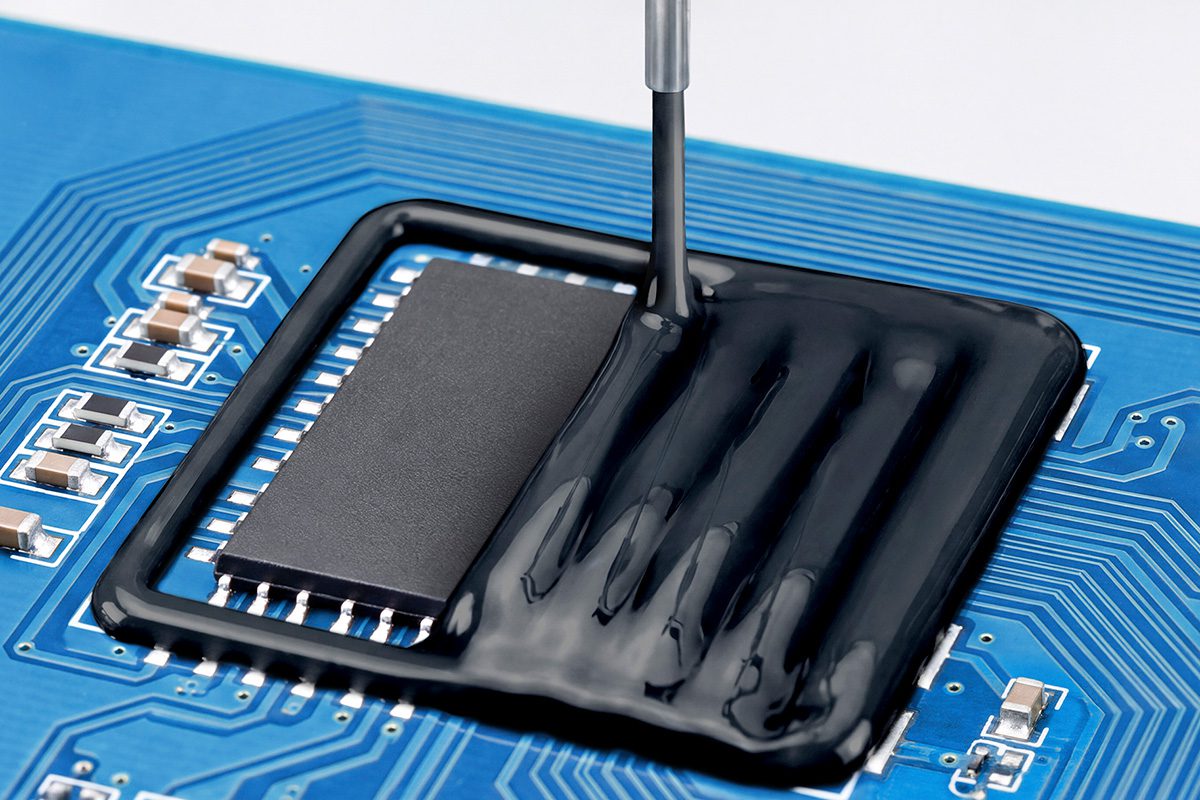
In a significant development for electric vehicle (EV) engineering, Wevo, a leading material solutions provider, has introduced WEVOPUR 60210 FL T, a specialized polyurethane compound designed for the selective potting of multilayer printed circuit boards (PCBs) within automotive battery management systems (BMS). This innovative solution aims to significantly enhance the resilience and longevity of critical EV components, particularly those monitoring and controlling voltages up to 800V.
The new compound, applied using the precise dam-and-fill method, addresses the escalating demands placed on high-density PCBs in modern EVs. As the automotive industry pushes towards higher performance and greater integration, these electronic systems face unprecedented challenges from mechanical stress, fluctuating environmental conditions, and elevated operating temperatures. WEVOPUR 60210 FL T emerges as a robust protective layer, encapsulating sensitive electronics where it is needed most, while keeping vital connectors and testing points accessible.

Key Takeaways
- Wevo’s WEVOPUR 60210 FL T is a new polyurethane compound for selective potting of EV battery management PCBs.
- It provides enhanced protection against mechanical stress, temperature fluctuations, moisture, and electrochemical corrosion.
- The compound is engineered for high-voltage applications, supporting systems up to 800V with a dielectric strength exceeding 20 kV/mm.
- Its specific material properties, including Shore hardness D 40-50 and thermal conductivity of 0.8 W/m·K, ensure shock absorption and efficient heat dissipation.
- Applied via the dam-and-fill method, it offers precise, customizable protection without hindering access to critical board elements.
- The system is compatible with standard mixing and dosing equipment, streamlining material qualification and process management.
The Indispensable Role of Battery Management Systems in Electric Vehicles
At the heart of every electric vehicle lies its battery management system (BMS), a complex electronic network responsible for overseeing the safety, performance, and lifespan of the battery pack. The BMS continuously monitors crucial parameters such as cell voltage, temperature, and current flow, ensuring optimal operation and preventing conditions that could lead to damage or hazardous situations like thermal runaway. Given the high voltages involved—often reaching up to 800V in advanced EV architectures—the integrity and reliability of BMS PCBs are paramount.
Modern BMS designs are characterized by their increasing integration density, packing more diagnostic, communication, and safety functions onto smaller boards. This miniaturization, while beneficial for space and weight, amplifies the vulnerability of these components to external factors. The operational environment within an EV battery pack is notoriously harsh, exposing PCBs to constant vibrations from road conditions, significant temperature variations, and the potential ingress of moisture and contaminants. These stressors can lead to premature component failure, compromising vehicle safety and performance.
Addressing Challenges for High-Density PCBs
The intense operating conditions within an EV, coupled with the intricate nature of high-density PCBs, present several engineering challenges. Mechanical stress from road vibrations and sudden impacts can cause physical damage to components and solder joints. Thermal fluctuations, particularly rapid heating and cooling cycles, induce stress within the materials, potentially leading to micro-cracks or delamination over time. Moreover, the risk of electrochemical corrosion due to moisture ingress remains a persistent threat to long-term reliability.
Traditional methods of protection often involve encapsulating the entire circuit board. However, this can make future diagnostics or component replacement challenging, as connectors and testing points become inaccessible. The need for a more targeted and efficient protection strategy has become critical for advanced automotive electronics, driving innovations like selective potting that provide robust defense while maintaining functional accessibility.
Polyurethane Potting: A Strategic Shield for Automotive Electronics
Potting involves encasing a circuit board or electronic assembly in a cured compound, forming a protective barrier against environmental aggressors. It is a well-established method in the automotive industry for shielding sensitive electronics from the detrimental effects of vibration, moisture, and heat. The specific innovation with WEVOPUR 60210 FL T lies in its formulation and application method, tailored precisely for the complex requirements of EV BMS.
The Precision of Selective Potting
Selective potting refines this concept by applying the protective compound only to specific areas where it is most needed. This targeted approach offers several advantages: it reduces material consumption, minimizes added weight, and crucially, ensures that connectors, testing points, and other user-interface elements remain unpotted and fully accessible for assembly, maintenance, and diagnostics. This balance of protection and accessibility is vital for the practical implementation and servicing of high-performance EV components.
WEVOPUR 60210 FL T: Engineered for Extreme Protection
Wevo’s WEVOPUR 60210 FL T polyurethane compound is meticulously engineered to provide superior protection under the most demanding conditions encountered in electric vehicles. Its material properties are optimized to counteract the specific threats faced by BMS PCBs, contributing significantly to the overall reliability and safety of EV battery packs.
Key Material Properties and Their Impact
The compound exhibits a Shore hardness of D 40 to 50, a characteristic that allows it to effectively absorb shocks and vibrations. This damping capability is crucial in mitigating mechanical stress on sensitive components and solder joints, thereby preventing fatigue-related failures. Its thermal conductivity of 0.8 W/m·K is another critical feature, enabling efficient heat transfer through the potted assembly. This helps to minimize temperature differences across components, reducing thermal stress and lowering the risk of stress cracks and solder joint detachment, which are common issues in high-power applications.
For high-voltage systems, dielectric strength is paramount. WEVOPUR 60210 FL T boasts a dielectric strength exceeding 20 kV/mm, providing robust electrical insulation essential for PCBs monitoring and controlling voltages up to 800V. This high insulation capability ensures the safety and operational integrity of the electrical pathways within the BMS, preventing short circuits and electrical breakdowns.
According to Wevo, the cured compound also plays a vital role in physically fixing components in place, preventing movement that could lead to wear or electrical issues. Furthermore, its formulation is specifically designed to prevent electrochemical corrosion, a significant concern in environments where moisture and electrical potential can combine to degrade metal components. Optimized adhesion properties ensure a durable bond with the substrate, effectively preventing delamination and maintaining the integrity of the protective layer over the lifespan of the vehicle.
The Dam-and-Fill Process: Precision in Application
The dam-and-fill application method is central to the efficacy of WEVOPUR 60210 FL T. In this process, the compound performs a dual function: first, it acts as a barrier, creating a containment wall around the areas to be protected; then, it serves as a filler, flowing into the defined region to encapsulate the components. Wevo has carefully tuned the flow behavior and thixotropy of the compound to ensure that the barrier maintains its shape reliably, while the filler wets the designated area thoroughly without trapping air pockets. Air bubbles within the potting compound can compromise insulation, reduce thermal conductivity, and create pathways for moisture, making their exclusion critical.
The versatility of the dam-and-fill method allows for precise control over the layer thickness and the amount of material applied. These parameters can be adjusted to suit different PCB geometries and component heights simply by modifying the process design and application speed. This adaptability ensures optimal protection tailored to the specific layout of each battery management board, maximizing efficiency and performance.
Streamlined Integration and Operational Efficiency
Beyond its protective capabilities, WEVOPUR 60210 FL T is designed for seamless integration into existing manufacturing workflows. Wevo formulated the system to run efficiently on standard two-component mixing and dosing equipment. This compatibility is a significant advantage for automotive manufacturers, as it helps to reduce the complexity and resources involved in material qualification, storage management, and overall process integration. By minimizing the need for specialized equipment or extensive procedural changes, the new polyurethane compound offers a practical and cost-effective solution for enhancing EV battery safety and reliability.
The Future of EV Battery Protection
As electric vehicles continue to evolve with higher power densities, faster charging capabilities, and increasingly sophisticated electronics, the demand for robust and reliable protection solutions for critical components like BMS PCBs will only grow. Innovations such as Wevo’s WEVOPUR 60210 FL T are crucial for ensuring the long-term performance, safety, and trustworthiness of EV technology. This targeted approach to encapsulation exemplifies the continuous advancements in material science that are vital for sustaining the rapid growth and widespread adoption of electric mobility.
Source: Wevo
Frequently Asked Questions (FAQs)
What is WEVOPUR 60210 FL T designed for?
WEVOPUR 60210 FL T is a polyurethane potting compound specifically developed by Wevo to protect multilayer printed circuit boards (PCBs) in automotive battery management systems (BMS) within electric vehicles, particularly those operating at high voltages up to 800V.
How is WEVOPUR 60210 FL T applied to PCBs?
The compound is applied using the dam-and-fill method. This technique allows for selective potting, where the compound first forms a barrier and then fills the designated area, protecting specific components while leaving others (like connectors) accessible.
What key properties does this compound offer?
WEVOPUR 60210 FL T features a Shore hardness of D 40-50 for shock absorption, a thermal conductivity of 0.8 W/m·K for efficient heat dissipation, and a dielectric strength exceeding 20 kV/mm for high-voltage insulation. It also protects against moisture and electrochemical corrosion.
Why is selective potting important for EV battery management systems?
Selective potting provides robust protection against mechanical stress, temperature fluctuations, and environmental ingress for critical PCB components. It ensures durability without compromising access to diagnostic points or connectors, which is essential for maintenance and servicing in complex EV systems.
How does WEVOPUR 60210 FL T contribute to thermal management?
With a thermal conductivity of 0.8 W/m·K, the compound facilitates the movement of heat away from components. This helps in reducing temperature differences across the PCB, lowering the risk of thermal stress-induced damage like stress cracks and solder joint detachment.
Is the application process of WEVOPUR 60210 FL T complex?
No, Wevo designed WEVOPUR 60210 FL T to be compatible with standard two-component mixing and dosing equipment. This streamlines the application process, reducing the effort and resources required for material qualification, storage, and overall process management for manufacturers.