
Key Takeaways
- hofer powertrain has developed a groundbreaking battery module featuring dynamically programmable cell pressure control.
- This innovation allows the mechanical preload on individual battery cells to vary with operating conditions, moving beyond traditional fixed designs.
- Optimizing mechanical stress on cells is crucial for extending battery cycle life and maintaining performance, potentially doubling longevity and energy density.
- Extensive research by hofer powertrain and validation from institutions like the University of Cambridge underpin the technology’s effectiveness.
- The applications for this adaptive battery management span electric vehicles, commercial transport, stationary energy storage, marine, and even future aviation and aerospace systems.
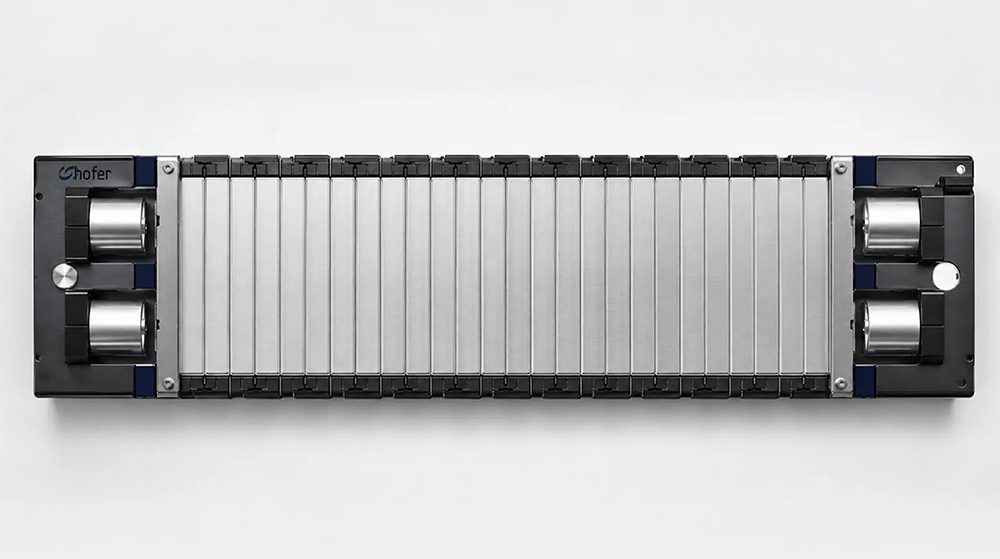
In a significant advancement for electric vehicle (EV) and energy storage technologies, hofer powertrain has unveiled a pioneering battery module that offers dynamic, programmable cell pressure control. This innovative system departs from conventional battery module designs, where the mechanical preload on individual cells remains a fixed parameter, often determined during manufacturing.
The new module introduces a freely programmable force map, allowing the pressure exerted on battery cells to adjust actively in response to varying operating conditions. This transformative capability converts what was once a static mechanical design element into a dynamic and controllable parameter within the overarching battery system, holding substantial implications for battery longevity and performance across numerous applications.

The Science Behind Dynamic Cell Preload Management
The core principle behind hofer powertrain’s innovation lies in precisely managing the mechanical stress experienced by battery cells. For over five years, hofer powertrain has conducted extensive research and engaged in various customer projects, meticulously investigating how cell preload, volumetric changes (often referred to as ‘breathing’), swelling, and deformation influence the cycle life and overall performance of diverse battery chemistries.
During a battery’s operational life, particularly during charging and discharging cycles, the active materials within the cells undergo volumetric expansion and contraction. This phenomenon, known as ‘cell breathing,’ can induce significant mechanical stresses on the cell’s internal structure and its surrounding packaging. Uncontrolled or suboptimal mechanical loading can accelerate degradation mechanisms, such as the growth of the solid-electrolyte interphase (SEI) layer, electrode cracking, and loss of electrical contact, ultimately diminishing the battery’s lifespan and capacity.
Advanced Testing and Multi-Chemistry Applicability
To quantify these intricate effects, hofer powertrain developed sophisticated programmable test equipment. This specialized apparatus is capable of recording a comprehensive suite of parameters, including cell deformation, temperature, voltage, capacity, and impedance, under precisely defined charge and load profiles. Such detailed measurements are instrumental in identifying early indicators of mechanical constraints that are best suited for a given cell technology.

The methodology has already demonstrated its versatility and effectiveness across a spectrum of modern battery chemistries. This includes Nickel Manganese Cobalt (NMC) and Lithium Iron Phosphate (LFP) cells, which are widely used in current EV and energy storage solutions, as well as next-generation solid-state cells, highlighting the technology’s readiness for future battery advancements.
Optimizing Cell Pressure: A Complex Equation
One of the critical findings from hofer powertrain’s research is that there is no singular ‘ideal’ pressure setting that applies universally to every battery cell. Both insufficient and excessive mechanical preload can detrimentally accelerate degradation processes. The optimal pressure range is a highly dynamic variable, intricately linked to a multitude of factors.
These influencing factors include the specific cell chemistry (e.g., NMC, LFP), the cell’s physical format (e.g., pouch, prismatic, cylindrical), its current state of charge (SOC), operating temperature, and the prevailing operating profile (e.g., fast charging, deep discharge, high-power demand). Recognizing these interdependencies, hofer powertrain emphasizes that these parameters must be treated as a holistic system rather than isolated variables for effective battery management.
Academic Validation and Transformative Potential
The foundational research supporting the benefits of carefully managed mechanical loading extends beyond hofer powertrain’s internal studies. Independent research conducted by the University of Cambridge has corroborated these findings, demonstrating that precisely controlled mechanical loading can significantly mitigate the aging processes of lithium-ion cells.
Under specific test conditions, the University of Cambridge research observed a substantial extension in the service life of the cells evaluated. Building on this scientific basis, hofer powertrain assesses the potential of its programmable battery cell pressure control approach to yield remarkable improvements: up to double the cycle life at double the energy density. This impressive projection is based on its ongoing work with current NMC and emerging solid-state cells.
It is important to note, however, that the magnitude of these gains is contingent upon several factors, including the specific cell technology employed, the real-world operating profile of the battery system, and the initial design architecture. Nonetheless, the potential for such significant enhancements underscores the transformative impact this technology could have on battery performance metrics.
Broadening the Horizon: Diverse Applications
The applications for hofer powertrain’s advanced programmable battery cell pressure control extend far beyond conventional passenger electric vehicles. Its capabilities are particularly relevant for demanding sectors that rely heavily on robust and long-lasting battery systems.
These include heavy-duty commercial vehicles, which often experience more strenuous duty cycles and require exceptionally durable power sources. Stationary energy storage systems, crucial for grid stability and renewable energy integration, also stand to benefit immensely from extended battery life and enhanced reliability. Furthermore, the technology holds promise for marine vessels, future aviation platforms, and even nascent aerospace systems, where every gram and every cycle count significantly.
The mechanics of dynamic pressure control are deemed especially vital for solid-state cells within stationary storage applications. These next-generation cells, while offering higher energy density and improved safety, are often sensitive to mechanical stress. Additionally, the technology is highly beneficial for vehicle batteries that support advanced functionalities like vehicle-to-home (V2H) and vehicle-to-grid (V2G) operations. These bidirectional energy transfer systems inherently demand a far greater number of charge and discharge cycles, making active degradation management paramount for their economic viability and operational lifespan.
Enhancing E-E-A-T in Battery Technology
This development by hofer powertrain exemplifies the ongoing commitment within the battery industry to push the boundaries of performance and longevity. By transforming a static design parameter into an actively controlled variable, the company is contributing to a new paradigm in battery management systems. This level of detailed engineering and scientific rigor strengthens the experience, expertise, authoritativeness, and trustworthiness (E-E-A-T) associated with battery development, reassuring consumers and industries about the reliability and advanced nature of future energy solutions.
The ability to dynamically manage programmable battery cell pressure control is not merely an incremental improvement; it represents a fundamental shift in how battery modules can be designed and operated. By effectively mitigating the inherent mechanical stresses that contribute to battery degradation, this technology paves the way for a new generation of electric vehicles and energy storage solutions that are not only more efficient and powerful but also significantly more durable and sustainable.
Future Outlook for Battery Longevity and Performance
As the global transition to electrification accelerates, the demand for high-performance, long-lasting, and cost-effective battery solutions continues to grow. Innovations like hofer powertrain’s programmable cell pressure control are critical enablers for meeting these evolving requirements. By actively addressing one of the primary drivers of battery degradation – mechanical stress – the technology promises to unlock new levels of performance and extend the economic viability of battery-powered systems.
The integration of such sophisticated mechanical control into battery management systems will likely become a cornerstone of advanced battery design. This focus on intelligent, adaptive management not only enhances individual cell performance but also contributes to the overall robustness and safety of the entire battery pack, ultimately benefiting end-users with more reliable and enduring power solutions.
Frequently Asked Questions About Programmable Battery Cell Pressure Control
What is programmable battery cell pressure control?
Programmable battery cell pressure control is an advanced technology developed by hofer powertrain that dynamically adjusts the mechanical force, or preload, applied to individual battery cells within a module. Unlike traditional designs with fixed pressure, this system uses a programmable force map to optimize pressure based on real-time operating conditions, aiming to extend cell life and performance.
How does mechanical preload affect battery life?
Mechanical preload significantly influences battery life by affecting internal cell structures. Both too little and too much pressure can accelerate degradation mechanisms like electrode cracking or unstable SEI layer formation during charge/discharge cycles (cell breathing). Optimizing this preload reduces stress, preserving cell integrity and extending operational lifespan.
What types of battery cells can benefit from this technology?
This programmable cell pressure control technology is versatile and applicable across various battery chemistries. hofer powertrain has successfully applied it to widely used NMC (Nickel Manganese Cobalt) and LFP (Lithium Iron Phosphate) cells, as well as to next-generation solid-state battery cells, demonstrating its broad potential for enhancing diverse battery technologies.
What are the potential benefits of hofer powertrain’s innovation?
The primary benefits include a significant extension of battery cycle life and improved performance. hofer powertrain projects up to double the cycle life and double the energy density for certain cell types, based on current NMC and solid-state cells. This translates to more durable, reliable, and efficient battery systems for various applications.
Beyond EVs, where else can this technology be applied?
While crucial for conventional EVs, the technology’s applications extend to commercial vehicles, where durability is paramount, and stationary energy storage systems, which demand long lifespans. It also holds promise for marine, aviation, and aerospace systems, as well as for vehicle batteries supporting demanding V2H (vehicle-to-home) and V2G (vehicle-to-grid) operations.
Is this technology currently available?
While hofer powertrain has developed and extensively researched this technology, details on its commercial availability for widespread integration into consumer products or current vehicle models would typically be announced by the company or its partners. The announcement highlights a significant engineering achievement poised for future implementation.
What is the significance of “cell breathing” in battery design?
Cell breathing refers to the volumetric expansion and contraction of battery cells during charging and discharging cycles. This phenomenon creates mechanical stress that can lead to degradation. Programmable cell pressure control actively manages this stress, mitigating its negative effects and thereby improving the longevity and reliability of the battery.
How does this technology enhance battery system control?
By transforming a fixed mechanical design parameter (cell preload) into an actively controlled variable, this technology provides the battery management system with an additional layer of optimization. It allows for adaptive adjustments to cell pressure based on real-time conditions, leading to more intelligent, responsive, and efficient overall battery system management and operation.