
Key Takeaways:
- Toyota Motor North America launched an ‘Electrification 101’ program to educate its diverse employee base on hybrid, EV, and hydrogen technologies.
- The training highlighted that many automotive employees, even at major manufacturers, may lack in-depth knowledge of electrification nuances.
- Toyota champions a ‘multi-pathway’ electrification strategy, focusing on hybrids while developing EVs and hydrogen fuel cell vehicles.
- The program debunked common EV myths, demonstrated the simplicity and efficiency of electric motors, and aimed to foster internal advocacy for electrification.
- Initial results show employees, like those in customer-facing roles, becoming more knowledgeable and enthusiastic about promoting electrified vehicles.
The global automotive industry is undergoing a monumental shift towards electrification, a transition that demands not only technological innovation but also a fully informed workforce. While industry critics and enthusiasts may be deeply engrossed in the intricacies of electric vehicles (EVs) and hybrid technologies, a recent initiative by Toyota Motor North America has shed light on a crucial internal education gap: not every employee at a leading car manufacturer is an electrification expert.

Toyota’s ‘Electrification 101’ program, designed to bridge this knowledge divide, recently offered a compelling reality check. It revealed that for a significant portion of the company’s diverse employee base, the fundamental concepts, benefits, and strategic importance of electrification were largely new information.
Understanding the Internal Knowledge Gap
It is a common misconception that every individual working within a prominent automotive corporation is inherently a ‘car nerd’ or a technical expert on emerging powertrain technologies. However, the operational reality of a global giant like Toyota encompasses a vast array of roles, from corporate accounting and human resources to software development and logistics.
Many employees are drawn to Toyota for its robust benefits, professional stability, esteemed corporate culture, and the prestige associated with working for the world’s largest automaker. Their expertise often lies outside the minutiae of automotive engineering or the evolving landscape of battery chemistries.

Even among car enthusiasts within the company, knowledge about specific electrification components, such as the distinctions between Nickel Manganese Cobalt (NCM) and Lithium Iron Phosphate (LFP) battery chemistries, may not be widespread. The technical complexities and rapid evolution of electric vehicle technology represent a new frontier for many, irrespective of their general automotive passion.
Toyota’s Proactive ‘Electrification 101’ Initiative
Recognizing this internal dynamic, Toyota developed its ‘Electrification 101’ program to equip curious staff members with foundational knowledge. This marks the second such educational offering from Toyota, following an earlier general introduction to all things automotive, further underscoring the company’s commitment to internal education.
The program’s nomenclature, ‘Electrification 101’ rather than ‘EV 101,’ is highly significant. It reflects Toyota’s well-articulated ‘multi-pathway’ approach to sustainable mobility. This strategy emphasizes a strong contemporary focus on hybrid electric vehicles (HEVs), while concurrently developing battery electric vehicles (BEVs) and exploring the long-term potential of hydrogen fuel cell electric vehicles (FCEVs).
Recent sales figures underpin this strategy. In the last quarter, 56.8% of Toyota’s total sales comprised electrified vehicles, a category that includes HEVs, BEVs, plug-in hybrid electric vehicles (PHEVs), and FCEVs. Notably, pure battery electric vehicles constituted only 1.7% of these electrified sales, highlighting the current dominance of hybrid technologies within Toyota’s portfolio.
Course Content and Practical Demonstrations
The core curriculum of the four-hour training session primarily took place in a classroom setting. It meticulously covered the fundamental principles of all primary powertrain types, offering clear distinctions between hybrids and PHEVs. Despite Toyota’s current strategic emphasis on hybrids, a substantial portion of the program was dedicated to clarifying misconceptions surrounding battery electric vehicles.
The course commenced with a historical parallel, referencing the early 20th-century automotive industry. During that era, the nascent gasoline car market grappled with nascent infrastructure, limited public education, unclear service protocols, and undefined rules of the road, making horse ownership appear simpler. Yet, automobiles ultimately prevailed, a narrative used to contextualize the current EV transition.
Participants were educated on the extensive advantages of electrification, emphasizing superior efficiency and environmental cleanliness. The program also highlighted the perceived benefits of the multi-pathway approach, asserting its role in offering customer choice and optimizing the utilization of finite battery resources. It is worth noting, however, that while Toyota champions this approach for resource allocation, much independent research suggests that BEVs often represent the cleanest option over their lifecycle, even considering manufacturing and energy sources.
The section addressing the comparative advantages of each powertrain type was identified as potentially lacking by some, particularly in its characterization of EVs. While it thoroughly examined the limitations of battery electric vehicles, it did not equally enumerate the additional maintenance requirements or the noise, vibration, and harshness (NVH) associated with traditional gasoline cars. Furthermore, the program maintained a characteristically optimistic outlook on hydrogen technology.
One slide, for instance, stated that hydrogen “can reduce ‘range anxiety’ as number of stations grow,” citing the Toyota Mirai’s range of up to 402 miles per tank. While such figures were impressive during the infancy of EV development, current market offerings include at least eight BEVs in the U.S. that surpass this range, with more advanced models continuously entering the market.
Beyond these specific discussions, the classroom content was broadly informative, focusing on core concepts such as battery chemistries, various charging types, electrical units like kilowatts and kilowatt-hours, and an overview of battery recycling initiatives.
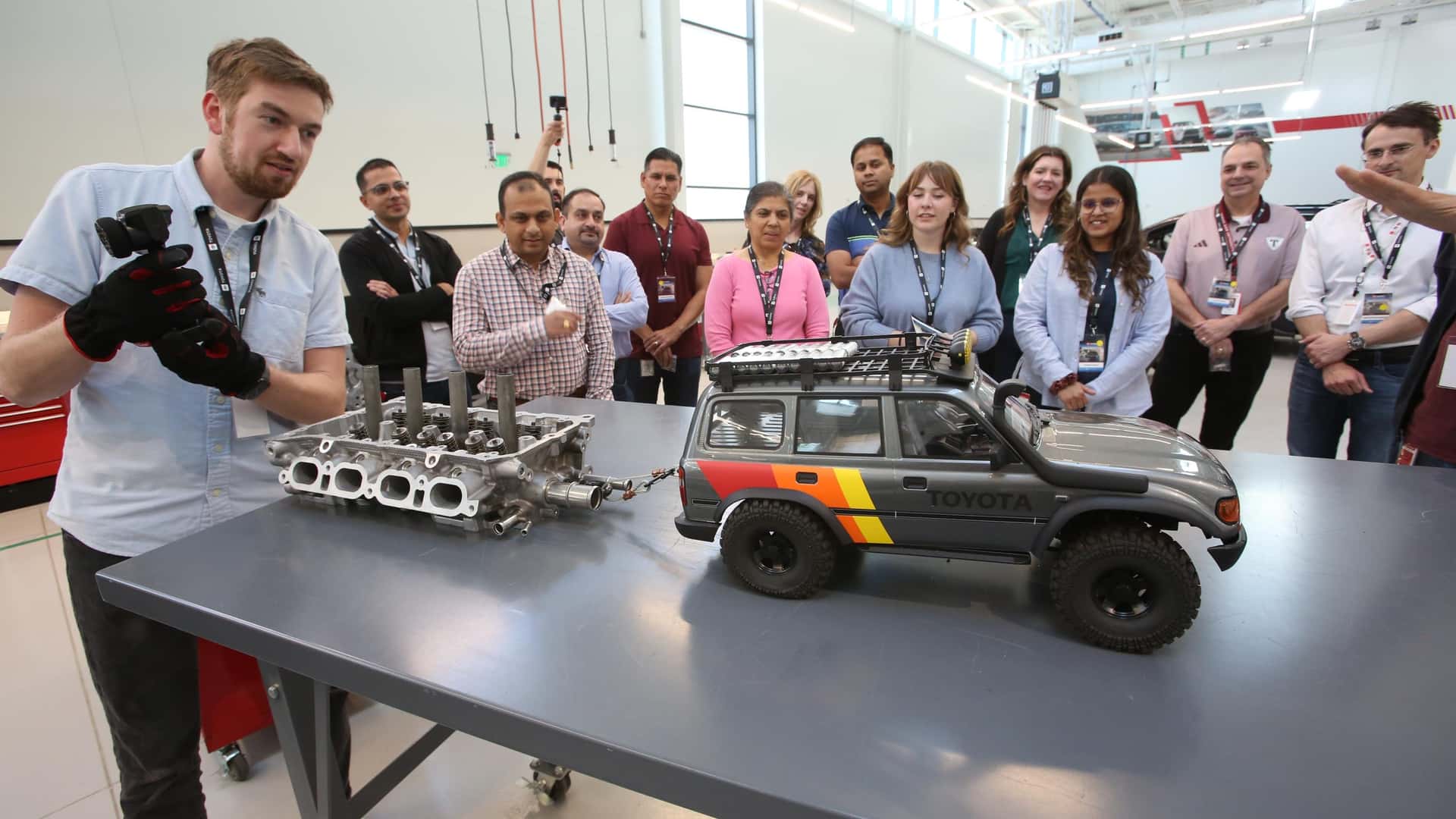
The most engaging segment of the program involved interactive, hands-on activities. Employees were guided through constructing a rudimentary electric motor using minimal components: a screw, a magnet, a AA battery, and a piece of wire. Participants also assembled a simple potato-based battery and observed different charging outputs in action. A highlight was a demonstration of the instantaneous torque of an EV motor, where a small remote-controlled Land Cruiser effortlessly towed a cylinder head weighing over 30 pounds.
Key Insights from the Electrification Experience
The overarching lesson from these activities was unequivocal: electric motors represent an extraordinary technological advancement. Presenters contrasted a complex, stripped-out Toyota V-6 engine, with its numerous intricate parts and accessories, against an equivalent electric motor. The electric motor demonstrated significantly greater power within a far smaller footprint and with a remarkably simpler design.
The program illustrated that even the integration of an electric motor into a gasoline powertrain, as seen in Toyota’s hybrid systems, can simplify overall vehicle design by eliminating complex components like traditional transmissions. This core message reinforced that incorporating electric propulsion, at any level, enhances efficiency with minimal compromises.
The further one progresses along the electrification spectrum, towards pure battery electric vehicles, the inherent design simplicity increases, translating to fewer potential points of failure. While Toyota representatives acknowledged that significant improvements are still needed in battery chemistry and charging infrastructure before BEVs become a universal solution, the training clearly aimed to cultivate enthusiasm among employees for a fully electric future.
Empowering Internal Advocacy for Electrified Vehicles
Cultivating this internal enthusiasm is crucial for influencing long-term strategic decisions within the company. Without a clear understanding of electrification’s long-term benefits, employees in roles such as corporate procurement might solely perceive the immediate challenges: increased costs for new component designs or the complexities of integrating new suppliers. This perspective could inadvertently foster resistance to change.
However, by generating excitement and understanding, employees become more willing to navigate short-term complexities in pursuit of long-term strategic objectives, and to champion these goals internally. Brigette Armato, a Toyota employee who attended the program, exemplifies this transformation.
Armato candidly admitted knowing “nothing” about EVs and hybrids prior to the training. Post-program, she has emerged as an advocate. “I work with our lease experience team, so I’m actually working with the customers and the vehicles. This was extremely helpful because now I can have an educated conversation with them and maybe convince them to go for an electric vehicle, whereas before I don’t think I had that skill,” she stated as the session concluded.
Her advocacy extends beyond customers; Armato is now seriously considering an electrified vehicle for personal use, despite her attachment to her current Toyota 4Runner. She expressed a desire for an electric alternative to her existing vehicle, eagerly anticipating a fully electric version should it become available.
“I wish we would gravitate more towards electric vehicles across the lineup,” Armato remarked. This sentiment, shared by many industry observers, finds resonance within Toyota’s North American headquarters. With hundreds of employees attending these ‘Electrification 101’ classes and a substantial waitlist for future sessions, the number of internal champions for electrification is steadily growing.
This widespread internal education initiative demonstrates that the previous lack of fervent advocacy wasn’t necessarily active resistance, but rather a simple deficit of knowledge – a situation not uncommon among a significant portion of the general car-buying public.
Evidence That EVs Are The Cleanest Option
- EV Myth Busted: No, They’re Not ‘Dirtier’ Than Gas Cars, Even If You Use Fossil Fuel Power
- Yes, EVs Really Are Cleaner Than Gas Cars. Here’s By How Much
Frequently Asked Questions (FAQ)
What is Toyota’s ‘Electrification 101’ program?
Toyota’s ‘Electrification 101’ is an internal training program designed to educate its diverse employee base on the fundamentals of electrified vehicle technologies. This includes hybrid electric vehicles (HEVs), plug-in hybrid electric vehicles (PHEVs), battery electric vehicles (BEVs), and hydrogen fuel cell electric vehicles (FCEVs). The program aims to ensure a common understanding of these evolving technologies across the company.
Why did Toyota launch an electrification training program for its employees?
Toyota recognized that not all employees, regardless of their role or department, possess in-depth knowledge of advanced electrification technologies. The program was initiated to bridge this internal knowledge gap, foster a greater understanding of Toyota’s multi-pathway strategy, and cultivate internal advocates for electrified vehicles, aligning the workforce with the company’s future direction.
What is Toyota’s ‘multi-pathway’ approach to electrification?
Toyota’s ‘multi-pathway’ approach is a strategic vision for decarbonization that advocates for developing and offering a diverse range of electrified vehicles. This includes a current focus on hybrids, while simultaneously advancing battery electric vehicles (BEVs) and exploring hydrogen fuel cell electric vehicles (FCEVs). The strategy aims to provide customers with choice and optimize global battery resource utilization.
What were some key takeaways for employees attending the training?
Employees gained a foundational understanding of various powertrain types, learned about battery chemistries and charging methods, and witnessed demonstrations of electric motor efficiency. A key takeaway was the inherent simplicity and power of electric motors compared to complex internal combustion engines, illustrating how electrification can enhance vehicle performance and reliability.
How is this training impacting Toyota’s employee engagement and customer interaction?
The training has significantly boosted employee knowledge and enthusiasm for electrification. For customer-facing teams, it provides the skills to have more educated conversations, potentially influencing customer choices towards electrified models. Internally, it creates a growing pool of employees who understand and are excited about Toyota’s long-term electrification goals, fostering a more unified company vision.
Does Toyota intend to increase its focus on pure battery electric vehicles (BEVs)?
While Toyota’s ‘multi-pathway’ approach currently emphasizes hybrids, the company is actively developing BEVs and aims to see improvements in battery chemistry and charging infrastructure. The ‘Electrification 101’ program, by educating employees on BEV advantages and dispelling myths, indicates a long-term strategic intention to expand its BEV offerings as market conditions and technological advancements evolve.