
Key Takeaways:
- Toyota Motor North America launched its ‘Electrification 101’ program to educate employees, many of whom lack in-depth knowledge of electric and hybrid vehicle technologies.
- The program emphasizes Toyota’s ‘multi-pathway’ electrification strategy, focusing on hybrids in the present while developing battery electric vehicles (BEVs) and hydrogen fuel cell vehicles (FCEVs) for the future.
- Despite a strong focus on hybrids (56.8% of electrified sales), the training aims to demystify BEVs, addressing common myths and showcasing their technological advantages.
- Interactive sessions, such as building electric motors and demonstrating instant torque, aim to excite employees about the potential of electric propulsion.
- The initiative seeks to foster internal advocacy for electrification, with employees like Brigette Armato reporting increased confidence in discussing and promoting electric vehicles to customers.
The global automotive industry is undergoing an unprecedented transformation, driven by the imperative for sustainable transportation. As manufacturers navigate this complex shift towards electrification, one of the often-overlooked challenges is ensuring a deep, company-wide understanding of these evolving technologies. Toyota Motor North America has actively addressed this internal knowledge gap by rolling out its ‘Electrification 101’ program, an initiative designed to bring its diverse workforce up to speed on the nuances of electric vehicles (EVs), hybrids, and other electrified powertrains.

For many industry observers, particularly those deeply embedded in the electric vehicle debate, there’s an assumption that everyone within a major automotive company shares a similar level of enthusiasm and expertise regarding electrification. However, a recent experience attending Toyota’s internal training revealed a stark reality: a significant portion of employees at a legacy automaker may possess limited knowledge about electrification or its profound benefits. This realization underscores the critical importance of foundational education within large corporations adapting to new industry paradigms.
Understanding Toyota’s Multi-Pathway Electrification Strategy
Toyota’s approach to sustainable mobility is characterized by its distinct ‘multi-pathway’ electrification strategy. This comprehensive vision prioritizes hybrid vehicles for immediate impact while concurrently developing advanced battery electric vehicles and, notably, hydrogen fuel cell technologies for future deployment. The company’s recent sales figures underscore this focus: 56.8% of its sales in the last quarter were electrified vehicles, encompassing hybrids, plug-in hybrid electric vehicles (PHEVs), and fuel cell electric vehicles. However, pure battery electric vehicles constituted only a modest 1.7% of these electrified sales, indicating the current emphasis within its diverse portfolio.
The multi-pathway strategy is championed by Toyota as the most effective way to utilize finite battery resources, arguing that it maximizes overall carbon reduction across a broader fleet. This perspective, while integral to Toyota’s current business model, is a subject of ongoing discussion within the wider automotive and environmental sectors. Many studies and industry analyses suggest that, on a life cycle basis, battery electric vehicles often emerge as the cleanest option, even when considering energy generation sources. For a deeper dive into this evidence, consider these insights: EV Myth Busted: No, They’re Not ‘Dirtier’ Than Gas Cars, Even If You Use Fossil Fuel Power and Yes, EVs Really Are Cleaner Than Gas Cars. Here’s By How Much.
Inside the ‘Electrification 101’ Program
Recognizing that not all employees, from corporate accountants to app developers, are inherently automotive enthusiasts or EV experts, Toyota meticulously crafted its ‘Electrification 101’ program. This initiative represents the second iteration of such foundational training, following an earlier general introduction to automotive concepts, further illustrating the company’s commitment to broad-based internal education.
Curriculum Design and Core Modules
The four-hour classroom-based course was meticulously structured to cover the fundamentals of various powertrain types. Participants learned the distinctions between traditional hybrids, plug-in hybrids, battery electric vehicles, and hydrogen fuel cell vehicles. A significant portion of the program was dedicated to dispelling common myths surrounding electric vehicles, a crucial step in fostering acceptance and understanding among a potentially skeptical or uninformed audience.
To contextualize the shift, the program drew parallels with the early 20th-century automotive industry. It highlighted how gasoline cars, despite initial challenges with infrastructure, education, and unclear regulations (much like modern EVs), ultimately triumphed over horse-drawn carriages. This historical perspective aimed to illustrate that disruptive technologies often face similar hurdles before widespread adoption.
The training also underscored the myriad advantages of electrification, primarily focusing on enhanced efficiency and environmental cleanliness. While emphasizing the benefits of the multi-pathway approach for customer choice and battery resource allocation, the program’s section on the relative advantages of each powertrain type presented a notable point of contention for some experts. It tended to focus more on the limitations of electric vehicles without adequately highlighting the maintenance demands or noise, vibration, and harshness (NVH) associated with gasoline cars. Furthermore, the program expressed a characteristically bullish outlook on hydrogen technology.
Addressing Misconceptions and Hydrogen’s Role
For instance, a slide presented during the training optimistically stated that hydrogen “can reduce ‘range anxiety’ as number of stations grow,” touting the Toyota Mirai’s impressive range of up to 402 miles per tank. While such figures were indeed impressive in the nascent stages of EV development, the current landscape of electric vehicles tells a different story. Today, at least eight battery electric vehicles available in the U.S. market already surpass the Mirai’s range, with many more high-range models continually entering the market. This rapidly evolving reality highlights the fast pace of innovation in the pure EV segment.
Beyond these specific points, the in-classroom content was largely informative and objective. It delved into fundamental concepts such as battery chemistries, the various types of charging infrastructure, and core electrical units like kilowatts and kilowatt-hours. The program also provided an overview of critical battery recycling efforts, addressing concerns about the end-of-life management of EV components.
Interactive Learning Experiences
The most engaging aspect of the ‘Electrification 101’ program was its interactive segment. This hands-on portion allowed employees to experience the principles of electric propulsion directly. Participants were guided through the process of building a rudimentary electric motor using only a screw, a magnet, a AA battery, and a piece of wire. Another activity involved constructing a simple potato-based battery to observe different charging outputs.
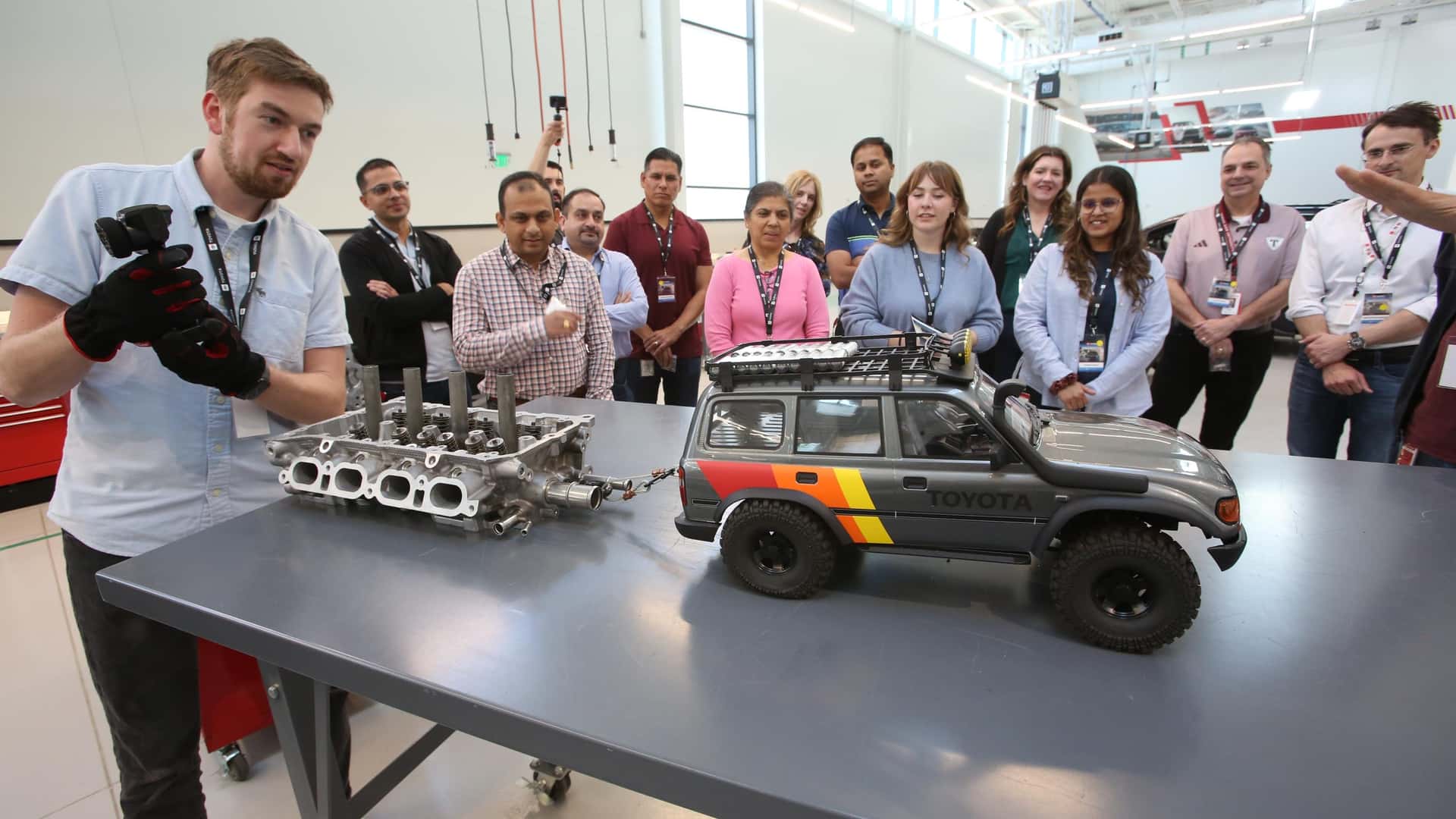
The highlight for many was a demonstration of the instant torque characteristic of an electric motor, where a small remote-controlled Land Cruiser effortlessly pulled a cylinder head weighing over 30 pounds. These practical exercises served to demystify complex engineering principles and create a tangible, memorable learning experience.
The Intrinsic Advantages of Electric Propulsion
A key lesson reinforced throughout the training was the inherent elegance and efficiency of electric motor technology. Presenters showcased a stripped-down Toyota V-6 engine, highlighting its intricate array of accessories and numerous moving parts. This complex assembly was then contrasted with an equivalent electric motor, which demonstrated superior power output within a significantly smaller footprint and a much simpler design. The program effectively illustrated that even when integrated into a gasoline powertrain, as seen in Toyota’s hybrid systems, electric motors enhance efficiency and reduce mechanical complexity by often eliminating the need for a traditional, finicky transmission.
The underlying message was clear: incorporating electric propulsion, in any form, can lead to more efficient vehicles with fewer compromises. The further one progresses along the path to full electrification, the simpler the system becomes. A pure battery electric vehicle, by design, features fewer moving parts, inherently reducing the number of potential points of failure and simplifying overall vehicle architecture.
While Toyota representatives acknowledged that significant improvements are still desired in battery chemistry and charging infrastructure before electric vehicles become a universally adopted solution, the training clearly aimed to cultivate enthusiasm among employees for an electrified future. This internal advocacy is crucial for driving innovation and strategic direction within the company.
Cultivating Internal Advocacy for Toyota’s Electrification Strategy
The strategic importance of educating and engaging employees in Toyota’s electrification strategy cannot be overstated. When corporate decision-makers and procurement teams fully grasp the long-term benefits of electrification, they are better equipped to look beyond the immediate costs of new component designs or the challenges of integrating new suppliers. Without this understanding, there’s a natural inclination to resist change, favoring existing, familiar processes.
However, by generating excitement and understanding, employees become willing to navigate short-term complexities in pursuit of long-term goals. They transform into internal champions, advocating for electrification across various departments. Brigette Armato, a Toyota employee who participated in the ‘Electrification 101’ class, exemplifies this transformation.
Initially, Armato admitted she knew “nothing” about electric vehicles and hybrids. Post-training, her perspective profoundly shifted. She stated, “I work with our lease experience team, so I’m actually working with the customers and the vehicles. This was extremely helpful because now I can have an educated conversation with them and maybe convince them to go for an electric vehicle, whereas before I don’t think I had that skill.”
Her newfound knowledge has not only empowered her in her professional role but has also influenced her personal vehicle considerations. Despite her strong attachment to her current Toyota 4Runner, she is now seriously contemplating an electric vehicle for herself. Armato voiced a sentiment shared by many consumers and enthusiasts, expressing, “I wish we would gravitate more towards electric vehicles across the lineup.”
With hundreds of employees having already attended these foundational classes and a substantial waitlist for upcoming sessions, Toyota is actively cultivating a growing cohort of electric vehicle advocates within its North American headquarters. This internal movement suggests a powerful shift in corporate culture. It’s not necessarily active resistance that was previously prevalent, but rather a common lack of detailed knowledge, mirroring the wider public’s understanding of this rapidly evolving automotive landscape.
The success of the ‘Electrification 101’ program highlights Toyota’s proactive stance in preparing its workforce for the future. By investing in comprehensive internal education, the company is not only enhancing its employees’ expertise but also laying the groundwork for more informed decisions and accelerated progress in its long-term electrification strategy.
FAQ Section
What is the primary goal of Toyota’s ‘Electrification 101’ program?
The program aims to educate Toyota employees, from various departments, about the fundamentals of electrified vehicle technologies, including hybrids, PHEVs, EVs, and FCEVs, fostering a deeper understanding of the company’s electrification strategy and its benefits.
What is Toyota’s ‘multi-pathway’ electrification strategy?
Toyota’s ‘multi-pathway’ approach focuses on offering a diverse range of electrified vehicles, prioritizing hybrids in the present while simultaneously developing battery electric vehicles and hydrogen fuel cell vehicles to achieve sustainable mobility.
Did the training program exclusively focus on Battery Electric Vehicles (BEVs)?
No, the ‘Electrification 101’ program covered all forms of electrified powertrains, including hybrids, plug-in hybrids, and hydrogen fuel cell vehicles, reflecting Toyota’s broader multi-pathway strategy, though a significant portion addressed BEV myths.
What kind of hands-on activities were included in the training?
Interactive sessions allowed employees to build a basic electric motor from simple components, construct a rudimentary potato-based battery, and witness a demonstration of the instant torque capabilities of an EV motor.
How has the program impacted Toyota employees?
Employees, like Brigette Armato, reported a significant increase in their knowledge and confidence regarding electrified vehicles. This enables them to have more informed conversations with customers and become internal advocates for Toyota’s electrification strategy, even considering an EV for personal use.
Why does Toyota prioritize internal education on electrification?
Educating employees is crucial for fostering an internal understanding and advocacy for long-term strategic decisions. It helps overcome resistance to change, ensures informed choices in product development and procurement, and ultimately supports the company’s transition to sustainable transportation.