
Key Takeaways
- Toyota’s “Electrification 101” program addresses a significant knowledge gap among its diverse employee base regarding electric and hybrid vehicle technologies.
- The training covers fundamental concepts of various electrified powertrains, including hybrids, plug-in hybrids, battery electric vehicles, and fuel cell electric vehicles.
- A core aspect of the program is to educate employees on Toyota’s “multi-pathway” strategy, advocating for a diverse portfolio of electrified solutions.
- Interactive sessions demonstrate the simplicity and efficiency of electric motors, aiming to build enthusiasm for electrification among staff.
- The initiative is designed to foster internal advocacy for electrified vehicles, influencing both product development decisions and customer interactions.
In the rapidly evolving landscape of automotive technology, industry observers and critics often assume a universal understanding of electrification among those working for major car manufacturers. However, a recent visit to Toyota Motor North America’s “Electrification 101” program revealed a surprising reality: a significant portion of employees, even within a leading automaker, possess limited knowledge about electric vehicle (EV) technology and its inherent advantages. This discovery, while initially unexpected, underscores the strategic importance of comprehensive internal education.
Toyota’s proactive approach to bridging this knowledge gap is a critical step in its journey towards sustainable mobility. By equipping its workforce with a foundational understanding of electrified powertrains, the company aims to foster a more informed and enthusiastic internal culture, which is essential for driving long-term strategic decisions and innovation. This internal educational initiative is more than just training; it’s an investment in the future of the automotive giant’s workforce and its product direction.

Addressing the Internal Knowledge Gap
It is a common misconception that all employees at an automotive company are deeply immersed in every technical aspect of car manufacturing. While many join for a passion for vehicles, a large number are drawn by other factors such as robust benefits, career stability, a respectful corporate culture, or the prestige associated with working for the world’s largest automaker. Roles like corporate accounting or app development, for instance, do not inherently require an encyclopedic knowledge of automotive engineering.
Even among car enthusiasts within the company, specialized knowledge of emerging powertrain technologies like electric vehicles or hybrids is not a given. Discussions around complex topics such as the differences between Nickel Cobalt Manganese (NCM) and Lithium Iron Phosphate (LFP) battery chemistries can easily draw a blank stare from someone accustomed to traditional internal combustion engines, such as a V8 muscle car aficionado. This technical depth represents a new frontier for many.
Recognizing this diverse knowledge base, Toyota developed its “Electrification 101” program to bring curious staff members up to speed. This is not the first such initiative; earlier in the year, Toyota offered an introductory course on general automotive topics, further illustrating that a broad understanding of the product’s minutiae isn’t universal across its campus in Plano, Texas.
The “Electrification 101” Curriculum
The program’s title, “Electrification 101,” is intentionally broad, reflecting Toyota’s commitment to a “multi-pathway” strategy. This approach emphasizes a clear focus on hybrids in the immediate term, with ongoing development in battery electric vehicles (BEVs) and, notably, hydrogen fuel cell electric vehicles (FCEVs) for the future. The company’s sales data from the last quarter highlights this strategy, with 56.8% of its sales categorized as electrified, encompassing hybrids, EVs, plug-in hybrid vehicles (PHEVs), and FCEVs. However, pure EVs constituted only 1.7% of these sales.
A significant portion of the four-hour course was conducted in a classroom setting, covering the foundational aspects of these diverse powertrain types. The curriculum meticulously explained the distinctions between conventional hybrids and plug-in hybrids, ensuring a clear understanding of each technology’s operational principles. While Toyota’s current market focus heavily leans on hybrids, a substantial segment of the program was dedicated to dispelling common misconceptions surrounding battery electric vehicles.
The historical context of the automotive industry was presented, drawing parallels to the early 20th century when gasoline cars faced challenges like undeveloped infrastructure, limited public education, and unclear regulations, making horse ownership seem simpler. The narrative illustrated how cars ultimately prevailed, suggesting a similar trajectory for electrified vehicles.
The program then delved into the myriad advantages of electrification, particularly emphasizing efficiency and environmental cleanliness. It championed the multi-pathway approach not merely as a means of offering customer choice, but as the most effective method for utilizing finite battery resources. This particular point is a subject of ongoing debate within the industry, as most lifecycle analyses tend to indicate that pure EVs generally represent the cleanest option from an environmental perspective. Readers interested in this topic can explore further through resources such as EV Myth Busted: No, They’re Not ‘Dirtier’ Than Gas Cars, Even If You Use Fossil Fuel Power and Yes, EVs Really Are Cleaner Than Gas Cars. Here’s By How Much.
During the segment on the relative advantages of each powertrain, a critical observer might note a slight imbalance. The presentation, perhaps understandably given the company’s current portfolio, focused more on the limitations of BEVs without equally highlighting the additional maintenance demands or the noise, vibration, and harshness (NVH) characteristics inherent in gasoline-powered vehicles. Furthermore, the program adopted a characteristically bullish stance on hydrogen technology.
A slide in the presentation asserted that hydrogen “can reduce ‘range anxiety’ as number of stations grow,” citing the Toyota Mirai’s impressive range of up to 402 miles per tank. While such figures were indeed noteworthy during the nascent stages of EV development, the current market features at least eight BEVs in the U.S. offering comparable or superior driving ranges, with many more advanced models on the horizon. The limited availability of hydrogen fueling stations, primarily concentrated in specific areas of California within the U.S., and the cost of hydrogen — which currently doubles that of gasoline — remain significant practical hurdles for FCEVs like the Mirai.
Beyond these specific points, the rest of the classroom content proved to be informative and well-structured. It included thorough explanations of fundamental battery chemistries, various charging standards, and essential electrical concepts such as kilowatts (kW) and kilowatt-hours (kWh). The program also provided an overview of ongoing battery recycling efforts, underscoring the sustainability aspect of electrified mobility.
Engaging with Electrified Technology: The Interactive Experience
The most compelling and memorable segment of the “Electrification 101” program was its interactive component, designed to provide employees with a hands-on understanding of electric propulsion. Toyota orchestrated a series of engaging activities that stripped away the complexity, revealing the underlying principles of electrification.
Participants were tasked with constructing a rudimentary electric motor using only a screw, a magnet, a AA battery, and a piece of wire. This simple yet effective exercise vividly demonstrated the core concept of electromagnetism at play in an electric motor. Further reinforcing practical understanding, employees also assembled a basic potato-based battery, showcasing how different materials can generate electrical current, and observed the varying outputs of different charging methods.
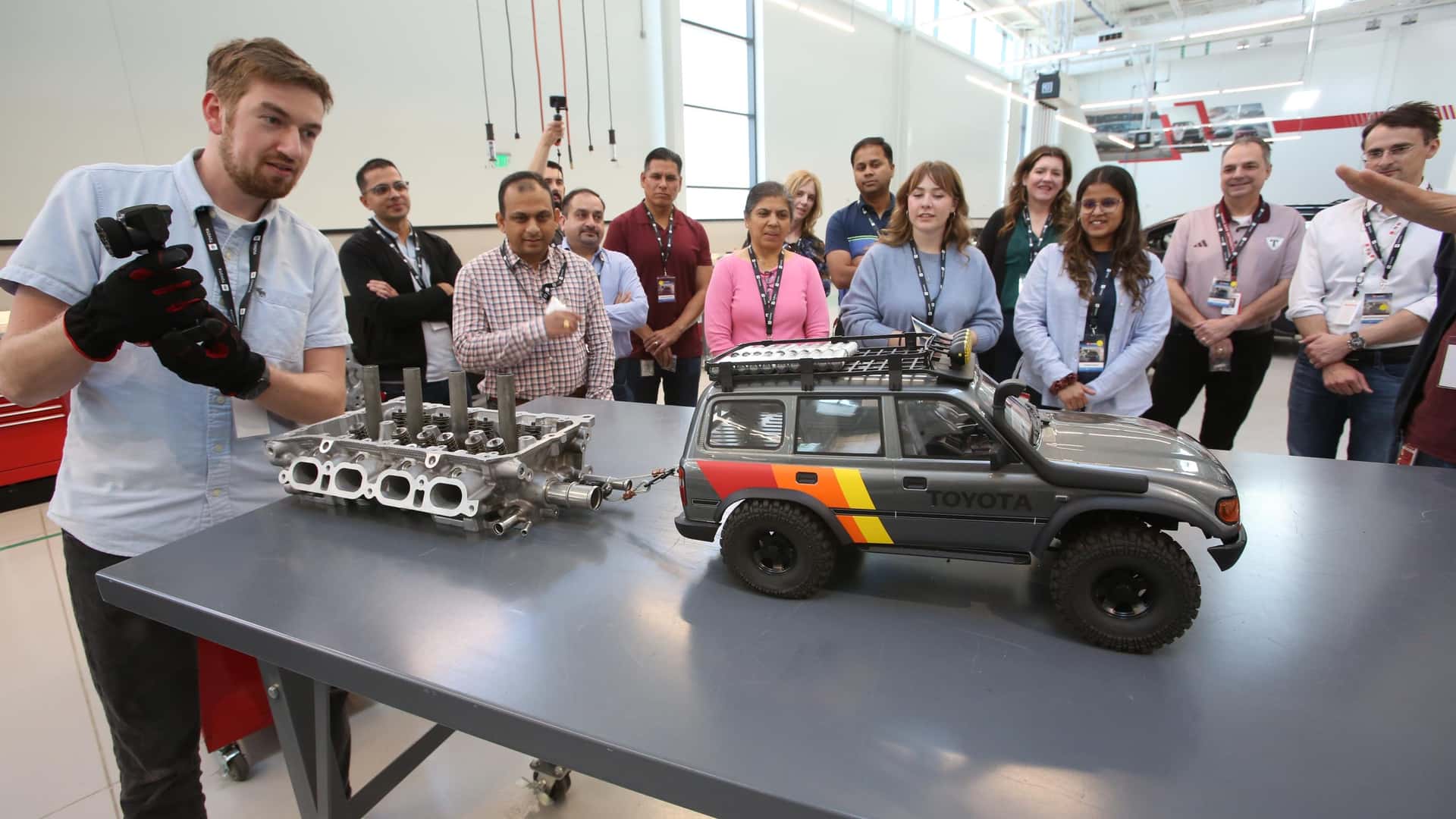
Perhaps the most impactful demonstration involved a tiny remote-controlled Land Cruiser. This miniature EV was used to effortlessly tow a cylinder head weighing over 30 pounds, dramatically illustrating the instant torque capabilities inherent in electric motors. This stark visual contrast highlighted a key performance advantage of EVs over traditional gasoline engines, making a strong impression on attendees.
The overarching lesson from these interactive sessions was undeniably clear: electric motors represent an incredible technological advancement. Presenters effectively showcased a stripped-down Toyota V-6 engine, revealing its intricate accessories and numerous complex components. This was juxtaposed with an equivalent electric motor, which demonstrated superior power output within a significantly smaller footprint and a much simpler design. Even when integrated into a gasoline powertrain, as seen in Toyota’s hybrid systems, electric propulsion simplifies the overall architecture by potentially eliminating the need for a complex and often finicky transmission.
The fundamental message was that integrating electric propulsion, in any form, can enhance efficiency with minimal trade-offs. As the degree of electrification increases, the system progressively simplifies. Ultimately, in a pure battery electric vehicle, there are significantly fewer moving parts, which translates to fewer potential points of failure and reduced maintenance complexity.
Fostering a Forward-Thinking Culture
Despite the evident benefits, Toyota representatives maintained a pragmatic stance, acknowledging that the company seeks further advancements in battery chemistry and charging infrastructure before embracing BEVs as a universal, one-size-fits-all solution. Nevertheless, the underlying intent of the program was unambiguous: to cultivate excitement and understanding for an all-electric future among its employees.
This internal enthusiasm is crucial for influencing long-horizon strategic decisions. Without a clear appreciation for the long-term benefits of electrification, individuals in roles such as corporate procurement might solely perceive the immediate challenges: the increased costs associated with new component designs or the complexities of onboarding new suppliers. Such a narrow view could naturally lead to resistance against change, a common human tendency.
However, by inspiring and educating its workforce, Toyota aims to empower employees to embrace short-term complexities for the sake of long-term objectives, and to actively advocate for these goals. Brigette Armato, a Toyota employee who attended the training, exemplifies this transformation. Admitting she knew “nothing” about EVs and hybrids beforehand, she emerged from the program as a fervent advocate.
“I work with our lease experience team, so I’m actually working with the customers and the vehicles. This was extremely helpful because now I can have an educated conversation with them and maybe convince them to go for an electric vehicle, whereas before I don’t think I had that skill,” Armato stated as the session concluded. Her newly acquired knowledge not only empowers her customer interactions but also influences her personal choices.
Armato is now actively considering an EV for herself, despite her strong attachment to her current Toyota 4Runner. She expressed a desire for more electric alternatives across Toyota’s product lineup. Her sentiment resonates with a growing number of newly informed employees. With hundreds attending these “Electrification 101” classes and a substantial waitlist for future sessions, Toyota’s North American headquarters is cultivating a burgeoning community of EV advocates. This shift isn’t about overcoming active resistance, but rather about addressing a fundamental lack of awareness that, much like many car buyers, employees simply “didn’t know any better.”
Frequently Asked Questions (FAQ)
What is Toyota’s “Electrification 101” program?
Toyota’s “Electrification 101” is an internal training program designed to educate its diverse workforce, including non-automotive specialists, about the fundamentals of electrified vehicle technologies. It aims to bridge knowledge gaps regarding hybrids, plug-in hybrids, battery electric vehicles, and fuel cell electric vehicles.
Why did Toyota create this employee electrification training?
Toyota recognized that many employees, regardless of their role, lacked a deep understanding of emerging electrification technologies. The program was created to inform staff, foster excitement for sustainable mobility, and ensure that internal decisions align with the company’s long-term strategic goals for an electrified future.
What topics are covered in the Electrification 101 curriculum?
The program covers basic concepts of various powertrain types, the distinctions between hybrids and PHEVs, battery chemistries, different charging types, and core electrical concepts like kilowatts and kilowatt-hours. It also includes interactive demonstrations of electric motors and discusses Toyota’s multi-pathway strategy.
Does Toyota’s electrification training promote only battery electric vehicles?
No, the program emphasizes Toyota’s “multi-pathway” approach, focusing on a diverse portfolio of electrified solutions including hybrids, plug-in hybrids, battery electric vehicles, and hydrogen fuel cell electric vehicles. While it dispels myths about BEVs, it presents all technologies as part of a broader strategy.
How does employee education impact Toyota’s overall electrification strategy?
By educating its workforce, Toyota aims to create internal advocates for electrification. This informed perspective encourages employees in various departments to make decisions that support long-term electrification goals, fostering innovation and reducing resistance to adopting new technologies and supply chains. It promotes a unified vision for a sustainable future.