
KEY TAKEAWAYS (TL;DR)
- The all-electric Jeep Recon Moab’s 222-mile range, coupled with its $66,995 starting price, has drawn criticism from consumers and journalists alike.
- This seemingly low Jeep Recon range is, however, a direct consequence of engineering compromises necessary to achieve its robust off-road capabilities.
- Features like high ground clearance, heavy skid plates, 33-inch all-terrain tires, and aggressive 15:1 rear motor gearing prioritize off-road prowess over maximum highway efficiency.
- Comparing the Recon to the road-focused Wagoneer S (294-mile range with the same battery) or other high-end electric off-roaders like the Rivian R1S and Mercedes G580 reveals a consistent trade-off: enhanced off-road capability often means reduced range and a higher price point in the current EV landscape.
- The electrification of inherently inefficient vehicle segments, such as heavy-duty off-roaders, presents unique challenges that necessitate a recalibration of consumer expectations regarding range and cost.
The announcement of the all-electric Jeep Recon Moab, specifically its estimated 222-mile range and a starting price of $66,995, has sparked considerable debate within the automotive community. Critics and journalists at events like the L.A. Auto Show have voiced concerns, arguing that the vehicle should offer greater range at a more accessible price point.
However, this perspective, while understandable from a mass-market standpoint, may overlook the fundamental principles of vehicle engineering and the inherent trade-offs involved in creating a truly capable off-road machine. The Jeep Recon range is not an arbitrary figure, but rather a calculated outcome of design decisions prioritizing extreme capability.
In the complex world of automotive manufacturing, particularly for specialized segments like off-roading, achieving optimal performance often necessitates a delicate balance between conflicting goals. Building a vehicle that excels in challenging terrains, delivers significant electric range, and maintains an affordable price is a trifecta that the current technology and physics make incredibly difficult to simultaneously achieve.
Understanding the Compromise in Automotive Engineering
The automotive industry operates on a bedrock of engineering compromises. Every design choice, from engine type to tire size, influences a vehicle’s overall performance, efficiency, and cost. This principle is particularly pronounced in the realm of off-road vehicles, where specific design elements, crucial for conquering rugged landscapes, inherently reduce on-road efficiency.
The Efficiency Challenge for Traditional Off-Roaders
Consider a traditional gasoline-powered, body-on-frame, 4×4 truck equipped with lifted suspension and aggressive gearing. These vehicles typically achieve less than 20 miles per gallon, often closer to 10 or 15 mpg. This reduced efficiency is not a flaw but a direct consequence of their off-road optimization.
Tall suspension, while providing vital ground clearance for navigating obstacles, significantly increases aerodynamic drag. Knobby, large all-terrain (AT) tires, essential for grip in mud, sand, or rocks, are inherently inefficient and noisy on paved roads compared to street-oriented tires. A robust 4×4 system, invaluable in slippery conditions, consumes more fuel when engaged.
Furthermore, aggressive gearing, which amplifies torque at the wheels for superior climbing and low-speed control, often results in the engine spinning at higher RPMs during highway cruising, leading to increased fuel consumption. The vehicle design that makes a Toyota Prius efficient is antithetical to the design required for a Jeep Wrangler’s off-road prowess. Modifying a Prius for off-road use, by lifting it and adding larger tires, would inevitably diminish its remarkable 50 mpg fuel economy.
Electric Off-Roaders: Facing Similar Constraints
These fundamental truths about design trade-offs are not exclusive to internal combustion engine (ICE) vehicles; they apply equally to battery electric vehicles (BEVs). Electric off-roaders, like their gasoline counterparts, must reconcile the demands of extreme capability with the desire for extended range.
High ground clearance, dual-motor all-wheel-drive designs, large and heavy all-terrain tires, and a boxy, upright body shape – all critical for off-road performance – directly impact an EV’s energy consumption. Each of these features increases aerodynamic resistance, rolling resistance, and overall vehicle weight, thereby reducing the achievable Jeep Recon range.
How Jeep Recon’s Design Prioritizes Capability
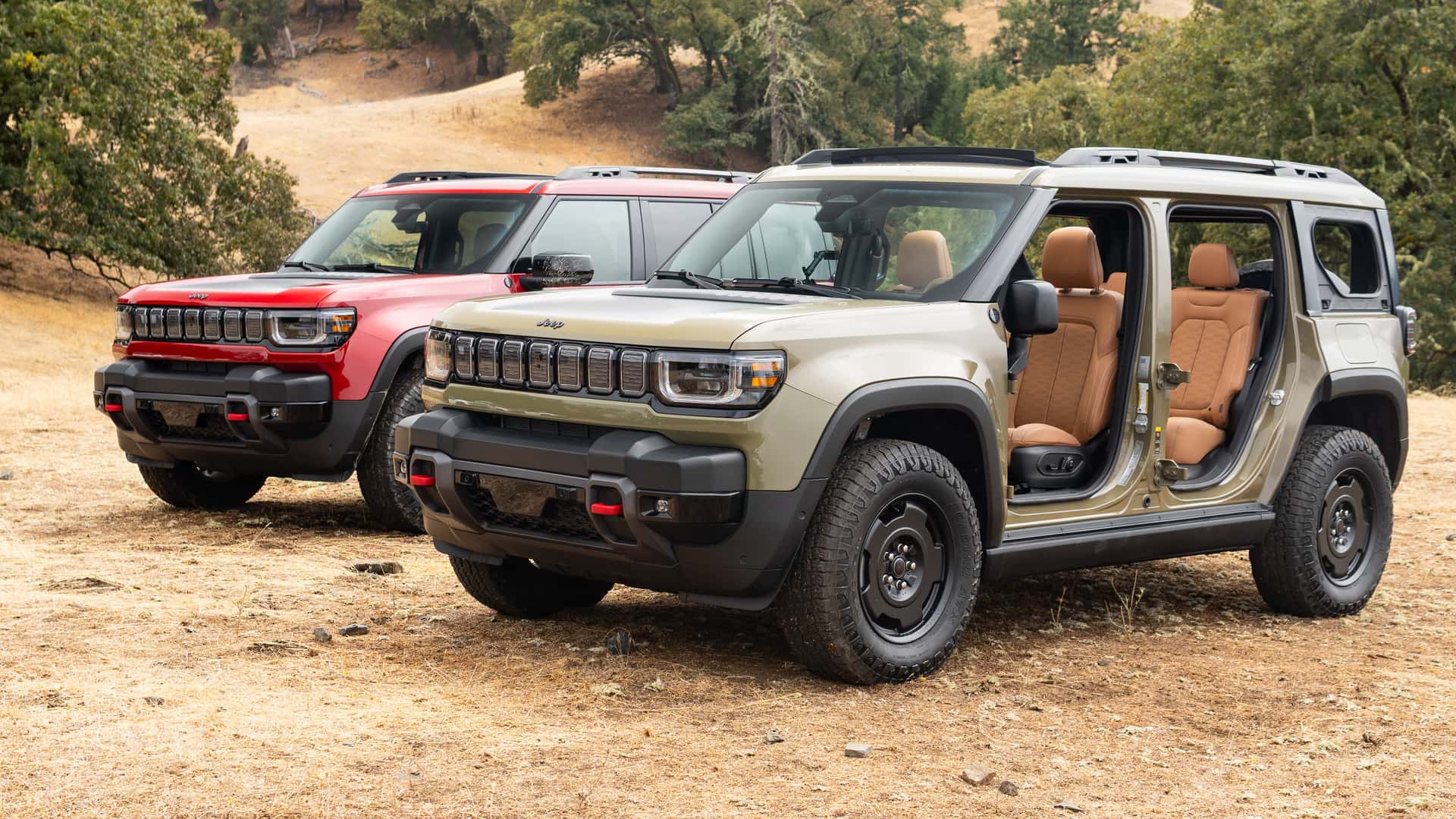
The Jeep Recon is engineered from the ground up to deliver authentic off-road capability. This commitment to performance is evident in several key design specifications. It boasts 9.1 inches of ground clearance, enabling it to clear significant obstacles. The inclusion of heavy skid plates provides crucial underbody protection during challenging terrain traversal.
Furthermore, its robust 33-inch all-terrain tires offer superior grip and durability in various off-road environments. The vehicle’s upright design is not merely aesthetic; it is meticulously crafted to optimize approach and departure angles, which are vital for ascending and descending steep inclines without scraping the vehicle’s extremities. These attributes, while indispensable for off-roading, inevitably consume more energy, directly impacting the Jeep Recon range.
The Role of Gearing in EV Performance
A crucial, often overlooked, aspect of EV design that profoundly affects both performance and range is gearing. While electric vehicles do not have multi-speed transmissions in the conventional sense, they still incorporate gear ratios that dictate how motor torque is delivered to the wheels. Taller gear ratios (a lower numerical value, e.g., 9:1 for an EV) are generally optimized for highway cruising and efficiency, allowing the motor to operate at lower RPMs.
Conversely, shorter gearing (a higher numerical value, e.g., 15:1) significantly increases torque at the wheels, providing explosive low-end power crucial for rock crawling, navigating steep ascents, and powering through difficult terrain. This choice undeniably makes the vehicle less efficient at higher speeds. The Recon, prioritizing off-road dominance, features a 15:1 gearing on its rear motor, a decision that enhances its climbing ability and quick acceleration (0-60 mph in 3.6 seconds) but contributes to its reported efficiency of just 2.5 miles per kWh.
Comparative Analysis: Jeep Recon vs. Competitors
Understanding the Jeep Recon range and its associated cost becomes clearer when compared to other electric vehicles, both within Jeep’s lineup and across the broader EV off-roading segment.
The Road-Focused Sibling: Jeep Wagoneer S
Jeep itself offers a compelling internal comparison with the Wagoneer S. This electric SUV, while sharing the same 100.5 kWh battery as the Recon, is designed with a focus on on-road comfort and efficiency rather than extreme off-road capability. Consequently, the Wagoneer S achieves a significantly higher range of up to 294 miles. The primary difference lies in its design: it has a lower 6 inches of ground clearance and utilizes street-oriented tires, illustrating the direct impact of off-road features on electric range.
High-End Electric Off-Roaders: Rivian R1S and Mercedes G580
Looking at the premium electric off-roader market further solidifies the trade-off narrative. The Rivian R1S, a highly regarded electric SUV, tends to be more efficient than the Recon, even when equipped with all-terrain tires. However, Rivian’s strategy highlights the same compromises.
All-terrain tires are not even offered on R1S models with the base 108 kWh battery pack. To get ATs, customers must upgrade to the larger 140 kWh version, which comes at a higher price point (around $96,000) and still sees its range drop from 410 miles to 370 miles. Furthermore, the Rivian R1S, with its taller gearing and absence of a locking rear differential, lacks some of the hardcore off-road advantages engineered into the Recon.
At the pinnacle of electric off-road capability is the Mercedes-Benz G580 w/EQ Technology. This formidable vehicle offers even greater off-road prowess than both the Recon and R1S, featuring separate low-range gears for each of its four motors. This advanced hardware allows it to excel in climbing while also providing more efficient on-road cruising by switching to higher gears. Despite its sophisticated engineering, a substantial 116 kWh usable battery capacity, and a hefty $163,000 price tag, the G580 achieves an EPA-estimated range of only 239 miles.
It is important to note that for all these vehicles, highway range is typically lower than combined range estimates due to the compounding effect of aerodynamic drag and other efficiency-reducing factors at higher speeds.
Shifting Expectations for the Electric Future
The experience with the Jeep Recon range, alongside other electric off-roaders, offers a crucial takeaway for the evolving electric vehicle industry: consumer expectations may need to be adjusted, especially for certain vehicle categories.
The Inherent Challenges of Electrifying Inefficient Segments
It is becoming increasingly clear that the electrification of inherently inefficient vehicles – those that are large, boxy, heavy, and designed for extreme performance like off-roaders – presents the most significant challenges. Achieving a substantial electric range in such vehicles requires an absurdly large battery, which translates directly into higher costs and increased weight. While battery packs of 91 kWh or 100 kWh are hardly small, the energy they store simply does not translate into long distances when the vehicle’s design actively works against efficiency. This challenge is compounded by the addition of off-road specific features like all-terrain tires, extra ground clearance, and aggressive gearing.
Future Outlook: Technology and Infrastructure Improvements
As battery technology continues to advance, offering greater energy density and faster charging capabilities, and as the global charging network expands, many of these current limitations will gradually diminish. However, for the foreseeable future, prospective buyers of electric off-road vehicles must be prepared for a reality where superior off-roading chops necessitate a compromise on both the total range and the overall purchase price.
The Jeep Recon Moab, therefore, stands as a testament to this current engineering reality, embodying a strategic compromise between formidable off-road capability and practical electric range within contemporary technological and economic constraints.
FAQ Section
Q1: Why is the Jeep Recon’s range considered low at 222 miles?
A1: The 222-mile Jeep Recon range is influenced by its design priorities. As an off-road vehicle, it features elements like high ground clearance, heavy skid plates, 33-inch all-terrain tires, and aggressive gearing (15:1 rear motor) that are crucial for capability but inherently reduce energy efficiency compared to road-focused EVs.
Q2: How do off-road features impact an EV’s range?
A2: Off-road features like lifted suspension increase aerodynamic drag, knobby tires create higher rolling resistance, and aggressive gearing optimizes torque for climbing over efficiency at higher speeds. These factors collectively increase energy consumption, leading to a shorter electric range for vehicles like the Jeep Recon.
Q3: Is the Jeep Recon’s price of $66,995 justified for its range?
A3: The price reflects the cost of integrating advanced off-road hardware with a substantial 100.5 kWh battery pack, along with the engineering required for rugged electric capability. The balance between extreme capability, battery size, and manufacturing costs contributes to its premium pricing despite the 222-mile Jeep Recon range.
Q4: How does the Jeep Recon compare to the Jeep Wagoneer S in terms of range?
A4: The Jeep Wagoneer S, utilizing the same 100.5 kWh battery, achieves up to 294 miles of range. This significant difference highlights the impact of design choices; the Wagoneer S is optimized for road efficiency with lower ground clearance and street tires, while the Recon prioritizes off-road prowess.
Q5: Do other electric off-roaders like Rivian and Mercedes G-Class face similar range challenges?
A5: Yes, other high-end electric off-roaders also demonstrate similar trade-offs. The Rivian R1S, with larger battery options, sees range drops when equipped with all-terrain tires. The Mercedes G580 w/EQ Technology, despite its advanced hardware and massive 116 kWh battery, offers 239 miles of EPA range, underscoring the universal compromise.
Q6: What does this mean for the future of electric off-roading?
A6: It signifies that the electrification of heavy, boxy, and off-road-capable vehicles inherently leads to compromises in either range or price with current technology. As battery technology and charging infrastructure improve, these challenges are expected to lessen, but for now, buyers should anticipate these trade-offs.