
Key Takeaways:
- The all-electric Jeep Recon Moab has drawn criticism for its 222-mile range and $66,995 starting price.
- This range limitation is not a design flaw but a direct consequence of prioritizing extreme off-road capability.
- Key features like high ground clearance, aggressive gearing, and large all-terrain tires significantly impact an EV’s efficiency.
- Comparisons with the road-focused Wagoneer S and other electric off-roaders like the Rivian R1S and Mercedes G580 highlight the trade-offs in EV design.
- Consumers must adjust expectations: advanced off-road EVs currently demand compromises in both range and cost due to existing battery technology and vehicle physics.
The announcement of the all-electric Jeep Recon Moab’s under 230-mile range has ignited considerable debate within the automotive industry and among potential buyers. Journalists and critics, including those present at last year’s L.A. Auto Show, have expressed significant disappointment, arguing that Jeep should have delivered a longer range at a more accessible price point.

With a 222-mile range and a $66,995 starting price, the Jeep Recon Moab does not immediately present itself as a compelling mass-market vehicle. However, automotive experts contend that viewing these specifications as shortcomings overlooks the fundamental compromises inherent in engineering a high-capability electric off-roader.
The business of car manufacturing, particularly in specialized segments like off-roading, is a delicate balance of conflicting objectives. Achieving superior off-road capabilities, an attractive price, and extensive range simultaneously often proves to be an engineering paradox.
While the Recon Moab’s range and price have sparked discussion, these figures are rooted in specific design decisions aimed at maximizing its off-road prowess, rather than representing a failure to meet basic expectations.

The Inherent Trade-Offs in Off-Road Vehicle Design
The principle of compromise is not new to the world of off-road vehicles. Traditional gas-powered, body-on-frame 4×4 trucks equipped with lifted suspensions and aggressive gearing typically deliver less than 20 miles per gallon, often closer to 10 or 15 mpg.
This reality is intuitively understood by experienced off-road enthusiasts. Features essential for tackling rugged terrain inevitably reduce on-road efficiency.
For instance, tall suspension systems provide crucial ground clearance for rock crawling but significantly increase aerodynamic drag. Large, knobby all-terrain tires, while excellent for traction in mud and over obstacles, are inherently inefficient and noisy at highway speeds compared to conventional road tires.
Furthermore, a robust 4×4 system is indispensable in challenging conditions, but its engagement invariably reduces fuel efficiency. Aggressive gearing boosts low-end torque at the wheels, dramatically improving climbing ability, but results in higher engine RPMs and increased fuel consumption during highway cruising.
Even a less extreme vehicle like a Chevrolet Tahoe, when equipped with 33-inch all-terrain tires, a 4WD system with low range, and a powerful V-8 engine, could achieve only about 13 miles per gallon in city driving, illustrating this fundamental trade-off.
The design dichotomy between a fuel-efficient vehicle like a Toyota Prius and an off-road specialist like a Jeep Wrangler exemplifies these opposing priorities. One is meticulously engineered for optimal fuel economy, while the other is built for uncompromising off-road performance.
Any attempt to enhance a Prius’s off-road capability—such as lifting it, adding larger tires, and modifying its aerodynamic bumper—would inevitably sacrifice its characteristic 50 mpg efficiency. Enhancing off-road capability almost universally leads to a reduction in on-road efficiency, a principle that holds true for electric vehicles as well.
Understanding the Jeep Recon’s Engineering Choices
The physics of vehicle design and energy consumption apply equally to electric vehicles. High ground clearance, dual-motor configurations, large tires, boxy body shapes, and aggressive gearing all contribute to reduced efficiency in an EV. Crucially, many of these elements are not mere luxuries but fundamental requirements for a credible off-road vehicle.
A vehicle cannot credibly claim off-road capability with limited ground clearance and slender tires. Jeep itself demonstrates this contrast with its Wagoneer S, an EV designed for road use. Despite utilizing the same 100.5 kWh battery pack as the Recon, the Wagoneer S achieves a significantly higher range of up to 294 miles.
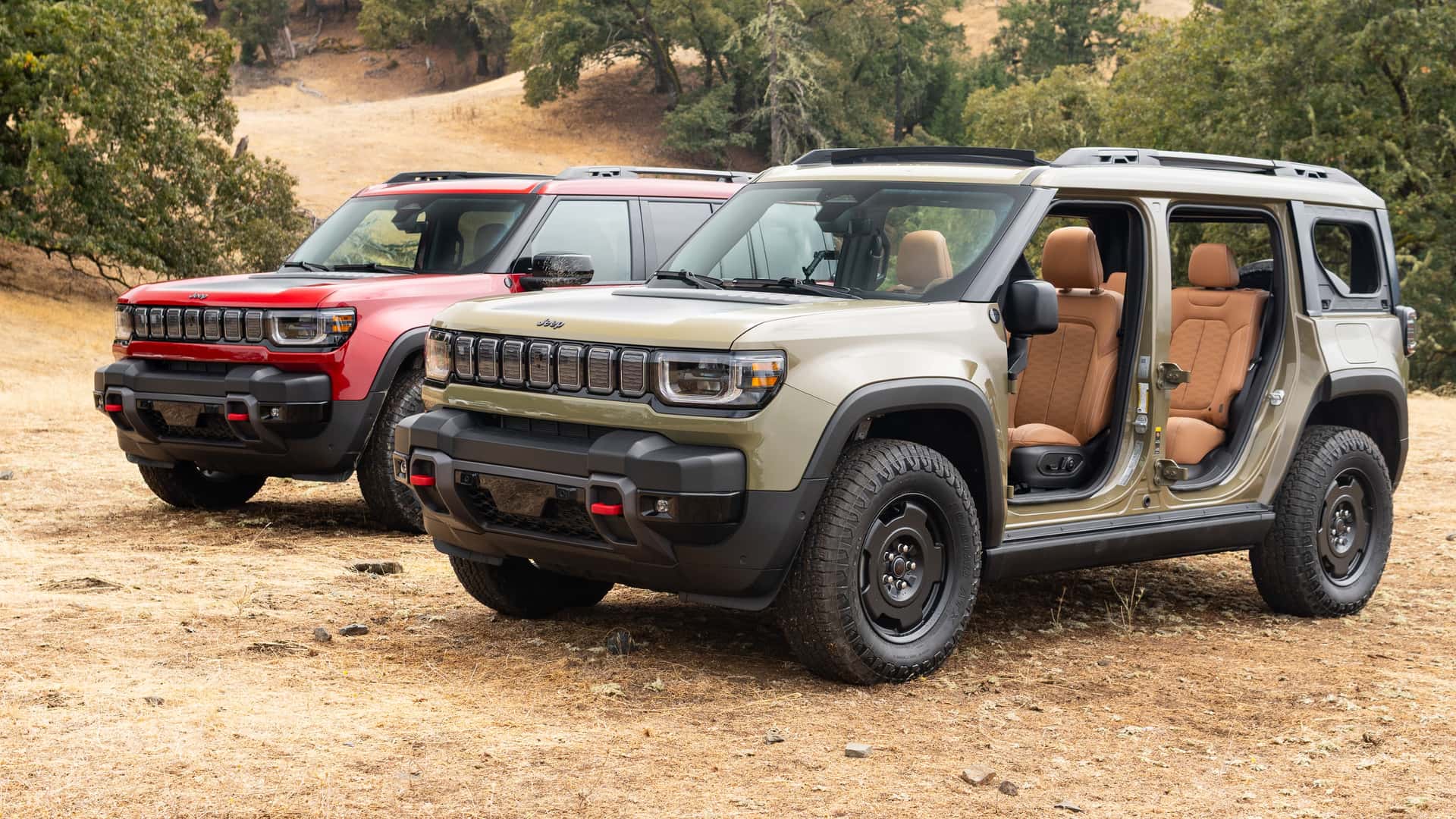
The key differentiator for the Recon is its purposeful design for genuine off-road capability. It boasts 9.1 inches of ground clearance, robust skid plates for underbody protection, 33-inch all-terrain tires, and an upright body design optimized for superior approach and departure angles. Each of these features, while critical for off-road performance, inherently diminishes its overall electric range.
Another often-overlooked factor is gearing. While EVs lack multi-speed transmissions in the traditional sense, they still incorporate gear ratios that dictate how motor torque is delivered to the wheels. Taller ratios, exemplified by a lower numerical value like 9:1 for an EV, are conducive to efficient cruising.
Conversely, shorter gearing amplifies torque at the wheels from a standstill, which is vital for off-roading, but at the cost of higher-speed efficiency. The importance of low-end torque in off-roading led the Jeep Recon to adopt 15:1 gearing on its rear motor.
This engineering choice, while enhancing the vehicle’s ability to climb and power through challenging obstacles, directly impacts its efficiency. This explains why the Recon exhibits an efficiency rating of approximately 2.5 miles per kWh during driving tests, contributing to its overall electric range.
Competitive Landscape and Industry Implications
When comparing the Jeep Recon to other electric off-roaders, similar trade-offs become apparent. The heavier Rivian R1S, for instance, generally offers better efficiency, even when fitted with all-terrain tires.
However, Rivian’s strategy involves bundling all-terrain tires only with its larger 140 kWh battery pack, as opposed to the base 108 kWh version. This upgrade sees its range drop from 410 miles to 370 miles, with the vehicle costing around $96,000. Despite its impressive range, the R1S features taller gearing and lacks the locking rear differential found in the Recon, pointing to different capability priorities.
The Mercedes-Benz G580 with EQ Technology exemplifies even more advanced off-road engineering. It provides greater capability than both the Recon and R1S, incorporating separate low-range gears for each of its four motors. This allows for superior climbing ability, with the flexibility to switch to higher gears for more efficient on-road travel.
Yet, even with this sophisticated hardware, a hefty $163,000 price tag, and 116 kWh of usable battery capacity, the G580 achieves an EPA-estimated range of just 239 miles. For all these vehicles, highway range is also expected to be notably lower than combined range estimates, as the factors impacting efficiency are compounded at higher speeds.
Adjusting Expectations for Electric Off-Roaders
The evolving landscape of electric vehicles, particularly in specialized segments like off-roading, necessitates a re-evaluation of consumer expectations. The electrification of inherently inefficient vehicle types presents significant engineering challenges.
It should come as no surprise when vehicles like the Volkswagen ID. Buzz or the Jeep Recon offer what might seem like modest ranges. Integrating a substantial battery pack, such as the 91- or 100-kWh units in these vehicles, incurs significant costs.
However, the energy stored within these large batteries does not translate into extensive range when the vehicle is large, aerodynamically challenging, and heavy. This effect is amplified by the inclusion of all-terrain tires, increased ground clearance, and aggressive gearing.
As battery technology continues to advance, charging times decrease, and charging infrastructure expands, many of these challenges are expected to mitigate. Nonetheless, for the foreseeable future, consumers seeking a capable electric off-road vehicle will likely need to accept a compromise between optimal range and a competitive price point.
FAQ Section
What is the estimated range of the Jeep Recon Moab?
The all-electric Jeep Recon Moab offers an estimated range of 222 miles on a single charge. This figure has been a point of contention for some, who expected a higher range for an electric vehicle in its segment.
Why is the Jeep Recon’s range considered low by some?
Critics argue the 222-mile range is insufficient, especially considering its $66,995 starting price. They often compare it to road-oriented EVs with longer ranges, overlooking the specific design compromises made for extreme off-road capability.
How does off-road capability impact the Jeep Recon’s range?
Features essential for off-roading, such as high ground clearance (9.1 inches), heavy skid plates, 33-inch all-terrain tires, a boxy design, and aggressive 15:1 gearing, all increase energy consumption and reduce the overall electric range compared to road-focused vehicles.
How does the Jeep Recon compare to other electric off-roaders like the Rivian R1S or Mercedes G580?
The Recon’s 222-mile range is in a similar ballpark to the Mercedes G580’s 239 miles (with a larger battery and higher price), but less than the Rivian R1S (which offers 370-410 miles depending on battery and tires, at a higher cost and with different gearing choices).
What is the starting price of the Jeep Recon Moab?
The all-electric Jeep Recon Moab has a starting price of $66,995. This pricing, combined with its range, has contributed to discussions regarding its value proposition in the burgeoning EV market.
Will EV off-roaders always have limited range?
Current electric off-roaders involve a trade-off between capability, range, and cost due to battery technology and vehicle physics. However, as battery technology advances, charging infrastructure improves, and manufacturing efficiencies increase, these limitations are expected to diminish over time.