
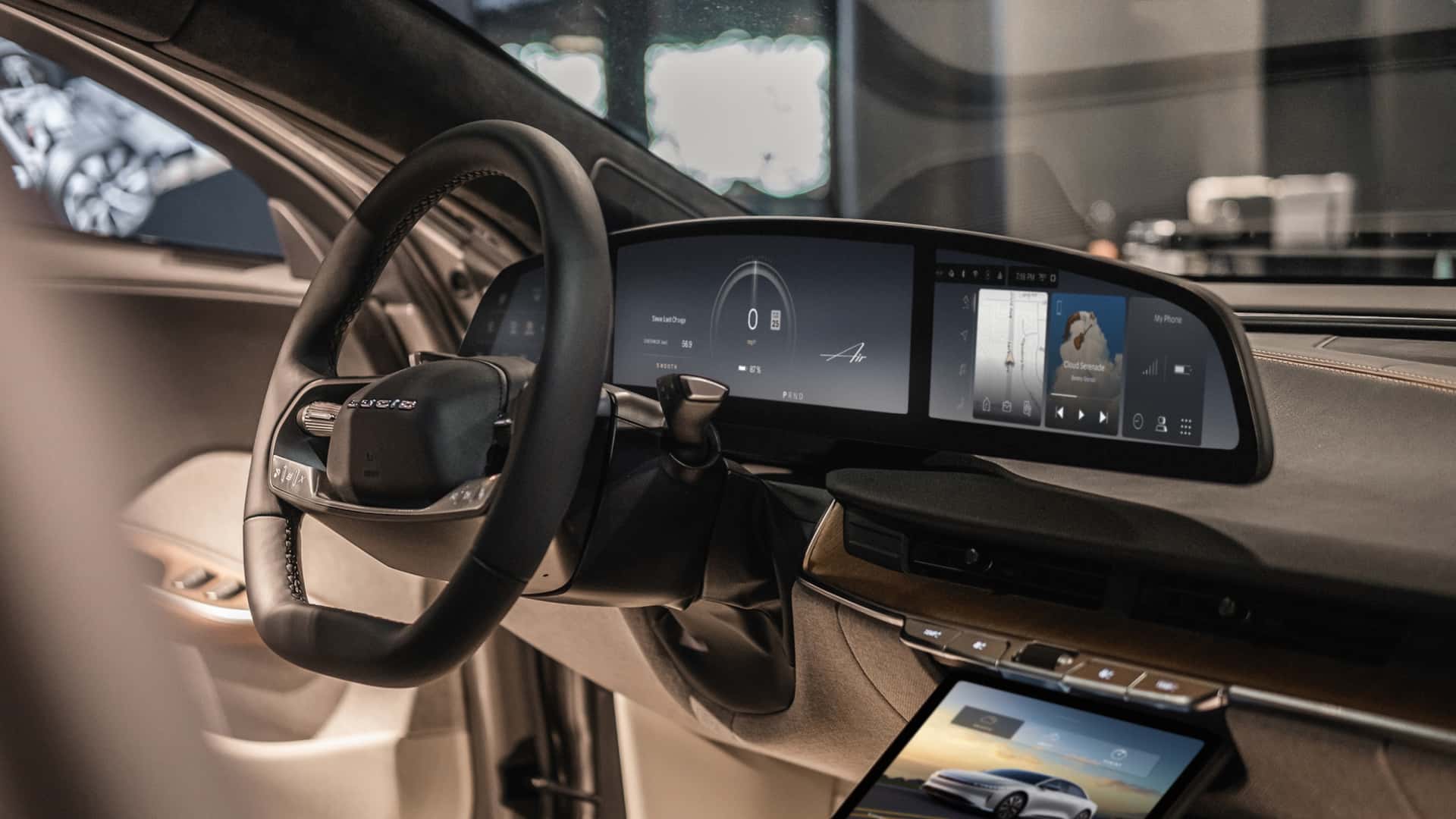
Lucid Motors has rolled out a significant overhaul to the infotainment system in its flagship Air sedan, introducing the advanced UX 3.0 user interface. This comprehensive update aims to deliver a faster, more intuitive, and highly integrated digital experience, aligning the Air with the cutting-edge system first seen in the Lucid Gravity SUV.
While the new UX 3.0 software promises enhanced features like improved route planning, refined Apple CarPlay and Android Auto integrations, and superior multitasking capabilities, its adoption will not be uniform across all Lucid Air models. Owners of pre-2025 Lucid Air vehicles will need to invest in a $950 processor upgrade to access the full benefits of this technological leap.

Key Takeaways:
- Lucid has introduced UX 3.0, a redesigned infotainment system for the Air sedan, promising a faster and more intuitive user experience.
- The update includes new route planning features, enhanced Apple CarPlay and Android Auto, and improved multitasking across displays.
- For 2025 and newer Lucid Air models, UX 3.0 will be delivered as a free over-the-air (OTA) software update (version 2.11.0).
- Owners of 2022, 2023, and certain 2024 Lucid Air models will require a hardware processor upgrade, priced at $950 (including installation in the U.S.), to implement UX 3.0.
- This hardware retrofit is necessary due to a mid-year switch to a second-generation infotainment processor during the 2024 model year production.
- The new digital experience unifies the interface across the Lucid Air and the forthcoming Gravity SUV, standardizing the brand’s in-car technology.
Introducing UX 3.0: A Seamless Digital Interface
The core of Lucid’s latest advancement lies in the UX 3.0 user interface, meticulously crafted to elevate the driver and passenger experience within the luxury electric sedan. This enhancement focuses on critical aspects such as response speed, ease of navigation, and overall system reliability, addressing key areas for modern automotive computing.
Central to the new design is a re-imagined home screen featuring dynamic, swipeable cards. These cards provide quick access to frequently used features, allowing drivers to intuitively manage various functions without delving into complex menus. Swiping these tiles seamlessly expands the full application onto the lower, vertically-oriented “Pilot Panel” display, optimizing screen real estate for an immersive user experience.
Furthermore, the UX 3.0 update introduces new quick controls, accessible by a simple downward swipe from the top of the Pilot Panel. This allows for immediate adjustments to popular settings, minimizing distractions and enhancing the driver’s ability to maintain focus on the road. The emphasis is on streamlining interactions, making every command more direct and responsive.

Enhanced Connectivity and Navigation Capabilities
A significant highlight of the new Lucid Air infotainment system is its improved integration with external smart devices and advanced navigation tools. Apple CarPlay and Android Auto, crucial for smartphone mirroring and access to popular apps, have been updated to be more reliable and now appear larger on the Air’s distinctive crescent-shaped screen. This ensures clearer visuals and better usability for smartphone-driven functions.
The route planning feature has also undergone a substantial upgrade, now offering a more sophisticated and customizable journey management system. Drivers can specify preferences for charging networks, desired arrival range, and even charging adapter capability directly within the navigation interface. This level of detail is particularly valuable for electric vehicle owners, enabling more confident and efficient long-distance travel planning.
One of the most anticipated improvements in the Lucid Air’s UX 3.0 is the newfound flexibility in screen management. Previously, the upper “Cockpit” display and the lower “Pilot Panel” were often linked in their functionality. With the new software, drivers can now more freely open different applications simultaneously across both screens. Lucid states that this allows drivers to “move more smoothly among navigation, media, vehicle controls, and apps across the Cockpit and Pilot Panel displays.”
This decoupling means, for instance, a driver can keep their navigation map prominently displayed on the upper screen while simultaneously adjusting music or vehicle settings on the lower panel. This enhancement in multitasking directly addresses a long-standing request from users, providing a more intuitive and personalized in-car technology experience, and setting a new benchmark for driver interface design in luxury EVs.
Hardware Implications for Existing Lucid Air Owners
While the UX 3.0 software update is a welcome development for Lucid Air owners, its implementation introduces a notable distinction based on the vehicle’s model year. For models designated 2025 and newer, the advanced Lucid Air infotainment system will be seamlessly delivered as an over-the-air (OTA) update through the company’s 2.11.0 software release, requiring no additional cost or intervention from the owner.
However, owners of earlier models, specifically 2022, 2023, and certain 2024 Lucid Air vehicles, will face a different path. To upgrade to UX 3.0, these vehicles necessitate a physical processor replacement. This hardware retrofit carries a cost of $950 in the U.S., which includes both the new processor and the installation service. Lucid Motors has indicated that details regarding pricing and availability for other international markets will be released in due course.
The reason for this hardware requirement stems from a production change during the 2024 model year. According to a Lucid spokesperson, the transition to a “second-generation infotainment processor” occurred midway through the 2024 production cycle. This means that some early 2024 models, alongside all 2022 and 2023 units, were manufactured with the original hardware architecture, which is not fully compatible with the enhanced demands of the UX 3.0 software without an upgrade.
This strategic decision highlights the rapid pace of innovation in automotive computing, where software advancements often outstrip the capabilities of older hardware. For affected Lucid Air owners, the $950 investment represents the cost of keeping their luxury electric sedan at the forefront of in-car technology, ensuring access to the latest digital interface and multimedia features offered by the brand.
Aligning with the Gravity’s Digital Experience
The introduction of UX 3.0 in the Lucid Air is not merely an isolated update; it represents a strategic move by Lucid Motors to create a cohesive and standardized digital ecosystem across its vehicle lineup. The new infotainment system essentially brings the Air’s user experience up to par with the highly anticipated Lucid Gravity SUV, which debuted with this advanced digital interface.
This commonality in the user experience across different models underscores Lucid’s commitment to delivering a consistent premium segment experience, irrespective of the vehicle type. It means that drivers transitioning between a Lucid Air sedan and a Gravity SUV will find a familiar and intuitive digital environment, reducing the learning curve and reinforcing brand loyalty. This unified approach to in-car technology is increasingly vital in the competitive luxury electric vehicle market, where software sophistication is as important as hardware performance.
The Evolution of In-Car Infotainment Systems
In the modern automotive landscape, the infotainment system has transcended its traditional role as a simple radio or navigation unit. It has evolved into the central nervous system of the vehicle, managing everything from climate control and vehicle settings to entertainment and connectivity. For luxury electric vehicles like the Lucid Air, a state-of-the-art infotainment system is a crucial differentiator, directly impacting customer satisfaction and perceived value.
Consumers expect a digital experience that mirrors the seamlessness and responsiveness of their personal smartphones and tablets. Automakers are therefore under constant pressure to develop user interfaces that are not only aesthetically pleasing but also highly functional, intuitive, and future-proof. Lucid’s UX 3.0 update, with its focus on speed, multitasking, and advanced connectivity, is a direct response to these evolving consumer expectations and industry trends.
The option of over-the-air updates for newer models signifies a commitment to continuous improvement, allowing vehicles to evolve digitally post-purchase. However, the necessity of a hardware upgrade for earlier models also highlights the challenges inherent in bridging the gap between rapidly advancing software and the fixed hardware architecture of older vehicles. It’s a testament to the dynamic nature of automotive innovation, where both software enhancement and underlying system architecture play critical roles.
Impact on Lucid Air Owners: A Choice for the Future
For current Lucid Air owners, the UX 3.0 update presents a clear path to an enhanced digital experience. While 2025 and newer models will benefit from a free, automatic upgrade, owners of 2022, 2023, and certain 2024 models must weigh the value of the $950 processor upgrade against the perceived improvements. The decision hinges on how much a smoother, more feature-rich Lucid Air infotainment system contributes to their daily driving pleasure and long-term satisfaction with their luxury electric vehicle.
This move by Lucid Motors reinforces the idea that an electric vehicle’s value is increasingly tied not just to its range and performance, but also to its digital capabilities and the ongoing software support provided by the manufacturer. As the automotive industry continues its rapid shift towards electric and digitally integrated platforms, such updates will become more commonplace, shaping the expectations of luxury EV buyers globally.
Frequently Asked Questions (FAQ)
What is the UX 3.0 update for the Lucid Air?
UX 3.0 is a significant software overhaul for the Lucid Air’s infotainment system, designed to make the in-car experience faster, more intuitive, and feature-rich. It introduces new capabilities for navigation, media management, and smartphone integration, enhancing the overall digital interface.
Which Lucid Air models will receive the UX 3.0 update?
All Lucid Air models will eventually be compatible with UX 3.0. However, 2025 and newer models will receive it as a free over-the-air software update. Older models (2022, 2023, and some 2024) will require a $950 hardware processor upgrade to implement the new system.
Why do some Lucid Air owners need a hardware upgrade for UX 3.0?
A hardware upgrade is necessary for older Lucid Air models because a switch to a second-generation infotainment processor occurred midway through the 2024 model year. Vehicles produced before this change do not have the required underlying system architecture to fully support the advanced UX 3.0 software without a physical processor replacement.
What are the key new features of the Lucid Air infotainment system with UX 3.0?
Key features include a redesigned home screen with swipeable cards for frequently used functions, new quick controls, enhanced route planning with charging preferences, and improved multitasking capabilities across the Cockpit and Pilot Panel displays. Apple CarPlay and Android Auto integration is also more reliable and visually prominent.
What is the cost of the UX 3.0 hardware upgrade for older Lucid Air models?
The hardware processor upgrade for 2022, 2023, and some 2024 Lucid Air models is priced at $950 in the U.S. This cost includes both the necessary processor component and its installation. Details for other international markets are expected to be announced by Lucid Motors.
How does UX 3.0 compare to the infotainment system in the Lucid Gravity SUV?
The UX 3.0 update brings the Lucid Air’s digital interface up to par with the system that debuted in the Lucid Gravity SUV. This ensures a consistent, advanced user experience across Lucid’s vehicle lineup, unifying the brand’s in-car technology and interaction design.