
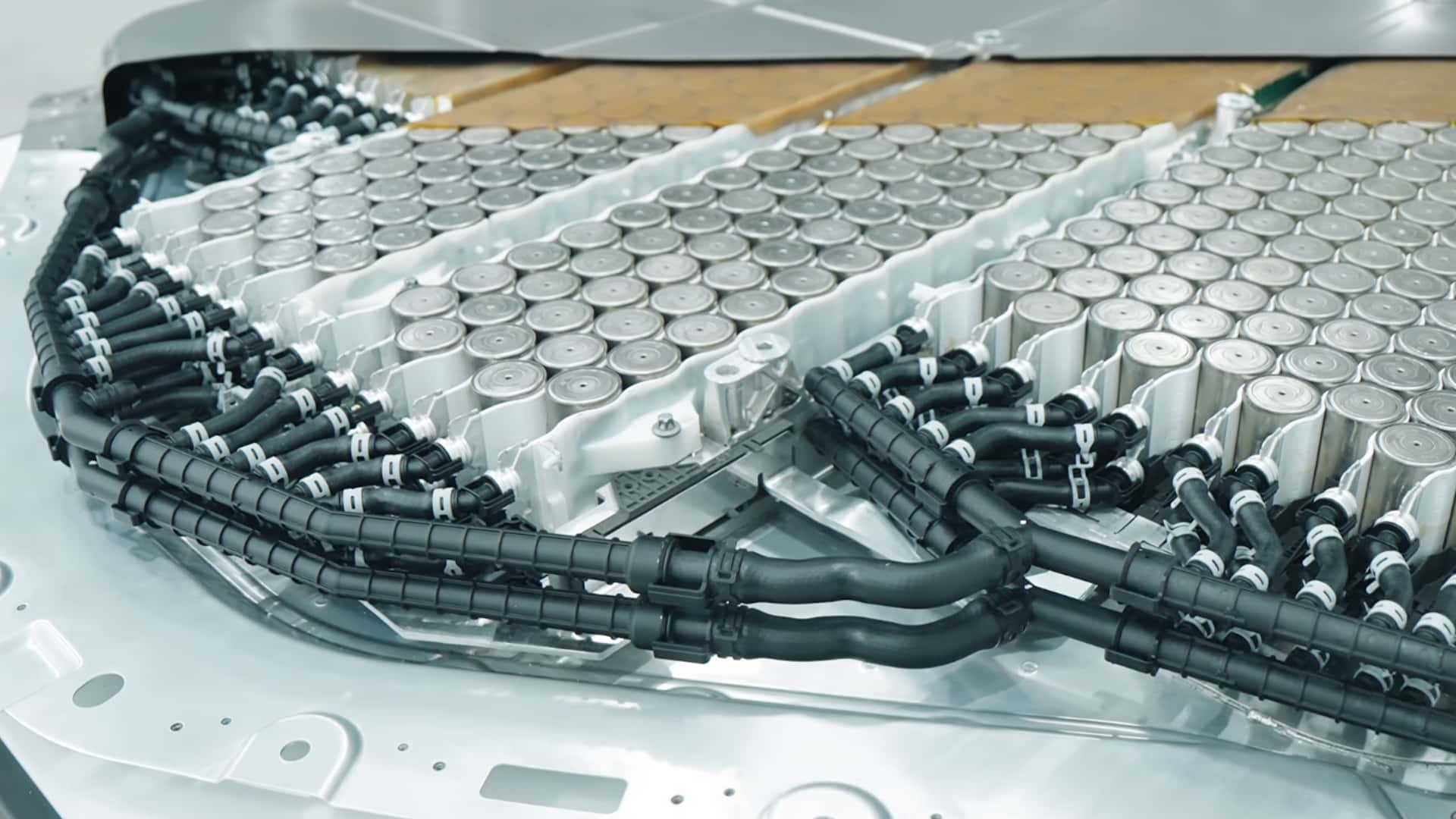
While much of the initial excitement surrounding the Tesla Roadster has focused on its ambitious features, such as SpaceX-developed cold gas thrusters and a powerful suction system, the electric supercar’s core performance hinges on groundbreaking electric vehicle (EV) fundamentals. At the heart of its capabilities lies Tesla’s most advanced high-voltage battery pack to date, positioning the Roadster as not only a performance marvel but also the fastest-charging Tesla ever produced.
This sophisticated battery system is meticulously engineered to support the Roadster’s extraordinary on-road performance, ensuring that its fundamental EV capabilities are as revolutionary as its more audacious features. The integration of cutting-edge Tesla Roadster battery technology is central to its promise of redefining the supercar segment.

Key Takeaways
- The new Tesla Roadster will feature the company’s most advanced high-voltage battery pack.
- It boasts rapid charging capabilities, achieving 15-85% charge in approximately 10 minutes.
- The battery design prioritizes power density and raw performance over longevity, aligning with supercar demands.
- Utilizing in-house developed 4680 cylindrical cells, the pack employs a bespoke, lithium-ion and nickel-based chemistry for high power throughput.
- An innovative thermal management system includes double-sided coolant tubes, lightweight aluminum cell cans, and a titanium upper plate for superior heat dissipation.
- The vehicle aims to deliver more than 300 miles of range, supporting its dual rear motors that generate 1,341 horsepower.
Engineering Excellence: A Culmination of Tesla’s EV Journey
Tesla’s Vice President of Engineering, Lars Moravy, underscored the significance of this new power unit, stating, “It’s everything we learned at Tesla for 20+ years making electric vehicles put into one,” when speaking to Hagerty’s Henry Catchpole. This statement highlights a two-decade evolution in EV battery design and manufacturing, culminating in the Roadster’s power source.
Unlike batteries in mass-market models such as the Model Y and Model 3, which are optimized for long-term durability and extended cycle life, the Roadster’s cells are specifically tuned to prioritize extreme power density and instantaneous performance. This focus is critical for a vehicle designed to deliver blistering acceleration and sustained high-speed capabilities.
The Heart of Performance: 4680 Cylindrical Cells
Central to the advanced Tesla Roadster battery technology are the automaker’s proprietary 4680 cylindrical cells. These larger-format cells, named for their dimensions (46mm diameter, 80mm length), represent a significant departure from previous cell designs and offer several advantages in high-performance applications.

Moravy confirmed in a Top Gear video that the Roadster’s battery utilizes a “bespoke chemistry for high power throughput.” While the exact composition remains under wraps, he noted that the materials are still lithium-ion and nickel-based. This specialized chemistry is crucial for handling the immense power demands of the Roadster, facilitating rapid energy discharge and recharge cycles without compromising integrity.
The 4680 cells are known for their potential to offer higher energy density, improved power output, and a more efficient thermal path compared to smaller, conventional cylindrical cells. Their larger size also simplifies the overall battery pack construction, potentially leading to a more robust and energy-dense package.
Revolutionary Thermal Management System
Managing heat generated by the battery cells is paramount in high-performance EVs, especially when dual rear motors collectively unleash 1,341 horsepower and 1,032 pound-feet of torque on the top trim. If not properly controlled, excessive heat can rapidly degrade battery performance and longevity.
Tesla has addressed this challenge with an innovative thermal management system. Moravy detailed the use of double-sided coolant tubes for each cell, a design that maximizes surface area contact with the cooling fluid. This approach significantly improves heat dissipation efficiency, allowing the cells to operate within optimal temperature ranges even under extreme loads.
Furthermore, the physical construction of the cells and battery pack has been optimized for thermal performance. The cells themselves feature aluminum cans, which are considerably lighter than traditional steel cans and possess superior thermal conductivity, aiding in more effective heat transfer away from the cell core. The pack’s upper plate is crafted from titanium, offering a lighter and thinner alternative to steel while also providing enhanced thermal insulation. For impact protection, the lower plate, situated at the vehicle’s underbody, remains aluminum, selected for its robust dent and impact resistance.
These combined innovations in thermal management ensure that the cells can not only discharge energy rapidly for peak performance but also recharge efficiently within minutes, a critical factor for a supercar destined for the track or demanding drives.
Setting New Benchmarks for Rapid Charging
The Tesla Roadster battery technology is set to redefine expectations for EV charging speeds. Tesla projects the Roadster will charge from 15% to 85% in approximately 10 minutes. This performance places it among the fastest-charging electric vehicles currently available from Western automakers.
For context, the new battery-powered Mercedes-AMG GT showcases an impressive charging time of 11-80% in just 11 minutes, leveraging a peak charging rate of 600 kilowatts. Most high-end EVs today typically require 16-20 minutes for a 10-80% charge. The Roadster’s projected charging speed therefore represents a significant leap forward in convenience and usability for high-performance electric vehicles.
Ambiguous, Yet Aspirational, Charging Specifications
While the 10-minute charge time is impressive, the Roadster’s exact peak charging speed and voltage architecture remain somewhat broad in their current disclosure. Moravy indicated that the vehicle would handle charging rates “somewhere between 500 kW and a megawatt,” a notably wide range that nonetheless signals an ambition for ultra-high-speed charging.
Similarly, the voltage architecture is stated to be “somewhere between 800 and 1,000 volts.” This high voltage platform is crucial for enabling such rapid charging rates and delivering immense power to the motors. High-voltage architectures reduce current flow for a given power output, leading to less heat generation in the charging cables and vehicle components, thereby improving efficiency and enabling faster charging.
Impact and Future Implications
The electric credentials of the Tesla Roadster appear exceptional, living up to its billing as a technological tour de force. While the vehicle will undoubtedly come with a premium price tag commensurate with its advanced capabilities and supercar status, the innovations within its Tesla Roadster battery technology hold broader implications for the automotive industry.
Industry observers and consumers alike eagerly anticipate whether some of these cutting-edge battery advancements, particularly in cell chemistry, thermal management, and rapid charging, will eventually trickle down to Tesla’s more affordable, mass-market models. Such a transfer of technology could significantly enhance the performance, range, and convenience of mainstream electric vehicles, furthering the global transition to sustainable transportation.
The Roadster serves as a high-profile testbed for Tesla’s most ambitious engineering. Its battery pack is not merely a power source; it is a statement of intent, showcasing the potential for electric vehicles to surpass traditional internal combustion engine performance benchmarks while simultaneously advancing critical areas like charging speed and thermal efficiency.
FAQ Section
What makes the Tesla Roadster’s battery pack so advanced?
The Roadster’s battery pack integrates two decades of Tesla’s EV learning. It uses specialized 4680 cylindrical cells with bespoke lithium-ion and nickel-based chemistry. Furthermore, it features an advanced thermal management system, including double-sided coolant tubes, aluminum cell cans, and a titanium upper plate, all designed for extreme power density and efficient heat dissipation.
How fast can the new Tesla Roadster charge?
The Tesla Roadster is designed to be the fastest-charging Tesla, capable of charging from 15% to 85% in approximately 10 minutes. This puts it among the quickest-charging EVs globally, comparable to or exceeding the performance of other high-end electric vehicles currently on the market.
What kind of battery cells does the Roadster use?
The Roadster utilizes Tesla’s in-house developed 4680 cylindrical cells. These larger-format cells offer advantages in energy density, power output, and thermal management, making them ideal for a high-performance application where both rapid discharge and fast charging are crucial for the vehicle’s dynamic capabilities.
Does the Roadster battery prioritize performance or longevity?
For the Roadster, the battery cells are specifically engineered to prioritize power density and raw performance. Unlike the batteries in Tesla’s mass-market vehicles, which are balanced for long-term longevity and efficiency, the Roadster’s battery is optimized to deliver peak power output for a supercar experience.
What is the estimated range of the Tesla Roadster?
While the exact battery pack size has not been disclosed, Tesla has indicated that the Roadster will deliver more than 300 miles of range. This substantial range, combined with its rapid charging capabilities, aims to alleviate range anxiety and enable extended high-performance driving sessions.
What is the voltage architecture of the Roadster’s battery?
The Tesla Roadster’s battery architecture operates at a high voltage, specified by Tesla to be “somewhere between 800 and 1,000 volts.” This high-voltage system is fundamental to achieving both the vehicle’s immense power output and its ultra-fast charging capabilities, enhancing overall efficiency and performance.